

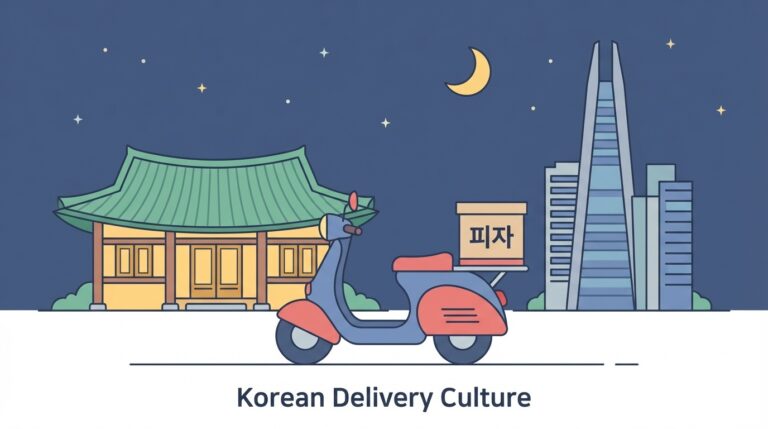
Phase 1: The “Ding-Dong” Panic Moment 🍕
Annyeonghaseyo! It’s your Daily Hangul editor here.
Imagine this: You are in your cozy Seoul Airbnb or sitting by the Han River on a Friday night. You’ve just watched a K-Drama scene where the characters are tearing into a cheesy pizza with pickles on the side (yes, pickles!). Your stomach growls. You want that.
But then, the fear sets in. You have to use a Korean delivery app or, worse, make a phone call. 😱
In many K-Dramas, ordering food looks effortless. A few clicks, a quick shout into the phone, and poof—a helmeted hero arrives on a scooter. But for us learners, that moment when the receiver clicks and a fast-talking Korean voice answers… it’s terrifying, right?
Don’t worry. I’ve been there. My first time ordering, I panicked and hung up three times before I got my pizza. Today, I’m going to give you the exact script to get that pizza delivered to your door without the sweat.
Phase 2: The Magic Words (Deep Dive)
Let’s master the absolute essentials. We are keeping this A1 (Beginner) friendly!
1. [메뉴 이름] 하나 주세요.
([Menu Name] hana juseyo)
- Pronunciation: [hana joo-seh-yo]
- Sound trick: Hana (like the name Hannah) + Juice + Say + Yo.
- Meaning: Please give me one [Menu Name].
- K-Culture Moment: You see this in variety shows like Running Man when they rush into a market. They don’t use full sentences; they point and say “Igeo juseyo!” (Give me this!).
- Editor’s Insight: This is the master key of Korean survival. You can use it for pizza, water, tickets, or anything. “Hana” means “one,” but it implies “one order of.”
- Situation Spectrum:
[🚫 Formal Meeting] ———— [✅ Standard Polite] ———— [✅ Casual]
- Note: It’s polite enough for any server or delivery person.
- 🤔 Think About It: Why do Koreans use “Give me” (Juseyo) instead of “I would like”? It reflects the “Palli-palli” (Hurry, hurry) culture. Directness is valued in service interactions to save time.
2. 주소는 [장소]입니다.
(Juso-neun [Place] imnida)
- Pronunciation: [Joo-so-neun … im-nee-da]
- Meaning: The address is [Place].
- K-Culture Moment: Think of the K-Pop idol doing a live stream (V-Live) and fans asking, “Where are you?” Address privacy is huge, but for pizza, you must be specific!
- Editor’s Insight: If you can’t pronounce your long Korean street address, it’s okay to say a major landmark nearby like “Gangnam Station Exit 1.”
- Situation Spectrum:
[✅ Delivery Call] ———— [✅ Taxi] ———— [🚫 Friends (Too formal)]- 🤔 Think About It: Korean addresses used to be based on land lots, but changed to road names recently. Many older taxi drivers still prefer the old system. Confusion is common, even for locals!
3. 카드로 계산할게요.
(Kadeu-ro gyesan-halgeyo)
- Pronunciation: [Ka-deu-ro gyeh-san-hal-geh-yo]
- Meaning: I will pay by card.
- K-Culture Moment: In modern K-Dramas, you rarely see cash. Everyone pays with a card or phone. It’s a “cashless society” vibe.
- Editor’s Insight: Most delivery drivers carry a portable card machine. You pay at the door. If you want to pay cash, say “Hyeon-geum” (Cash) instead of “Kadeu.”
Phase 3: Textbook vs. Real Life 🗣️
| Situation | 📖 Textbook Korean | 🗣️ Real Korean (Street/App Style) | 💡 Why different? |
|---|---|---|---|
| Ordering | 피자를 주문하고 싶습니다. (I would like to order a pizza.) |
여기요, 주문이요! (Excuse me, order here!) |
Efficiency! In a loud restaurant or busy call, short phrases work best. |
| Payment | 신용카드를 받으십니까? (Do you accept credit cards?) |
카드 돼요? (Card okay?) |
“Do you accept…” is too long. “Card okay?” is the standard spoken form. |
| Asking Time | 도착까지 얼마나 걸립니까? (How long will it take to arrive?) |
얼마나 걸려요? (How long does it take?) |
Korean drops unnecessary nouns (arrival) when the context is obvious. |
Editor’s Note: As a beginner (A1), sticking to the polite “-yo” ending (Real Korean column) is safer and sounds more natural than the stiff textbook style.
Phase 4: Cultural Context — The “Baedal” (Delivery) Nation 🛵
4-1. Non-verbal: The Speed Factor
When you order, don’t pause too long. The delivery culture is built on speed. If you are ordering by phone, have your decision ready before you dial. If you stutter too much, they might ask, “Yeoboseyo?” (Hello?) repeatedly to check if you’re still there.
4-2. K-Culture Connection: The Han River Miracle
Have you seen photos of people eating food on mats by the Han River? This is a huge part of Seoul life.
- The Magic: You can order pizza to a park. You don’t need a building number.
- How: There are designated “Delivery Zones” (Baedal Zone). You just tell them “Han River Park, Delivery Zone 2.”
- K-Food Fact: Pizza in Korea often comes with pickles and hot sauce, but also corn salad or garlic dipping sauce. And yes, sweet potato mousse on pizza is a national obsession. Don’t knock it until you try it!
Phase 5: Immersive Roleplay 🎬
Setting: Friday night, 8 PM. You are at your Airbnb in Hongdae. You are hungry, and it’s raining, so you call the pizza place flyer on the fridge.
Characters:
* YOU: Hungry traveler.
* Boss: Busy pizza shop owner.
Boss: 네, 피자나라입니다. (Ne, Pizza-nara imnida.)
(Hello, this is Pizza Land.)
YOU: 안녕하세요! 페퍼로니 피자 하나 주세요. 🍕
(Annyeonghaseyo! Pepperoni pizza hana juseyo.)
[Hello! Please give me one Pepperoni pizza.]
Boss: 주소가 어디세요? (Juso-ga eodise-yo?)
(Where is your address?)
YOU: 주소는 [홍대로 10번길] 입니다.
(Juso-neun [Hongdae-ro sip-beon-gil] imnida.)
[The address is Hongdae-ro Street 10.]
Boss: 결제는 어떻게 하시나요? (Gyeolje-neun eotteoke hasinayo?)
(How will you pay?)
🔀 Decision Point! How do you answer?
A) “I have money.” (Using English)
B) “Kadeu-ro gyesan-halgeyo.” (I’ll pay by card.)
C) “O-cheon-won.” (5,000 won.)
✅ Best Choice: B — This is the standard, polite, and clear answer. Most frequent!
⚠️ Choice A Analysis: They might understand “Money,” but “Cash” (Hyeon-geum) is the Korean word. English doesn’t always work with older owners.
Boss: 네, 30분 걸려요~ (Ne, samsip-bun geollyeoyo~)
(Okay, it takes 30 mins~)
Bonus Scenario: The Delivery Arrival 🚪
(Ding-dong! The driver arrives)
Driver: 배달 왔습니다! (Baedal watseumnida!)
(Delivery is here!)
YOU: 감사합니다! 수고하세요!
(Gamsahamnida! Sugohaseyo!)
[Thank you! Keep up the good work!]
Phase 6: 10-Second Shadowing Drill 🎤
Practice this sentence until it flows naturally. Imagine you are holding your credit card out.
😊 (Polite & Clear):
카드로 / 계산할게요!
(Ka-deu-ro / gyeh-san-hal-geh-yo!)
Phase 7: K-Culture Mini Glossary 📘
| Korean | Romanization | Meaning | Context |
|---|---|---|---|
| 배달 | Baedal | Delivery | Korea is often called the “Baedal Minjok” (Delivery Nation). |
| 치맥 / 피맥 | Chimaek / Pimaek | Chicken+Beer / Pizza+Beer | The ultimate combo. Maek comes from Maekju (Beer). |
| 요기요 / 배민 | Yogiyo / Baemin | Popular Apps | The two biggest food delivery apps everyone uses. |
| 리뷰 | Ribyu | Review | “Service” (free food) is often given if you promise to write a good review! |
Phase 8: Traveler’s Survival Kit 🧳
Since you are likely ordering from a hotel or Airbnb, here is what you need.
🆘 Survival Expression #1: The “Spicy” Check
– 🇰🇷 “이거 매워요?” (Igeo maewoyo?)
– 🗣️ Meaning: Is this spicy?
– 📍 Use: Even pizza in Korea can have spicy sauce. If you can’t eat heat, ask this!
– 💡 Pro Tip: If they say “Jogeum” (A little), assume it is medium spicy for a foreigner.📌 Editor’s Travel Note
– Apps: Download Shuttle Delivery or Uber Eats if you aren’t comfortable with Korean apps yet. They have English support!
– No Tips: Do not tip the delivery driver. They will run away or think you made a mistake. The delivery fee is already included in the app/bill.
Phase 9: Think Deeper — Why “Palli-Palli”? 🧠
Topic: Speed and Service
In Korea, if a pizza takes more than 40 minutes, people get anxious. Why? Korea’s rapid economic growth created a culture where “speed is competence.” This “Palli-palli” (Hurry, hurry) culture makes delivery amazingly convenient for customers, but it puts high pressure on drivers.
💬 Your Turn: In your country, is it rude to rush a waiter or delivery person? Or is speed the most important thing? How does this compare to the Korean mindset?
Phase 10: FAQ & Troubleshooting 🛠️
Q: Can I order to my hotel room door?
A: Usually, no. Most hotels require you to meet the driver in the lobby. It’s a security rule. Don’t make the driver wait in the lobby while you are in the shower!
Q: Why are there pickles with my pizza?
A: Koreans love to balance “greasy” (neukki-han) food with something sour and crisp. Pickles are essential here, just like radish cubes with fried chicken!
❌ Common Mistake #1: Trying to pay in Dollars or Euros.
✅ Fix: Only Korean Won (KRW) or Credit Cards (Visa/Master) work. Even global cards work on the portable machines 99% of the time.
Phase 11: Wrap-up & Action Mission 🚀
One-Liner: To order pizza, just remember: Menu + Hana (One) + Juseyo (Please).
🏁 Action Mission:
– 🥉 Bronze: Say “Pepperoni Pizza Hana Juseyo” out loud 3 times right now.
– 🥈 Silver: Open a Korean map app (Naver/Kakao), find a pizza place, and look at the menu photos.
– 🥇 Gold: If you are in Korea, order a delivery! Or, go to a Korean restaurant in your city and try ordering in Korean.
K-Culture Mission: Watch a “Mukbang” (Eating show) of someone eating Korean Pizza on YouTube. Notice the toppings—corn, sweet potato, shrimp! Would you try it?
Phase 12: Quiz — Interactive Challenge 🧩
1. Situation: The delivery driver hands you the pizza. What is the best thing to say?
– A) Saranghaeyo (I love you) ❤️
– B) Gamsahamnida, Sugohaseyo (Thank you, keep up the good work) 👍
– C) Mianhaeyo (I’m sorry) 😢
2. True or False:
– “In Korea, you should give a 15% tip to the delivery driver.”
– Answer: “[ __ ]” (True / False)
Answers:
1. B. “Saranghaeyo” is for idols or lovers! “Sugohaseyo” is the perfect respectful phrase for workers.
2. False. No tipping in Korea! Save your money for more pizza.
See you next time! Masitge deuseyo! (Enjoy your meal!) 🍕






