

Help! My Ramyun is Burning! 🔥 Essential Korean Phrases for Controlling the Heat
Phase 1: The Immersive Hook
Hello! Daily Hangul Editor here. 👋
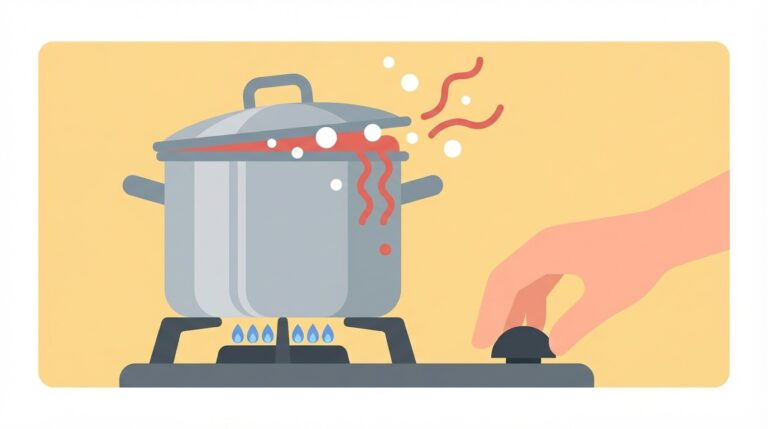
Picture this: You are watching a K-Drama. The lead characters are in a tiny, cozy kitchen, cooking Ramyun together late at night. Suddenly, the water boils over! Bubbles go everywhere! The main character screams something, and the other person quickly twists the knob on the stove.
Or maybe you are at a Korean BBQ restaurant in Seoul. The pork belly (Samgyeopsal) is sizzling aggressively, smoke is rising, and you realize… the meat is about to turn into charcoal. You look at the waiter, desperate to say, “Stop the fire!” but the words stick in your throat.
Don’t panic. Today, we are learning the art of “Fire Control” in Korean. In Korea, cooking is all about timing. Knowing how to say “Turn it off” or “Turn it down” isn’t just about language—it’s about saving your dinner from disaster. Let’s become the master of the kitchen!
Phase 2: Deep Dive into Key Phrases
Here are the top 3 phrases you need to save your food.
1. 불 꺼주세요 (Please turn off the fire)
- Pronunciation: [Bul kkeo-ju-se-yo]
- Sound Analogy: “Bul” sounds like “Bull” (the animal). “Kkeo” sounds like the “caw” of a crow, but deeper in your throat.
- Meaning:
- Literal: Fire turn-off-please.
- Real Nuance: “Kill the heat!” or “Switch it off.”
- K-Culture Moment: Think of a K-Pop idol on a cooking variety show. They finish plating the food and shout to their teammate, “Ya! Bul kkeo!” (Hey! Turn it off!) to stop the cooking process immediately.
- Editor’s Insight: The word ‘불’ (Bul) means fire, but in a kitchen context, it means “heat” or “stove,” even if you are using an induction cooktop.
- Situation Spectrum:
[🚫 Formal Speech] ———— [⚠️ Polite/Standard] ———— [✅ Casual]
- Close Friend: “불 꺼!” (Bul kkeo! – ✅)
- Stranger/Older Person: “불 꺼주세요.” (Bul kkeo-ju-se-yo – ⚠️)
- 🤔 Think About It: In English, we say turn “off” the stove. In Korean, we “extinguish” (끄다) the fire. Why do you think Korean uses the same word for a light bulb and a raging fire?
2. 불 줄여주세요 (Please turn down the fire)
- Pronunciation: [Bul jul-yeo-ju-se-yo]
- Sound Analogy: “Jul” sounds like “Jewel” but shorter. “Yeo” sounds like “Yuh”.
- Meaning:
- Literal: Fire reduce-please.
- Real Nuance: “Lower the heat.”
- K-Culture Moment: In a drama, when a mother teaches her daughter to make Kimchi-jjigae (stew), she whispers softly, “Now, lower the heat and let it simmer.” It’s the secret to deep flavor.
- Editor’s Insight: This is tricky! If you say “Kkeo” (off) instead of “Juryeo” (reduce), the cooking stops completely. Precision matters!
- Situation Spectrum:
[🚫 Formal Speech] ———— [⚠️ Polite/Standard] ———— [✅ Casual]
- Close Friend: “불 줄여.” (Bul juryeo – ✅)
- Restaurant Staff: “불 좀 줄여주시겠어요?” (Bul jom juryeo-ju-si-gess-eo-yo? – ⚠️)
- 🤔 Think About It: The verb ‘줄이다’ means to reduce or shorten. You can use this for volume, size, and even weight! Is there a word in your language that works for both “fire” and “weight”?
3. 탄다! (It’s burning!)
- Pronunciation: [Tan-da!]
- Sound Analogy: “Tan” like a “Sun-tan”. “Da” like “Da-da”.
- Meaning:
- Literal: (It) burns!
- Real Nuance: “Emergency! Save the meat!”
- K-Culture Moment: Every BBQ scene ever. Someone gets distracted talking, and suddenly everyone yells “Ah! Tanda!” (Ah! It’s burning!) while frantically moving their chopsticks.
- Editor’s Insight: This isn’t a command; it’s an alert. It prompts immediate action from everyone at the table.
- Situation Spectrum:
[🚫 Formal Speech] ———— [⚠️ Polite/Standard] ———— [✅ Casual]
- Used universally as an exclamation.
Phase 3: Textbook vs. Real Life
| Situation | 📖 Textbook Korean | 🗣️ Real Korean | 💡 Why the difference? |
|---|---|---|---|
| Ramyun is boiling over | 가스레인지를 끄십시오. (Please turn off the gas range.) |
야! 불 꺼! 불!! (Hey! Fire off! Fire!!) |
In an emergency, we drop all unnecessary words for speed. |
| At a BBQ place (Meat is done) | 불을 꺼 주시겠습니까? (Would you please turn off the fire?) |
사장님, 여기 불 좀 빼주세요. (Boss, please remove the fire here.) |
At Charcoal BBQ places, they physically remove the coal bucket. |
Bottom Note: At a BBQ restaurant with a gas stove, stick to “Bul kkeo-ju-se-yo.” If it’s charcoal, try the pro phrase “Bul ppae-ju-se-yo” (remove the fire)!
Phase 4: Cultural Deep Dive
4-1. The “Nunchi” (Eye-measure) of Cooking
In Korea, cooking is a communal activity. You don’t just watch; you participate. If you see the soup boiling over and the cook is busy, Nunchi (reading the room) dictates that you should reach out and turn the knob yourself, or at least yell “Tanda!” (It’s burning!). Doing nothing is considered indifferent.
4-2. K-Food Connection: The “Golden Time” of Ramyun
Why is turning off the fire so important? Because of Ramyun. Koreans take noodle texture very seriously.
– Kkodul-myeon (Hard/Chewy): Turn off exactly at 3 mins.
– Peojin-myeon (Soft/Soggy): Turn off at 4.5 mins.
If you miss the timing by even 30 seconds, you might get a disappointed look from your Korean friend. The phrase “Bul kkeo!” is the final judgment call of the chef.
Phase 5: Immersive Roleplay 🎬
Setting: A Friday night at your friend Min-su’s apartment in Seoul. You are making Ramyun together after a night out. The pot is on a portable gas stove on the living room table.
Characters:
– YOU: Hungry foreigner who loves chewy noodles.
– Min-su: Your Korean friend, currently cutting Kimchi.
(The water starts boiling vigorously)
Min-su: 면 넣었어? 시간 잘 봐야 해!
(Myeon neoh-eoss-eo? Si-gan jal bwa-ya hae!)
(English: Did you put the noodles in? You have to watch the time!)
YOU: 응, 넣었어. 지금 2분 지났어.
(Eung, neoh-eoss-eo. Ji-geum 2-bun ji-nass-eo.)
(English: Yeah, I put them in. 2 minutes have passed.)
(Suddenly, white foam rises to the top of the pot!)
Min-su: 어, 어! 물 넘친다!
(Eo, eo! Mul neom-chin-da!)
(English: Uh, oh! The water is overflowing!)
🔀 YOUR TURN! How do you react?
- A) “도와주세요!” (Help me!) – A bit helpless.
- B) “불 줄여?” (Should I turn down the heat?) – Calm and logical.
- C) “불 꺼!” (Turn it off!) – Panic mode, might stop cooking too early.
✅ Best Choice: B) “불 줄여?”
Reason: If you turn it off (C), the noodles won’t cook. If you ask for help (A), it might be too late. Asking “Should I reduce the heat?” shows you know how to control the temperature!
Phase 6: 10-Second Shadowing Drill 🗣️
Repeat after me! Pay attention to the emotion.
- (😤 Urgent/Panic)
야! / 탄다! / 빨리 / 뒤집어!
(Ya! / Tanda! / Ppal-li / Dwi-jib-eo!)
Hey! It’s burning! Quickly flip it! -
(😊 Politely to waiter)
저기요~ / 불 좀 / 줄여주세요.
(Jeo-gi-yo~ / Bul jom / Jul-yeo-ju-se-yo.)
Excuse me~ Please turn down the heat a little. -
(😎 Confident Chef)
지금이야. / 불 꺼.
(Ji-geum-i-ya. / Bul kkeo.)
Now is the time. Turn off the fire.
Phase 7: K-Culture Mini Glossary
| Korean | Romanization | English | Context |
|---|---|---|---|
| 가스버너 | gaseu-beoneo | Portable Gas Stove | Essential item for home BBQ or Ramyun. |
| 쫄다 | jjolda | To boil down | When soup reduces and becomes salty. “국물이 쫄았어.” |
| 화력 | hwaryeok | Fire power | Referring to the strength of the stove. “화력이 너무 세요!” (The heat is too strong!) |
| 보글보글 | bogeul-bogeul | Bubbling sound | Sound of stew boiling perfectly. |
| 인덕션 | indeok-syeon | Induction Cooktop | Many modern Korean homes use this now. |
Phase 8: Traveler’s Survival Kit ✈️
Scenario: You are at a Korean BBQ Restaurant. The meat is cooking too fast!
🆘 Survival Phrases
1. 🇰🇷 “불이 너무 세요.” (Buri neomu seyo.)
– Meaning: The fire is too strong.
2. 🇰🇷 “불판 갈아주세요.” (Bulpan gara-juseyo.)
– Meaning: Please change the grill/grate. (Use this when the grill is black/burnt).
3. 🇰🇷 “이제 먹어도 돼요?” (Ije meogeodo dwaeyo?)
– Meaning: Can I eat this now? (Ask this to check if it’s fully cooked).📌 Editor’s Travel Note
At many modern K-BBQ places, the staff will grill the meat for you. In this case, don’t touch the fire knob! It’s considered their territory. Just watch and wait. If you think it’s burning, point and say “Tanda!” (It’s burning!).
Phase 9: Think Deeper — “The Culture of Pali-Pali”
🧠 Why is everyone rushing the fire?
In Korea, you might hear the phrase “Pali-pali” (Hurry, hurry) often. This culture applies to cooking too. High heat (Sen-bul) is preferred to cook things quickly and preserve texture, especially for stir-fries and BBQ. This contrasts with some Western cooking styles that favor “low and slow.”
Does this reflect the fast-paced lifestyle of modern Korea? Or is it simply because high heat makes the food taste better?
💬 Your Turn: Does your culture prefer slow cooking or fast high-heat cooking? Tell us in the comments!
Phase 10: FAQ & Troubleshooting
Q: Can I use “Bul kkeo” for turning off the lights in my room?
A: YES! Ideally, “Turn off the light” is “Bureul kkeuda.” The verb ‘끄다’ (kkeuda) is used for fire, lights, engines, and electronic devices. It’s a super versatile verb!
Q: Is it rude to say “Bul kkeo!” to a waiter if the meat is burning?
A: YES. Even in an emergency, shouting specific commands (Banmal) to staff is rude. Instead, wave your hand and say “Sajang-nim!” (Boss!) loudly. They will run to you.
❌ Common Mistake: Trying to blow out a gas stove fire like a candle.
✅ Fix: Always use the knob or ask for help. Blowing creates ash and is dangerous!
Phase 11: Wrap-up & Action Mission
📝 Summary: Today we learned how to save our food with “Bul kkeo-ju-se-yo” (Turn off), “Bul juryeo-ju-se-yo” (Turn down), and the emergency alert “Tanda!” (It’s burning!).
🚀 Action Missions:
– 🥉 Bronze: Stand in front of your stove (cold) and practice saying “Bul kkeo!” firmly 3 times.
– 🥈 Silver: Watch a “Mukbang” or Cooking video on YouTube. Listen for when they mention the fire or heat.
– 🥇 Gold: Go to a K-BBQ restaurant. When the meat is almost done, try saying “Bul jom juryeo-ju-se-yo” to the staff (or your friend)!
🌟 K-Culture Mission: Next time you make instant noodles, try to time the “Bul kkeo” moment exactly when the noodles are perfectly chewy!
Phase 12: Interactive Quiz 🧩
1. Situation: You are simmering a stew, but it’s boiling too hard. What do you say?
– A) 불 꺼! (Turn it off!)
– B) 불 줄여! (Turn it down!)
– C) 불판 갈아줘! (Change the grill!)
2. True or False:
– “You should always turn the fire knob yourself at every Korean restaurant.”
– (Answer: False. At full-service grill places, staff manage the fire.)
3. Fill in the blank:
– “Oh no! The meat is turning black! ______!”
– (Hint: It starts with T)
(Scroll down for answers)
.
.
.
Answers: 1. (B), 2. (False), 3. Tanda (탄다)
See you in the next lesson! Happy cooking! 🍳
Frequently Asked Questions (FAQ)
Q: What does "불 꺼주세요 (Please turn off the fire)" mean in Korean and how do you pronounce it?
A: In Korean, "불 꺼주세요 (Please turn off the fire)" is pronounced [Bul kkeo-ju-se-yo] and means: a key conversational Korean expression covered in this lesson.
Q: What does "불 줄여주세요 (Please turn down the fire)" mean in Korean and how do you pronounce it?
A: In Korean, "불 줄여주세요 (Please turn down the fire)" is pronounced [Bul jul-yeo-ju-se-yo] and means: a key conversational Korean expression covered in this lesson.
Q: What does "탄다! (It's burning!)" mean in Korean and how do you pronounce it?
A: In Korean, "탄다! (It's burning!)" is pronounced [Tan-da!] and means: a key conversational Korean expression covered in this lesson.







