

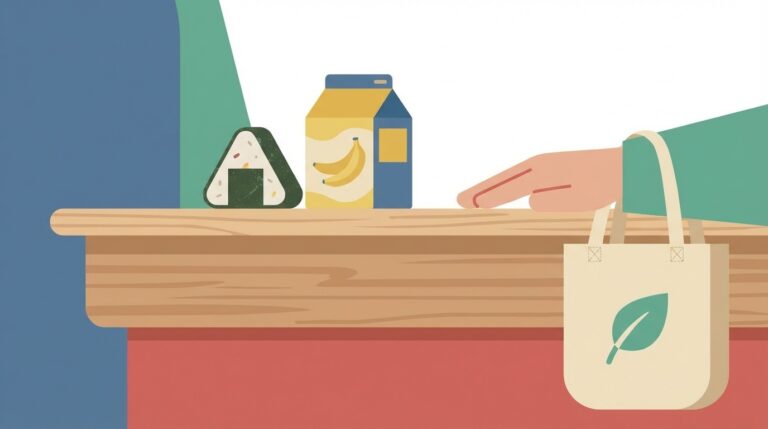
Phase 1: The Immersive Hook — That Awkward Silence at the Counter
Hello, Daily Hangul family! It’s your Chief Editor here.
Picture this: You’ve just finished a late-night study session and popped into a convenience store (pyeoneui-jeom) for a quick snack. You pile a triangular kimbap, a banana milk, and a bag of chips onto the counter. The part-timer scans them—beep, beep, beep—and then stops.
Silence.
They look at your items. They look at you. They look at your empty hands.
In a K-Drama, this is the moment the lead actor would coolly whip out a stylish canvas tote, maybe one with a witty slogan like “I’m not plastic.” But in reality? You’re freezing. Why aren’t they bagging it? Are they waiting for a confession?
Here’s the reality check: In South Korea, the ban on disposable plastic bags is strictly enforced. If you don’t speak up, you’ll be juggling your snacks all the way home. Today, we’re not just learning how to ask for a bag; we’re diving into the eco-conscious psyche of modern Korea. Ready to become an eco-insider?
Phase 2: Deep Dive — Advanced Expressions for the Eco-Savvy
Since you are at a C2 level, we won’t waste time with “Please give me a bag.” Let’s look at the nuanced phrases that make you sound like a local who follows the news.
1. 담아 드릴까요? vs. 봉투 필요하세요?
- Pronunciation: [Dama deuril-kkayo?] / [Bongtu piryo-haseyo?]
- Meaning: “Shall I put this in (a bag)?” vs. “Do you need a bag?”
- K-Culture Moment: You will hear this everywhere, from Olive Young to the local mart. It’s the standard opening line.
- Editor’s Insight: As a C2 learner, pay attention to the implied cost. When they ask this, they are implicitly asking, “Are you willing to pay 20 to 100 won for a bag?” It’s not a courtesy service anymore; it’s a transaction.
- Situation Spectrum:
[✅ Casual] ———— [✅ Formal](Standard service phrase)- 🤔 Think About It: Why does Korean use the verb 담다 (to put into/contain) instead of just “give”? It focuses on the action of service rather than the object (the bag).
2. 종량제 봉투로 주세요.
- Pronunciation: [Jong-nyang-je bong-tu-ro ju-se-yo]
- Meaning: “Please give me a standard garbage bag (instead of a regular plastic bag).”
- K-Culture Moment: This is the ultimate “Life Hack” in Korea. In Seoul, convenience stores allow you to buy a standard district garbage bag (usually white or green) to carry your goods. You use it to carry groceries home, then reuse it to throw out your trash later. Two birds, one stone.
- Editor’s Insight: Using this phrase instantly upgrades your status from “tourist” to “resident.” It shows you understand the waste management system.
- Situation Spectrum:
[✅ Convenience Stores] ———— [✅ Supermarkets]- 🤔 Think About It: Jong-nyang-je (Volume-rate system) reflects a society where waste disposal is strictly regulated by volume. How does this differ from waste management in your country?
3. 장바구니/에코백 가져왔어요.
- Pronunciation: [Jang-ba-gu-ni / Eko-baek ga-jyeo-wa-sseo-yo]
- Meaning: “I brought my shopping bag/eco-bag.”
- K-Culture Moment: In reality shows like I Live Alone, you often see celebrities proudly pulling out their own bags. It’s a sign of a diligent lifestyle.
- Editor’s Insight: Say this before the clerk reaches for a plastic bag to save them the hassle. It creates a small moment of “good citizen” bonding.
Phase 3: Textbook vs. Real Life
| Situation | 📖 Textbook Korean | 🗣️ Real Korean (Street Level) | 💡 Why the difference? |
|---|---|---|---|
| Rejecting a bag | 아니요, 봉투는 필요 없습니다. (No, I do not need a bag.) | 아, 됐어요. 그냥 들고 갈게요. (Ah, it’s done/fine. I’ll just carry it.) | “됐어요” implies “that is sufficient/no need,” which is softer yet firmer than a direct “No.” |
| Asking for a bag | 비닐 봉투 하나 주세요. (Please give me one plastic bag.) | 봉투 하나만요. (Just a bag, please.) | Efficiency. In a busy 8282 (hurry-hurry) culture, dropping particles is standard. |
| Checking recycling | 이 제품은 재활용이 가능한가요? (Is this product recyclable?) | 이거 분리수거 되나요? (Can I separate-collect this?) | Real life focuses on the action of separating trash (bunli-sugeo), not just the ability to recycle. |
Bottom Note: At a C2 level, using “됐어요” with a polite hand wave is the most natural way to decline anything in Korea.
Phase 4: Cultural Deep Dive — The “Eco” Context
4-1. Non-verbal Communication: The “Ready Stance”
When you approach the counter with your own bag, don’t keep it folded in your pocket. Open it and place it on the counter next to your items. This non-verbal cue tells the cashier, “I am prepared. Do not ask me about bags. Just scan.”
4-2. K-Culture Connection: The “Packing Station” Drama
In major Korean marts (Emart, Lotte Mart, Homeplus), there used to be “Packing Stations” (자율포장대) with free cardboard boxes and tape. However, due to eco-regulations, tape and plastic string have largely disappeared. You might see people struggling to fold boxes without tape like origami masters.
* Critical Perspective: This policy sparked huge debates. Is removing tape actually saving the environment, or just inconveniencing shoppers? It’s a classic Korean debate of Efficiency vs. Moral Duty.
Phase 5: Immersive Roleplay — The Mart Checkout Line
Setting: A bustling Lotte Mart on a Saturday evening. The checkout line is long. You have a cart full of groceries but forgot your eco-bag. The cashier is moving at light speed.
Characters:
* YOU: A foreign resident living in Seoul for 3 years.
* Cashier: A middle-aged lady (Imo-nim), very fast, slightly impatient but efficient.
Dialogue:
Cashier: (Scanning items rapidly) 봉투 필요하세요?
(Scanning items rapidly) Bongtu piryo-haseyo?
(English) Do you need a bag?
YOU: 아, 깜빡했네요. 혹시 종량제 봉투 있나요?
Ah, kkam-ppak-haet-neyo. Hoksi jong-nyang-je bongtu innayo?
(English) Ah, I slipped my mind. Do you happen to have standard garbage bags?
Cashier: 저희는 재사용 봉투만 파는데요. 500원이에요.
Jeohui-neun jae-sa-yong bongtu-man paneundeyo. Obaek-won-ieyo.
(English) We only sell reusable bags (thick plastic). It’s 500 won.
🔀 Decision Point! How do you respond?
* A) “너무 비싸요. 그냥 박스에 담아갈게요.” (Too expensive. I’ll use a box.)
* B) “아, 네. 하나 주세요.” (Ah, okay. Please give me one.)
* C) “에이, 깎아주세요!” (Hey, give me a discount!)✅ Best Choice: A — Why? It shows you know the system. You can walk over to the packing station and find a cardboard box. It’s free and eco-friendly.
⚠️ Choice C Analysis: Never haggle at a supermarket or convenience store. It’s not a traditional market. It will make things very awkward.
Phase 6: 10-Second Shadowing Drill
Let’s practice the flow of declining politely but explaining your method.
Emotion: 😌 Casual, slightly apologetic but confident.
“아, 봉투는 / 됐어요! / 가방에 / 담아 갈게요.”
(Ah, bongtu-neun / dwae-sseo-yo! / Gabang-e / dama gal-ge-yo.)
Translation: “Ah, no need for a bag! I’ll put it in my (own) bag.”
Phase 7: K-Culture Glossary — Eco Edition
| Korean | Romanization | Meaning | Context |
|---|---|---|---|
| 분리수거 | Bunli-sugeo | Separate Collection (Recycling) | The act of separating trash. Korea has one of the strictest systems in the world. |
| 일회용품 | Il-hoe-yong-pum | Disposable goods | Usually refers to plastic cups, straws, and bags. Often restricted in cafes. |
| 텀블러 할인 | Tumbler hal-in | Tumbler Discount | Many cafes (Starbucks, etc.) give a 300-500 won discount if you bring your own cup. |
| 라벨 제거 | Label je-geo | Label Removal | You must remove plastic labels from PET bottles before recycling. |
Phase 8: Traveler’s Survival Kit — The “Bag” Crisis
Even if you aren’t living here, you will shop. Here is your survival card.
🆘 Survival Phrases #1
* Situation: You bought too much and can’t carry it.
* 🇰🇷 “담아갈 것 좀 있을까요?” (Dam-a-gal geot jom isseul-kkayo?)
* English: “Is there something I can carry this in?”
* 💡 Pro Tip: This is a broad question. They might offer a paper bag, a plastic bag, or point you to a box. It covers all bases.📌 Editor’s Travel Note
* Department Stores: They usually provide high-quality paper bags for free or a small fee (100 won). Don’t worry about eco-bags here.
* Traditional Markets: Grandmas will still often give you black plastic bags freely, though the law is tightening there too. It’s part of the “Jeong” (affection) culture.
Phase 9: Think Deeper — Critical Thinking
Topic: The Sociology of Recycling in Korea
Korea has a limited landmass and high population density. There is literally no space for landfills. This geographical reality forced the government to implement the Volume-Rate Garbage Disposal System (쓰레기 종량제) in 1995.
🧠 Think Deeper:
While the system is efficient, does it create a class divide? Wealthier districts often have cleaner separation areas, while older, poorer neighborhoods struggle with illegal dumping. Also, consider the “shame culture”—neighbors often police each other’s recycling habits. How does this compare to environmental actions in your country? Is it driven by policy or conscience?
Phase 10: FAQ & Troubleshooting
- Q: Can I just carry items out in my hands without a bag? Will they think I’m stealing?
- A: Yes, you can! Just make sure you have the receipt visible in your hand. It’s very common now. In fact, carrying a single banana milk and a kimbap in your hands is the quintessential “salaryman lunch” vibe.
- Q: Is it rude to ask for a bag after I paid?
- A: Not rude, but annoying for the clerk because they have to ring up a separate transaction for the 20 or 50 won bag. Try to ask during the scanning process.
- ❌ Common Mistake: Asking for a “Plastic Bag” using the English word “Plastic.”
- Correction: In Korean, “Plastic” usually refers to hard plastic material. For soft bags, use “비닐” (Vinyl). So it’s “Binil bongtu,” not “Plastic bongtu.”
Phase 11: Wrap-up & Action Mission
One-Liner: Knowing how to refuse a bag is the first step to sounding like a Seoulite, not a tourist.
Your Mission:
* 🥉 Bronze: Practice saying “봉투는 됐어요” (No bag needed) out loud 5 times.
* 🥈 Silver: Go to a convenience store, buy 3 items, and successfully refuse the bag using the phrase.
* 🥇 Gold: Ask for a “Jong-nyang-je bongtu” (Standard garbage bag) at a convenience store and use it to carry your snacks home.
💬 Your Turn: Does your country charge for plastic bags? Or is it still free? Tell me in the comments!
Phase 12: Interactive Quiz
- True or False? You should use the word “Plastic Bongtu” to ask for a shopping bag.
- (Answer: False. Use “Binil Bongtu”.)
- Situation: The clerk asks “담아 드릴까요?” but you have your own eco-bag. What is the most natural C2-level response?
- A) 아니요, 싫어요. (No, I hate it.)
- B) 네, 담아주세요. (Yes, put it in.)
- C) 괜찮아요, 가방 있어요. (It’s okay, I have a bag.)
- (Answer: C. It’s polite and explanatory.)
- Critical Thinking: Why do Korean convenience stores sell “Standard Garbage Bags” (Jong-nyang-je)?
- (Answer: To allow customers to reuse the shopping bag as a trash bag at home, reducing single-use plastic waste.)
Frequently Asked Questions (FAQ)
Q: What does "담아 드릴까요? vs. 봉투 필요하세요?" mean in Korean and how do you pronounce it?
A: In Korean, "담아 드릴까요? vs. 봉투 필요하세요?" is pronounced [Dama deuril-kkayo?] and means: "Shall I put this in (a bag)?" vs. "Do you need a bag?"
Q: What does "종량제 봉투로 주세요." mean in Korean and how do you pronounce it?
A: In Korean, "종량제 봉투로 주세요." is pronounced [Jong-nyang-je bong-tu-ro ju-se-yo] and means: "Please give me a standard garbage bag (instead of a regular plastic bag)."
Q: What does "장바구니/에코백 가져왔어요." mean in Korean and how do you pronounce it?
A: In Korean, "장바구니/에코백 가져왔어요." is pronounced [Jang-ba-gu-ni / Eko-baek ga-jyeo-wa-sseo-yo] and means: "I brought my shopping bag/eco-bag."






