

Phase 1: Immersive Hook
Greeting: 안녕하세요! This is your Senior Editor at Daily Hangul.
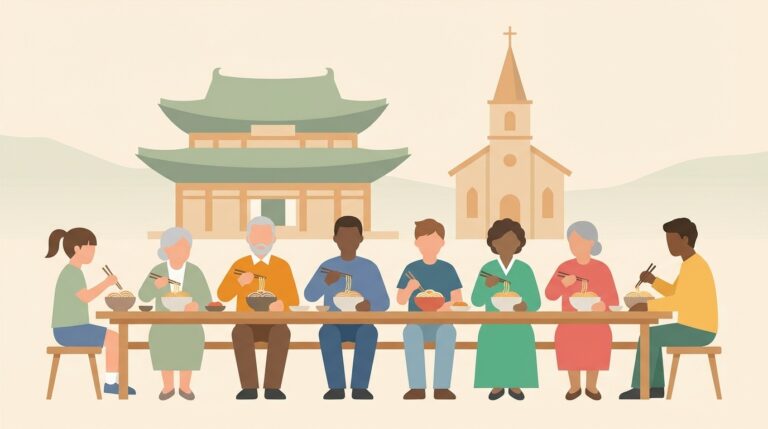
Imagine this scene: It’s lunchtime in a busy alley near Jongno. You see a long line of elderly people, taxi drivers, and even some young students standing in front of a building. Is it a famous restaurant? A K-Pop pop-up store? No, it’s a Buddhist temple or a Christian church offering free noodles (guksu).
In K-Dramas like The Glory or My Liberation Notes, religious spaces aren’t just backdrops for prayer; they are places where secrets are exchanged, communities gather, and social hierarchies play out. In Korea, religious facilities function as social hubs (구심점). They are polling stations during elections, shelters during floods, and study rooms for students.
Today, we are stepping away from theology and diving into sociology. As an advanced learner (C1), understanding how to discuss the social role of these institutions is key to discussing current affairs, social welfare, and community dynamics in Korea. Ready to see the holy side of K-Society?
Phase 2: Deep Dive into Key Expressions
Here are three advanced expressions used when discussing the social function of organizations.
1. 구심점 역할을 하다 [gusimjeom yeok-hareul hada]
- Pronunciation: gu-sim-jeom (think ‘goo’ + ‘sim’ + ‘jum’) + yeok-hal-eul ha-da
- Meaning: To play a pivotal role; to act as a central hub (Literal: To act as the centripetal point).
- K-Culture Moment: Think of the Reply 1988 parents. Where do they gather to discuss neighborhood safety or gossip? Often at a religious gathering or a community center initiated by one. The church/temple is the gusimjeom of their social life.
- Editor’s Insight: This is a high-level C1 phrase. You wouldn’t use it to describe a casual dinner. You use it when analyzing group dynamics. “This community center plays a gusimjeom role for foreign residents.”
- Situation Spectrum:
[🚫 Casual Friends] ———— [⚠️ Colleagues] ———— [✅ Formal/Debate]- 🤔 Think About It: Why does Korea need these “hubs” so badly? Rapid urbanization broke up traditional village bonds. Do religious centers replace the lost “village square” in modern Seoul?
2. 나눔과 봉사 [nanum-gwa bongsa]
- Pronunciation: na-num (sounds like ‘na-noom’) + gwa + bong-sa
- Meaning: Sharing and Service (Volunteerism).
- K-Culture Moment: You know those scenes where celebrities are wearing orange vests and carrying coal briquettes (yeontan) in winter? That is nanum-gwa bongsa. Religious groups organize about 70% of these events in Korea.
- Editor’s Insight: Nanum comes from nanuda (to share). It has a warmer, more emotional nuance than the dry academic term gibu (donation). Use this when you want to emphasize the spirit of giving, not just the money.
- Situation Spectrum:
[✅ Casual] ———— [✅ Semi-formal] ———— [✅ Formal]- 🤔 Think About It: In many Western countries, charity is often secular or NGO-driven. In Korea, the line between religious activity and social welfare is very blurry. Is this efficiency or a lack of public infrastructure?
3. 정서적 위안 [jeongseojeok wian]
- Pronunciation: jeong-seo-jeok + wi-an (‘wee’ like ‘wee’ in ‘week’ + ‘an’)
- Meaning: Emotional solace/comfort.
- K-Culture Moment: In My Mister (나의 아저씨), characters often seek a quiet place just to breathe. A temple stay or sitting in an empty chapel provides jeongseojeok wian even if they aren’t deeply religious.
- Editor’s Insight: This is a sophisticated way to say “It makes me feel better.” Instead of saying “기분이 좋아져요” (I feel good), saying “정서적 위안을 얻었어요” makes you sound like a refined intellectual or a thoughtful essayist.
- Situation Spectrum:
[🚫 Kids] ———— [⚠️ Close Friends] ———— [✅ Serious Conversation]
Phase 3: Textbook vs. Real Life
| Situation | 📖 Textbook Korean | 🗣️ Real Korean (C1 Level) | 💡 Why the difference? |
|---|---|---|---|
| Describing charity | 종교 단체는 가난한 사람을 도와줍니다. (Religious groups help poor people.) | 소외 계층을 위한 사회 안전망 역할을 하죠. (They act as a social safety net for the marginalized.) | C1 level requires specific terms like ‘social safety net’ to discuss systemic roles. |
| Free meals | 여기서 공짜 밥을 줘요. (They give free rice here.) | 무료 급식소를 운영하고 있어요. (They operate a free meal center.) | ‘공짜 밥’ can sound demeaning. ‘무료 급식’ is the respectful, administrative term. |
| Meeting people | 교회에서 친구를 만나요. (I meet friends at church.) | 교회가 거의 동네 사랑방이에요. (The church is practically the neighborhood lounge.) | Sarangbang is a traditional reception room; using it invokes a cultural nuance of hospitality and chatter. |
Phase 4: Cultural Deep Dive
4-1. Non-verbal: The Art of “Invisible” Service
In Korea, there is a concept called “오른손이 하는 일을 왼손이 모르게 하라” (Do not let your left hand know what your right hand is doing – biblical, but universally quoted). When engaging in bongsa (volunteering) at these facilities, humility is key. Taking too many selfies or bragging about your good deeds is considered “showing off” (생색내기) and is socially frowned upon. Keep your head down, work hard, and let the nunchi of others recognize your effort.
4-2. K-Culture Connection: Temple Food & Veganism
Have you seen Chef Jeong Kwan on Netflix’s Chef’s Table? Temple Food (사찰 음식) has transcended religion to become a cultural icon of sustainability and health.
– The Social Role: It’s not just for monks anymore. Temples now run cooking classes for foreigners and young Koreans as a form of “cultural outreach.”
– Critical View: Why is this “ascetic” food becoming a “luxury” wellness trend? It reflects modern Korea’s obsession with health and the desire to escape the “Ppalli-Ppalli” (hurry-hurry) fast-food culture.
Phase 5: Immersive Roleplay
Setting: A quiet cafe in Insadong on a rainy Saturday. You are talking to Hyun-woo (35), a Korean friend who is organizing a charity bazaar at his cathedral.
Dialog:
Hyun-woo: 이번 주말에 성당에서 바자회 하는데, 너도 올래? 수익금은 전액 기부하거든.
(Ibeon jumare seongdang-eseo bajahoe haneunde, neodo ollae? Suikgeumeun jeonaek gibuhageodeun.)
[Translation: We’re having a bazaar at the cathedral this weekend, want to come? All proceeds are donated.]
YOU: (Choose your response below)
Hyun-woo: 오, 정말? 사실 외국인 봉사자도 있으면 분위기가 더 좋을 것 같아서!
(Oh, jeongmal? Sasil oegugin bongsajado isseumyeon bunwigiga deo joeul geot gataseo!)
[Translation: Oh, really? Actually, having a foreign volunteer would make the atmosphere even better!]
🔀 Decision Point: How do you respond?
- Option A: “좋아! 나도 나눔과 봉사에 참여하고 싶었어.” (Enthusiastic & Advanced)
- Option B: “그래? 거기서 공짜 밥도 줘?” (Too casual/Rude)
- Option C: “종교 시설이 지역 사회의 구심점이네.” (Analytical & Intellectual)
✅ Best Choice: Option A. It uses the target vocabulary naturally and shows willingness.
⚠️ Choice C Analysis: While grammatically correct, using “gusimjeom” (pivotal role) in casual chatter might make you sound like a news anchor. Save it for a debate!
Phase 6: 10-Second Shadowing Drill
Let’s practice a sentence you can use when visiting a cultural event at a temple or church.
Emotion: 😊 Appreciative & Thoughtful
“이곳은 / 종교를 떠나서 / 마음이 편안해지는 / 공간이네요.”
(Igoseun / jonggyoreul tteonaseo / maeumi pyeonanhaejineun / gongganineyo.)
Meaning: “Regardless of religion, this is a space where my mind feels at ease.”
Phase 7: K-Culture Mini Glossary
| Korean | Romanization | Meaning | Context |
|---|---|---|---|
| 사랑방 | Sarangbang | Reception Room / Social Hub | Originally a room for male guests in Hanok, now metaphorically used for any place where community gossip/discussion happens. |
| 공양 | Gongyang | Buddhist Meal | Eating at a temple isn’t just “eating”; it’s an offering. You must clean your bowl with water and drink it (zero waste). |
| 성지순례 | Seongji-sullye | Pilgrimage | Now slang for K-Pop fans visiting locations related to their idols (e.g., “I’m going on a RM tour seongji-sullye“). |
Phase 8: Traveler’s Survival Kit
Even if you aren’t religious, you will likely visit Myeongdong Cathedral or a mountain temple like Bulguksa.
🆘 Survival Expressions
– 🇰🇷 “비신자도 들어갈 수 있나요?” (Bisinjado deureogal su innayo?)
– “Can non-believers enter?” (Essential for respecting sacred spaces)
– 🇰🇷 “사진 찍어도 실례가 안 될까요?” (Sajin jjigeodo sillyega an doelkkayo?)
– “Would it be rude if I took a photo?” (Always ask this inside main halls)📌 Editor’s Travel Note:
– Dress Code: Sleeveless shirts or mini-skirts might be restricted in main prayer halls of temples.
– Templestay: This is a major tourist activity. It’s not about conversion; it’s about cultural experience. Book in advance via the official website.
Phase 9: Think Deeper — “Cultural Venues”
Topic: Religious Spaces as Cultural Venues (Secularization)
Recently, Myeongdong Cathedral held a media art exhibition on its exterior walls, and Buddhist temples host jazz concerts.
🧠 Think Deeper:
Why are sacred spaces opening up to secular culture? Some say it’s to lower the entry barrier for the younger generation (MZ gen) who are leaving religion. Others say it’s the modernization of the “community hub” role. In your country, do churches or temples host rock concerts or art shows? How does that change the sanctity of the space?
Phase 10: FAQ & Troubleshooting
Q: Can I eat the free lunch (Guksu/Bibimbap) at a temple if I didn’t donate?
A: Generally, yes. The concept is nanum (sharing). However, it is polite to put a small amount of cash (even 1,000 KRW) in the donation box if you can, as a gesture of gratitude. Or, wash your own dishes (common in temples)!
Q: A stranger on the street asked me “Do you know the Tao?” (도를 아십니까?)
A: Run. Or just say “No” firmly and keep walking. This is NOT a standard religious social role; these are often cult-like recruiters targeting foreigners or lone travelers. Do not engage in conversation.
❌ Common Mistake: calling a monk “Sir” or “Mr.”
✅ Fix: Use the title “스님” (Seunim). For a Catholic priest, use “신부님” (Sinbunim). Using proper titles is crucial for C1 level politeness.
Phase 11: Wrap-up & Action Mission
Summary: Today we learned that Korean religious facilities are vital social hubs (구심점) that offer solace (위안) and perform service (봉사) beyond just prayer.
Action Missions:
– 🥉 Bronze: Say “이곳은 마음이 편안해지는 공간이네요” out loud three times.
– 🥈 Silver: Look up “Templestay Korea” and read the schedule of a daily routine. Note the word “Gongyang” (meal).
– 🥇 Gold: Visit a religious site in your city (or in Korea) that is open to the public and observe the notice board. What kind of social activities (bazaar, choir, cleanup) are they organizing?
💬 Your Turn: Does your country have a “Sarangbang” culture in religious places? Tell us in the comments!
Phase 12: Interactive Quiz
- [Fill in the blank] Select the most appropriate word for a formal discussion.
“최근 종교 시설은 지역 사회의 ___ 역할을 하고 있습니다.”
A) 놀이터 (Playground)
B) 구심점 (Pivotal Hub)
C) 편의점 (Convenience Store) -
[True or False – Culture] If you eat a meal at a Buddhist temple, it is polite to leave a little bit of food to show you were full.
(True / False) -
[Situation] You are writing an email to a Korean NGO about partnering for a charity event. Which word is best to describe “volunteering”?
A) 알바 (Alba)
B) 노가다 (Nogada)
C) 봉사 (Bongsa)
🔑 Answers:
1. B (구심점) – C1 level vocabulary for “hub.”
2. False – In Temple culture (Barugongyang), you must eat EVERYTHING, including washing the bowl with water and drinking it, to respect the effort behind the food.
3. C (봉사) – ‘Alba’ is part-time work, ‘Nogada’ is manual labor slang, ‘Bongsa’ is the correct term for service.
Frequently Asked Questions (FAQ)
Q: What does "구심점 역할을 하다 [gusimjeom yeok-hareul hada]" mean in Korean and how do you pronounce it?
A: In Korean, "구심점 역할을 하다 [gusimjeom yeok-hareul hada]" is pronounced [gu-sim-jeom (think 'goo' + 'sim' + 'jum'] and means: To play a pivotal role; to act as a central hub (Literal: To act as the centripetal point).
Q: What does "나눔과 봉사 [nanum-gwa bongsa]" mean in Korean and how do you pronounce it?
A: In Korean, "나눔과 봉사 [nanum-gwa bongsa]" is pronounced [na-num (sounds like 'na-noom'] and means: Sharing and Service (Volunteerism).
Q: What does "정서적 위안 [jeongseojeok wian]" mean in Korean and how do you pronounce it?
A: In Korean, "정서적 위안 [jeongseojeok wian]" is pronounced [jeong-seo-jeok + wi-an ('wee' like 'wee' in 'week' + 'an'] and means: Emotional solace/comfort.







