

Phase 1: Immersive Hook
Greeting: 안녕하세요! This is your Daily Hangul Chief Editor.
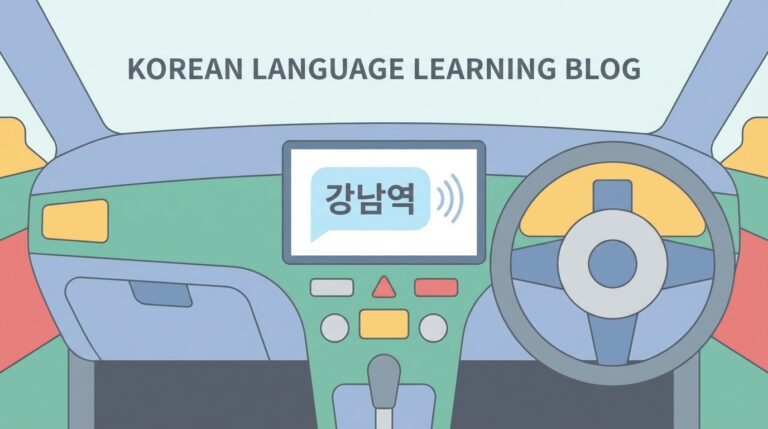
Picture this: You’re watching a high-stakes chase scene in a K-Drama. The protagonist, a sharp-dressed CEO, jumps into his luxury sedan. He needs to get to Incheon Airport right now to stop the love of his life from leaving. He presses a button on the steering wheel and shouts a command.
But wait—in real life, it’s rarely that smooth, is it? Even with the best Korean voice recognition technology, we often find ourselves in a shouting match with our dashboard.
“No, not ‘Music,’ I said ‘Map’!” 🤯
If you’re driving in Korea, or even just using a navigation app in a taxi, knowing how to “tame” the AI with natural Korean phrasing is a game-changer. It’s the difference between looking like a tech-savvy local and a confused tourist poking at a screen. Today, we’re going beyond the robotic “Go home” commands and learning how to talk to your car like a true Seoulite.
Phase 2: Deep Dive into Key Expressions
Since you are at a C1 (Advanced) level, we aren’t just going to say “Turn on the radio.” We will explore how Koreans actually interact with technology, including the frustration and the shortcuts.
1. [장소]로 찍어 줘 ([Jangso]-ro jjigeo jwo)
- Pronunciation: [..ro jji-geo jwo] Think of ‘jj’ as a sharp, tense sound, like the ‘zz’ in pizza but with more pressure.
- Meaning:
- Literal: Please point/mark to [Location].
- Real Nuance: “Set the destination to [Location].” / “Punch in [Location].”
- K-Culture Moment: You’ll hear this in reality TV shows where managers drive K-Pop idols around. They don’t say “Navigate to the hair salon.” They say, “Shop-euro jjigeo jwo” (Set the destination to the salon).
- Editor’s Insight: The verb 찍다 (jjikda) is incredibly versatile (take a photo, dip in sauce, stamp a seal). Here, it implies the action of selecting a point on a map. It feels much more immediate and decisive than “안내해 줘 (Guide me).”
- Situation Spectrum:
[🚫 Formal Meeting] ———— [⚠️ Semi-formal] ———— [✅ Casual/AI Interaction]
(Perfect for friends and AI assistants. Avoid using ‘jjigeo jwo’ with a taxi driver unless you are very close; use ‘gajuseyo’ instead.) - 🤔 Think About It: Why does Korean favor action-oriented verbs like “stamp/mark” (찍다) over abstract ones like “navigate” in casual speech? It reflects a preference for concrete imagery.
2. 가는 길에 [장소] 들러 줘 (Ganeun gire [jangso] deulleo jwo)
- Pronunciation: [Ganeun gire … deulleo jwo] ‘Deulleo’ sounds a bit like ‘dealer’ but with a softer ‘d’ and ‘u’ sound.
- Meaning:
- Literal: On the going road, drop by [Location].
- Real Nuance: “Add [Location] as a stopover.”
- K-Culture Moment: A classic road trip scene. The driver wants to go straight to the pension (vacation rental), but the passenger insists: “Ganeun gire pyeoniejeom deulleo jwo!” (Let’s stop by the convenience store on the way!).
- Editor’s Insight: This uses the grammar structure -는 길에 (on the way to doing something). It’s crucial for multitasking. If you tell the AI just the location, it might reroute your entire trip. This phrase clarifies it’s a stopover.
- Situation Spectrum:
[🚫 Formal Speech] ———— [⚠️ Polite Request] ———— [✅ Casual/AI]
3. 아, 말귀를 못 알아듣네 (Ah, malgwireul mot aradeunne)
- Pronunciation: [Ah, mal-gwi-reul mot ara-deun-ne]
- Meaning:
- Literal: Ah, it cannot understand the ‘ear for words’.
- Real Nuance: “Ugh, it just doesn’t understand what I’m saying!”
- K-Culture Moment: This isn’t a command to the car, but a complaint about it. You will hear this constantly from older Koreans or impatient characters in dramas when technology fails them.
- Editor’s Insight: 말귀 (Malgwi) literally means “ear for speech.” To have “dark malgwi” (malgwiga eoduopda) means you are slow to understand. Using this phrase personifies the machine, treating it like a slow-witted listener.
- Situation Spectrum:
[🚫 To a Superior] ———— [⚠️ To a Junior] ———— [✅ To Yourself/Friends]
Phase 3: Textbook vs. Real Life
| Situation | 📖 Textbook Korean | 🗣️ Real Korean (C1) | 💡 Why the difference? |
|---|---|---|---|
| Setting Destination | 목적지를 설정해 주세요. (Please set the destination.) |
여기 좀 찍어 봐. (Yeogi jom jjigeo bwa – Punch this in.) |
“찍다” is the de facto verb for GPS interaction in casual speech. |
| Error Correction | 다시 말씀해 주세요. (Please say it again.) |
아니, 그거 말고! (Ani, geugeo malgo! – No, not that!) |
Koreans value speed (Ppalli-ppalli). Formalities are dropped in frustration. |
| Music Request | 신나는 음악을 틀어 주세요. (Please play exciting music.) |
노동요 틀어 줘. (Nodongyo teureo jwo – Play ‘labor songs’.) |
Nodongyo (work songs) is a slang/internet term for upbeat K-Pop that helps you focus/work. |
Bottom Note: As a C1 learner, you can use the “Real Korean” column with your close friends or your car’s AI. But stick to the Textbook version if you are guiding a client or a professor.
Phase 4: Cultural Deep Dive — The “Ppalli-ppalli” GPS
4-1. Non-verbal: The Tone of Frustration
When talking to voice assistants in Korea, articulation is key, but so is speed. If you pause too long between “Incheon…” and “…Airport,” the AI might cut you off. This often leads to a specific “annoyed correction tone” where you over-enunciate every syllable: “IN. CHEON. GONG. HANG!”
4-2. K-Travel Connection: T-Map & KakaoNavi
In many Western countries, Google Maps is king. In Korea, Google Maps can be… unreliable for driving.
* K-Reality: Most Koreans use T-Map or KakaoNavi. These apps are culturally tuned. They don’t just give directions; they warn you about speed bumps (a massive obsession in Korean driving) and speed cameras with extreme precision. Knowing how to “summon” these specific apps via voice command is a mark of a true local.
Phase 5: Immersive Roleplay
Setting: Saturday morning, 9:00 AM. You are in a rental car with your Korean friend, Jisoo (29, energetic but impatient). You are driving to Gangneung for a weekend trip. You need to use the voice command because your hands are on the wheel.
Jisoo: 야, 우리 커피 안 마셨잖아. 드라이브스루 좀 찾아봐. ☕
(Ya, uri keopi an masyeotjana. Deuraibuseuru jom chajabwa.)
[Hey, we didn’t drink coffee. Look for a drive-thru.]
YOU: (Pressing the voice button on steering wheel) …
🔀 Your Turn! What command do you give?
– A) “스타벅스 찾아 줘.” (Seutabeokseu chaja jwo.)
– B) “가는 길에 스타벅스 경유해 줘.” (Ganeun gire seutabeokseu gyeongyuhae jwo.)
– C) “커피 마시고 싶어.” (Keopi masigo sipeo.)✅ Best Choice: B
Reasoning: Choice A might reroute you to a Starbucks behind you. Choice B (using 경유/stopover or 가는 길에/on the way) ensures you don’t lose your main route to Gangneung. C is too vague for most older car systems, though Siri/Bixby might get it.
(The navigation sets the route, but to a Starbucks 20km away)
Jisoo: 헐, 20km? 야, 너무 멀어! 취소해, 취소! 🙅♀️
(Heol, 20km? Ya, neomu meoreo! Chwisohae, chwiso!)
[Omg, 20km? Hey, that’s too far! Cancel it, cancel!]
YOU: (To the machine) ______________!
🔀 Your Turn! How do you cancel quickly?
– A) “경로 취소!” (Gyeongno chwiso! – Cancel route!)
– B) “미안하지만 가지 말아 주세요.” (Mianhajiman gaji mara juseyo. – Sorry but please don’t go.)
– C) “멈춰!” (Meomchwo! – Stop!)✅ Best Choice: A
Reasoning: Short, noun-ending commands work best for AI. B is too poetic/polite. C might be interpreted as “Stop the music” or “Stop the car.”
Phase 6: 10-Second Shadowing Drill
Let’s practice the rhythm. Remember, talk to the machine with confidence!
Emotion: 😤 Slightly impatient but clear (Standard Driver Mode)
“아니 / 집 말고 / 회사로 / 찍어 달라고!”
(Ani / jip malgo / hoesaro / jjigeo dallago!)
“No / not home / set it to the office / I said!”
Note: notice the ending -dallago. This is a C1 grammar point emphasizing a repeated command or annoyance (“I said do X!”).
Phase 7: K-Culture Mini Glossary
| Korean | Romanization | English | Context |
|---|---|---|---|
| 내비 | Naebi | Navigation | Short for “Navigation.” No one says the full word. “Naebi jikanda” (Navigation is weird). |
| 경유지 | Gyeongyuji | Stopover/Waypoint | Essential for complex trips. |
| 방지턱 | Bangjiteok | Speed Bump | Korean GPS warns you about these constantly. |
| 티맵 / 카카오내비 | T-map / KakaoNaebi | (App Names) | The two giants of Korean navigation. |
| 음성 인식 | Eumseong insik | Voice Recognition | The technology itself. |
Phase 8: Traveler’s Survival Kit (Car & Map Edition)
Even if you aren’t driving, you will use map apps (Naver Map/KakaoMap). Here is how to survive.
🆘 Survival Phrases #1
– 🇰🇷 “가까운 편의점 찾아 줘.” (Gakkaun pyeoniejeom chaja jwo)
– 🗣️ Meaning: “Find a nearby convenience store.”
– 📍 Use: Speaking to your phone map app while walking.🆘 Survival Phrases #2
– 🇰🇷 “여기서 얼마나 걸려?” (Yeogiseo eolmana geollyeo?)
– 🗣️ Meaning: “How long does it take from here?”
– 📍 Use: Asking a taxi driver or checking the app.📌 Editor’s Travel Note: The “Address” Problem
Korean addresses have two systems: the old Jibun (Land lot number) and the new Doro-myeong (Road name). Voice recognition works MUCH better with the new Road Name addresses (e.g., “Gangnam-daero 123-gil”) than the complicated old ones.
Phase 9: Think Deeper — “Machine or Servant?”
Humanizing Technology in High-Context Culture
Have you noticed that in Korean, we often use specific honorifics or specific levels of politeness even when talking to ourselves? But with AI, the dynamic shifts. We default to Banmal (Casual speech) or terse noun-endings.
However, interestingly, when the machine fails, Koreans often use the phrase “Malgwi” (Ear for words), which is a trait attributed to humans. We get angry at the AI not because it’s a broken machine, but because it feels like a distinct entity that is ignoring us. It reflects the high expectation of Nunchi (sensing the context). We expect the AI to have ‘Nunchi’ and know that when we say “Home,” we mean our home, not the ‘Home Plus’ supermarket.
💬 Your Turn: Do you talk to Siri or Alexa politely in your language? Or do you bark commands? Let me know in the comments!
Phase 10: FAQ & Troubleshooting
Q: Can I use polite language (존댓말) with the car AI?
A: You can (e.g., “~해 주세요”), and it will understand. However, most systems are optimized for short, direct commands. Also, it’s socially acceptable to use Banmal with AI, even if your mother-in-law is in the passenger seat!
Q: My pronunciation is okay, but the AI never understands me! Why?
A: It might be your intonation of loan words.
* English: “McDonald’s” (Stress on Don)
* Korean AI Expectation: “Mac-Do-Nal-Deu” (Flat, staccato syllables).
* Tip: Try pronouncing loan words “flatly” without the English rolling R or stress.
❌ Common Mistake #1: using “Open” (열어) for electronics.
* Wrong: 라디오 열어 줘 (Open the radio).
* Right: 라디오 켜 줘 (Turn on the radio). Yeol-da is for physical doors; Kyeo-da is for electronics.
Phase 11: Wrap-up
One-Liner Summary: Treat your car AI like a close friend—use clear, short commands like “~로 찍어 줘” and don’t be afraid to get a little annoyed if it has “bad Malgwi!”
Action Mission:
– 🥉 Bronze: Open Google Translate or Papago voice input and say “강남역으로 찍어 줘” until it recognizes it perfectly.
– 🥈 Silver: Search for a “Korean Navigation Voice Fail” video on YouTube to see real Koreans struggling (and laughing).
– 🥇 Gold: Next time you are in a Korean taxi (or using a map app), try using voice search instead of typing!
K-Culture Mission: Watch a scene from the drama “Descendants of the Sun” or similar, where they use the “Auto-drive” feature (PPL). Notice how they speak (or don’t speak) to the car.
Phase 12: Interactive Quiz
1. Which command is best for adding a stop without losing your final destination?
a) 집으로 가 줘 (Go home)
b) 편의점 들렀다 가자 (Let’s stop by the convenience store)
c) 편의점 안내해 (Guide to convenience store)
2. True or False?
“You must use honorifics (Jondaetmal) with AI voice assistants in Korea.”
3. Situation Check:
The AI keeps playing classical music when you asked for K-Pop. You exclaim: “Ah, really… ________!”
a) Malgwireul mot aradeunne! (It can’t understand!)
b) Annyeonghaseyo! (Hello!)
c) Gamsahamnida! (Thank you!)
(Answers: 1-b, 2-False, 3-a)
Frequently Asked Questions (FAQ)
Q: What does "[장소]로 찍어 줘 ([Jangso]-ro jjigeo jwo)" mean in Korean and how do you pronounce it?
A: In Korean, "[장소]로 찍어 줘 ([Jangso]-ro jjigeo jwo)" is pronounced [..ro jji-geo jwo] and means: Literal: Please point/mark to [Location].
Q: What does "가는 길에 [장소] 들러 줘 (Ganeun gire [jangso] deulleo jwo)" mean in Korean and how do you pronounce it?
A: In Korean, "가는 길에 [장소] 들러 줘 (Ganeun gire [jangso] deulleo jwo)" is pronounced [Ganeun gire ... deulleo jwo] and means: Literal: On the going road, drop by [Location].
Q: What does "아, 말귀를 못 알아듣네 (Ah, malgwireul mot aradeunne)" mean in Korean and how do you pronounce it?
A: In Korean, "아, 말귀를 못 알아듣네 (Ah, malgwireul mot aradeunne)" is pronounced [Ah, mal-gwi-reul mot ara-deun-ne] and means: Literal: Ah, it cannot understand the 'ear for words'.






