

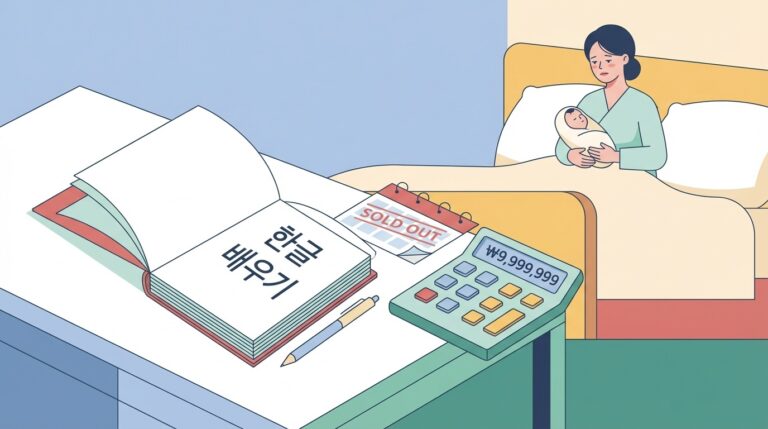
Phase 1: The ‘Sanhujoriwon’ Reality Check – Paradise or Pressure?
Hello there! It’s your Daily Hangul Senior Editor. 👋
Picture this K-Drama scene: The protagonist has just given birth. She isn’t at home. She’s in a room that looks like a 5-star hotel suite. There’s an aesthetic massage chair, a gourmet meal tray with endless Seaweed Soup (Miyeok-guk), and nurses bowing politely. But cut to the husband in the hallway—he’s looking at the bill, and his soul is leaving his body. 💸👻
Welcome to the world of Sanhujoriwon (산후조리원)—Postpartum Care Centers. In Korea, this isn’t just a luxury; for many, it’s considered an absolute necessity. But with popularity comes the infamous ‘Reservation War’ (예약 전쟁) and prices that make your wallet cry.
Today, we aren’t just learning vocabulary. We are diving into the intense socio-economic debate of modern Korean parenting. Ready to discuss the “won” (circle) of life and debt? Let’s go.
Phase 2: Deep Dive Expressions (C2 Level)
1. 조리원 천국 (Joriwon Cheonguk)
- Pronunciation: [Jo-ri-won Cheon-guk] (Sounds like ‘Jolly-won’ + ‘Chun’ (like Chun-Li) + ‘Gook’)
- Meaning: Literal: Postpartum Center Heaven / Real Nuance: “Enjoy it while it lasts because reality hits when you leave.”
- K-Culture Moment: In the drama Birthcare Center, mothers constantly tell the newbie, “This is paradise. The moment you step out, it’s hell.” It refers to the 2 weeks where nurses handle the baby 24/7 so the mom can sleep.
- Editor’s Insight: This phrase is bittersweet. It acknowledges that parenting outside the center is overwhelmingly difficult. It’s a phrase of solidarity among exhausted parents.
- Situation Spectrum:
[🚫 Formal Reports] ———— [✅ Casual/Semi-Formal]- 🤔 Think About It: Why is the separation from the baby (nursery care) considered “heaven” in Korean culture, whereas some Western cultures emphasize immediate 24/7 bonding? What does this say about the physical toll of recovery?
2. 등골이 휘다 (Deung-gori hwida)
- Pronunciation: [Deung-go-ri hwi-da]
- Meaning: Literal: One’s spine bends / Real Nuance: “To break one’s back working to pay for something expensive.”
- K-Culture Moment: Often heard in family dramas when a father looks at tuition fees or, in this case, the $4,000+ bill for 2 weeks at a Joriwon.
- Editor’s Insight: This is a high-level idiom. Use this instead of just “too expensive” (너무 비싸요) to sound like a native with C2 proficiency. It conveys the physical weight of financial responsibility.
- Situation Spectrum:
[✅ All Situations](Very common idiom)- 🤔 Think About It: Korea has the “Spine Breaker” (등골 브레이커) concept, originally for expensive padded jackets. How does the social pressure to book a “premium” center contribute to this spinal stress?
3. 스강신청 (Seu-gang-sin-cheong)
- Pronunciation: [Seu-gang-sin-cheong]
- Meaning: A portmanteau of Studio/Snap (photos) + Sugang-sincheong (University Course Registration). It means booking something is as fierce as signing up for college classes.
- K-Culture Moment: The moment the clock strikes 9:00 AM, thousands of pregnant women (and their husbands) are refreshing their browsers to book a popular Joriwon. If you blink, it’s full.
- Editor’s Insight: We use this to describe the ‘Reservation War’. It highlights the hyper-competitive nature of Korean society, starting even before birth.
- Situation Spectrum:
[🚫 Formal Business] ———— [✅ Casual/Internet Slang]
Phase 3: Textbook vs. Real Life
| Situation | 📖 Textbook Korean | 🗣️ Real Korean (C2/Native) | 💡 Why the difference? |
|---|---|---|---|
| Complaining about price | 가격이 너무 비싸서 부담스러워요. (The price is too high, so it’s burdensome.) | 거기 가격이 완전 깡패더라. (The price there is a total gangster.) | “Gangster” implies the price is robbing you, but you have no choice but to pay. |
| Trying to book | 예약을 서둘러야 해요. (You must hurry to reserve.) | 거기 광클 안 하면 못 들어가. (If you don’t ‘crazy-click’, you can’t get in.) | Shows the urgency of digital competition (Gwang-click). |
| Asking for advice | 어느 조리원이 좋은지 추천해 주세요. (Please recommend a good center.) | 조리원 투어 어디로 다녀오셨어요? (Where did you go for your Joriwon tour?) | Using “Tour” implies the ritual of visiting multiple centers like wedding venues. |
Bottom Note: “광클 (Gwang-click)” is widely understood slang, but in a formal setting, stick to “경쟁이 치열하다” (competition is fierce).
Phase 4: Cultural Context — K-Culture Deep Dive
4-1. The ‘Joriwon Donggi’ Phenomenon (조리원 동기)
In the military, you have comrades. In parenting, you have ‘Joriwon Donggi’ (Postpartum Center Peers). Mothers who stay at the center during the same 2 weeks often form a lifelong bond. They share the same baby age, the same sleepless nights, and often, the same socio-economic status (since they afforded the same center).
- Implicit Rule: If you don’t go to a Joriwon, you miss out on this crucial first social network for your child. It’s not just about health; it’s about networking.
4-2. The ‘Miyeok-guk’ Marathon 🥣
If you watch any K-Drama involving birth, you see Seaweed Soup (Miyeok-guk). In a Joriwon, you will eat this for breakfast, lunch, and dinner. It’s rich in iodine and calcium for recovery.
- K-Food Insight: Complaining about “too much seaweed soup” is the universal ice-breaker conversation among moms at the center.
Phase 5: Immersive Roleplay Scenario
Setting: A trendy brunch cafe in Hannam-dong. You are talking to Jiwon, a Korean friend who is 5 months pregnant and stressed.
Characters:
* YOU: An expat living in Korea for 5 years, C2 level speaker.
* Jiwon: 30s, working professional, worried about the ‘Reservation War’.
Dialogue:
Jiwon: 휴, 나 어제 ‘세인트 조리원’ 예약 실패했어. 대기 10번이래. 진짜 멘붕이다.
(Hyu, na eoje ‘Saint Joriwon’ yeyak silpae-haesseo. Daegi sip-beon-irae. Jinjja menbung-ida.)
(Sigh, I failed to book ‘Saint Joriwon’ yesterday. I’m number 10 on the waitlist. I’m having a mental breakdown.)
YOU: 저런… 거기가 그렇게 인기가 많아? 하긴, 시설 보니까 호텔급이긴 하더라.
(Jeoreon… geogiga geureoke ingiga mana? Hagin, siseol bonikka hotel-geubigin hadeora.)
(Oh no… is it that popular? Well, I saw the facilities, and it really is hotel-grade.)
Jiwon: 맞아. 근데 2주에 500만 원이라니… 솔직히 등골 휘는 거지. 그래도 다들 가니까 안 가면 불안하고.
(Maja. Geunde i-ju-e obaek-man won-irani… soljiki deunggol hwineun geoji. Geuraedo dadeul ganikka an gamyeon buranhago.)
(Right. But 5 million won for 2 weeks… honestly, it’s back-breaking. Still, everyone goes, so I feel anxious if I don’t.)
🔀 Decision Point: How do you respond?
- Option A: “에이, 그래도 남들 다 하는데 무리해서라도 가야지. 평생 한 번인데.” (Encourage spending for the experience.)
- Option B: “굳이 그렇게 비싼 데 갈 필요가 있을까? 가성비 좋은 곳도 많잖아.” (Suggest a pragmatic alternative.)
💡 Editor’s Analysis:
* Option A: Validates her anxiety. In Korean ‘Face’ culture (Chemyon), sometimes reassurance is what they need.
* Option B: Practical, but tread carefully. Suggesting “cheap” options for a birth event can sometimes be perceived as undervaluing her suffering. Use the word ‘실속 있는’ (substantial/practical) instead of ‘싼’ (cheap).
Phase 6: 10-Second Shadowing Drill
Let’s practice the tone of resignation mixed with determination.
😥 (Sighing) 가격 보고 놀랐는데 / 그래도 어쩌겠어요. / 예약 전쟁에 참전해야죠.
(Gagyeok bogo nollanneunde / geuraedo eojjeogesseoyo. / Yeyak jeonjaeng-e chamjeonhaeyajo.)Meaning: I was shocked by the price, but what can I do? I have to participate in the reservation war.
Phase 7: K-Culture Mini Glossary
| Korean | Romanization | English Context |
|---|---|---|
| 모동시간 | Modong Sigan | Mother-Baby Time. The specific time block (usually evenings) when the baby comes to the mom’s room so the nursery can be cleaned. |
| 수유콜 | Suyu Call | Breastfeeding Call. When the nurse calls your room saying, “The baby is hungry!” (The dread of the phone ringing!) |
| 마사지 추가 | Massage Chuga | Add-on Massage. The hidden cost. The base fee is high, but the ‘recovery massages’ can add another $1,000. |
| 남편 출입 | Nampyeon Churip | Husband Access. Rules on whether dads can stay overnight or visit, often strict due to infection control. |
Phase 8: Expat Survival Kit (Living in Korea)
If you are an expat having a baby in Korea, know this:
🆘 Survival Tip #1: Government Vouchers
Korea offers ‘First Meeting Voucher’ (첫만남이용권) and various happiness cards that give you roughly 2 million won (varies by year) to spend on medical bills or… yes, Joriwon fees! Ask your local community center (Dong-seams-so).📌 Editor’s Note:
Most Joriwons require booking as soon as you see two lines on the pregnancy test (6-8 weeks). Do not wait until your belly shows!
Phase 9: Think Deeper — “Language & Society”
Topic: The Cost of ‘Jeong’ (Affection) or Peer Pressure?
The word ‘산후조리’ (Postpartum Care) implies restoring the body to its original state. But modern usage has shifted from ‘health’ to ‘status’. When Koreans ask, “Which Joriwon are you going to?”, it’s often a coded way of asking about your budget and lifestyle standard. The term ‘등골이 휘다’ perfectly captures this irony: parents break their backs financially to heal their backs physically. Is this collective culture supportive, or does it amplify the anxiety of new parents?
💬 Your Turn: In your country, is postpartum care a medical necessity or a family responsibility? Share in the comments!
Phase 10: FAQ & Troubleshooting
Q: Can I negotiate the price at a Joriwon?
* Answer: Generally, No. It’s a fixed price system like a hotel. However, if you pay in cash (Hyungum-youngsujeung), they might throw in an extra massage or extend the facial service. But don’t expect a discount on the room rate.
Q: I’m a foreigner. Will they speak English?
* Answer: In premium centers in Gangnam or Yongsan? Yes. In local neighborhood centers? Unlikely. You will need to learn terms like ‘오로’ (lochia) and ‘유축기’ (breast pump).
Phase 11: Wrap-up & Mission
One-Liner: Postpartum care in Korea is a mix of medical necessity, luxury vacation, and extreme peer pressure.
🚀 Action Mission:
* 🥉 Bronze: Say “등골이 휘어요” (It’s back-breakingly expensive) next time you see a high price tag.
* 🥈 Silver: Search “산후조리원 비용” (Postpartum center cost) on Naver to see the real prices in Seoul.
* 🥇 Gold: Ask a Korean friend, “Did you have a ‘Joriwon Donggi’?” and listen to their story.
Phase 12: Interactive Quiz
Q1. Situational Judgment:
Your friend says, “Here comes the Suyu Call (수유콜).” How should she look?
1. Excited to eat dinner.
2. Exhausted and dreading the phone.
3. Happy to call her husband.
Answer: 2. ‘Suyu Call’ means the nurse is calling her to breastfeed again, interrupting her rest.
Q2. True or False:
“Joriwon Donggi (Peers)” are usually people you went to high school with.
Answer: False. They are strangers you met at the center, but you become close like sisters due to shared trauma/experience.
See you in the next lesson! Stay healthy! 🍼
Frequently Asked Questions (FAQ)
Q: What does "조리원 천국 (Joriwon Cheonguk)" mean in Korean and how do you pronounce it?
A: In Korean, "조리원 천국 (Joriwon Cheonguk)" is pronounced [Jo-ri-won Cheon-guk] and means: Literal: Postpartum Center Heaven / Real Nuance: “Enjoy it while it lasts because reality hits when you leave.”
Q: What does "등골이 휘다 (Deung-gori hwida)" mean in Korean and how do you pronounce it?
A: In Korean, "등골이 휘다 (Deung-gori hwida)" is pronounced [Deung-go-ri hwi-da] and means: Literal: One's spine bends / Real Nuance: “To break one’s back working to pay for something expensive.”
Q: What does "스강신청 (Seu-gang-sin-cheong)" mean in Korean and how do you pronounce it?
A: In Korean, "스강신청 (Seu-gang-sin-cheong)" is pronounced [Seu-gang-sin-cheong] and means: A portmanteau of Studio/Snap (photos) + Sugang-sincheong (University Course Registration). It means booking something is as fierce as signing up for college classes.







