

Phase 1: The Immersive Hook
Annyeonghaseyo! This is your Daily Hangul Editor. 👋
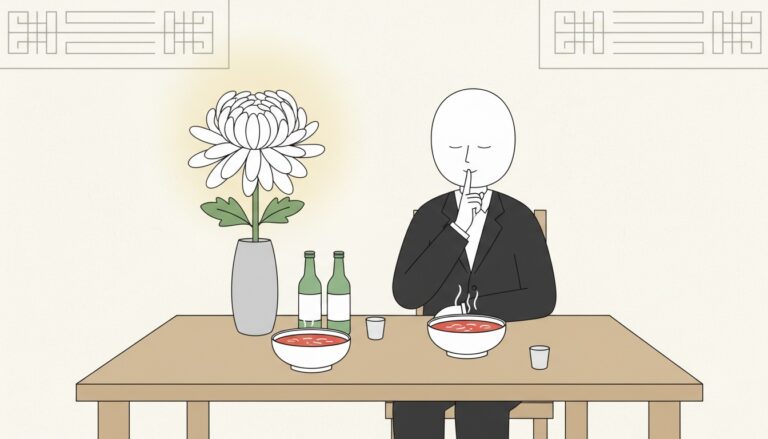
Imagine this: You are watching a K-Drama like My Mister or Reply 1988. The characters are in a large room at a hospital, wearing black suits with armbands. There are bottles of Soju and bowls of spicy red soup (Yukgaejang) on the tables. It looks like a restaurant, but the air is heavy. Suddenly, someone laughs too loudly, and everyone shoots them a glare. The room goes silent.
That chilling silence? That’s “Nunchi” (reading the room) in action at a Korean funeral home (Jangryesikjang).
In Korea, funerals are communal events where people eat and drink to comfort the family, but there is an invisible volume knob you must respect. Today, we aren’t just learning how to say “be quiet.” We are learning how to respect the sadness of others without being awkward. If you master this, you won’t just be a foreigner; you’ll be a considerate guest.
Phase 2: Deep Dive into Core Expressions
Here are the three most important phrases to control the volume and apologize if you slip up.
1. 조용히 해 주세요
- Pronunciation: [Joyonghi hae juseyo] (Sounds like: Jo-young-he heh ju-se-yo)
- Meaning: Please be quiet.
- K-Culture Moment: You’ll hear this in K-Dramas when a student is studying or when someone is on a serious phone call. At a funeral, you might whisper this to a friend who is getting too excited about the food.
- Editor’s Insight: This is a standard polite request. It’s direct but polite enough for strangers.
- Situation Spectrum:
[🚫 Boss/Elders] ———— [✅ Strangers/Coworkers] ———— [✅ Friends]- 🤔 Think About It: Why does Korean have a specific verb for “to do quietly” (joyonghi hada) instead of just “don’t talk”?
2. 목소리 좀 낮춰 주세요
- Pronunciation: [Moksori jom natchwo juseyo] (Sounds like: Mok-so-ri jom nat-chwo ju-se-yo)
- Meaning: Please lower your voice a little.
- K-Culture Moment: Think of a K-Pop idol doing a V-Live in their dorm at 2 AM, whispering to the camera so they don’t wake up the members. That’s the vibe.
- Editor’s Insight: This is much softer than “Be quiet.” It acknowledges that talking is okay, but the volume is the problem. It is very sophisticated.
- Situation Spectrum:
[⚠️ Elders (Use with caution)] ———— [✅ Coworkers] ———— [✅ Friends]3. 죄송합니다 / 실례했습니다
- Pronunciation: [Joesong-hamnida] / [Sillye-haet-seumnida]
- Meaning: I am sorry / I was rude (Excuse me).
- K-Culture Moment: If you accidentally drop your metal chopsticks on the floor (Clang!), you immediately bow your head and say this.
- Editor’s Insight: Sillye-haet-seumnida is past tense. It means “I have committed a rudeness just now.” Perfect for immediate apologies.
- Situation Spectrum:
[✅ Boss/Elders] ———— [✅ Strangers] ———— [✅ Friends]
Phase 3: Textbook vs. Real Life
| Situation | 📖 Textbook Korean | 🗣️ Real Korean | 💡 Why the difference? |
|---|---|---|---|
| Telling a friend to hush | 조용히 하세요 (Please be quiet) | 쉿! / 야, 작게 말해 (Shh! / Hey, speak small) | “Please” feels too distant for close friends. |
| Apologizing for noise | 시끄럽게 해서 죄송합니다 (Sorry for making it noisy) | 아, 죄송해요 (Ah, sorry) | In real life, speed matters. Short & sincere is better. |
| Asking if it’s okay to talk | 여기서 이야기해도 됩니까? (May we speak here?) | 나가서 얘기할까요? (Shall we go out and talk?) | Koreans prefer to remove the noise source rather than ask permission. |
Bottom Note: In a funeral home, body language speaks louder than words. A small bow is often enough.
Phase 4: Cultural Deep Dive
4-1. Non-verbal: The “Bow” of Silence
If your phone rings or you make a loud noise, don’t just stare. Bow your head slightly. This physical gesture says, “I am humble and I know I made a mistake.” Eye contact should be avoided in that awkward moment.
4-2. K-Drama Connection: The “Yukgaejang” Scene
In almost every Korean drama involving a death, you see people eating spicy red beef soup (Yukgaejang). Why?
– The Red Color: Believed to chase away bad spirits.
– The Noise: Actually, Korean funerals aren’t silent libraries. You will hear talking, drinking, and even card games (Hwatu). This noise is meant to keep the chief mourner (Sangju) awake and company. However, the noise must be “mournful camaraderie,” not “party laughter.” Knowing the difference is key.
Phase 5: Immersive Roleplay
Setting: Friday night. A hospital funeral hall in Seoul. The air smells of incense and spicy soup. You are sitting with your Korean colleague, Min-su.
Characters:
– YOU: A foreign colleague visiting a Korean funeral for the first time.
– Min-su: (30s, Korean coworker) Helpful but conscious of etiquette.
Dialogue:
Min-su: (Whispering) 와 주셔서 감사해요. 분위기가 좀 무겁죠?
(Wa jusyeoseo gamsahaeyo. Bunwigiga jom mugeopjyo?)
Translation: Thanks for coming. The atmosphere is a bit heavy, right?
YOU: 네, 조금요. 그런데… (You see a celebrity enter the room and get excited) Look! Is that BTS? (You say this too loudly in English).
(🎭 Stage Direction: Several people at the next table turn to look at you with frowned faces.)
Min-su: (Putting a finger to his lips) 쉿! 목소리 좀 낮춰 주세요. 여기 장례식장이에요.
(Shh! Moksori jom natchwo juseyo. Yeogi jangryesikjang-ieyo.)
Translation: Shh! Please lower your voice. This is a funeral home.
🔀 Your Turn! How do you react?
- A) “Why? I’m just asking.” (Defensive)
- B) “아, 죄송합니다.” (Ah, Joesong-hamnida – Bowing head)
- C) “Oh my god, sorry!” (Loud whisper)
✅ Best Choice: B — Immediate apology in Korean shows you respect the local custom. It diffuses the tension instantly.
⚠️ Choice C Analysis: Even a loud whisper can be distracting. Switching to Korean helps show cultural effort.
Phase 6: 10-Second Shadowing Drill
Let’s practice the “Polite Whisper.” Imagine you are in a library or a quiet café.
Emotion: 🤫 Soft, apologetic, and cautious.
죄송하지만 / 목소리 좀 / 낮춰 / 주시겠어요?
(Joesong-hajiman / moksori jom / natchwo / jusigesseoyo?)
Translation: I am sorry, but could you please lower your voice?
Phase 7: K-Culture Mini Glossary
| Korean | Romanization | Meaning | Context |
|---|---|---|---|
| 장례식장 | Jangryesikjang | Funeral Home | Usually located in hospitals in Korea. |
| 조의금 | Joui-geum | Condolence Money | Money given in a white envelope. Usually 30,000, 50,000, or 100,000 won. |
| 상주 | Sangju | Chief Mourner | The person (usually the eldest son) wearing the armband who greets guests. |
| 분위기 | Bunwigi | Atmosphere/Vibe | Used often like “Read the room” (Bunwigi pa-ak). |
Phase 8: Traveler’s Survival Kit
While this lesson is about funerals, “being quiet” is crucial in many Korean travel spots.
🆘 Survival Phrases for Silence
– 🇰🇷 “조용히 해 주세요” (Joyonghi hae juseyo)
– Meaning: Please be quiet.
– 📍 Where to use: Movie theaters, dormitories, study cafes.
– 🇰🇷 “여기서 통화해도 돼요?” (Yeogiseo tonghwahaedo dwaeyo?)
– Meaning: Can I talk on the phone here?
– 💡 Pro Tip: In Korean subways and buses, talking loudly on the phone is considered very rude. If you must answer, whisper “I’ll call you back” and hang up.
Phase 9: Think Deeper — “One Step Further”
Topic: The Sound of Mourning (Sound vs. Silence)
In many Western cultures, funerals are expected to be somber and silent. However, in traditional Korean culture, a completely silent funeral was considered lonely for the deceased. Historically, professional mourners were even hired to cry loudly (Aigo! Aigo!) to show how much the person was loved. Today, modern hospital funerals are quieter, but the drinking and eating area remains a space for noise—a human noise that says, “Life goes on, and you are not alone.”
💬 Your Turn: In your culture, is a funeral a silent event or a noisy celebration of life? Let us know in the comments!
Phase 10: FAQ & Troubleshooting
Q: Can I wear navy or dark grey to a Korean funeral?
A: Yes. Black is best, but dark navy or dark grey is acceptable. Avoid bright colors, patterns, or heavy makeup.
Q: Do I have to cry?
A: No. You don’t need to fake emotion. A solemn face and a respectful bow are enough.
Q: Can I refuse the food?
A: It is polite to eat a little bit if offered, as sharing the meal is part of the mourning process. But if you really can’t, just accept a cup of water or drink.
❌ Common Mistake: Clinking glasses when drinking alcohol.
✅ Correction: At a funeral, we never clink glasses for a “Cheers” (Geonbae). We just raise the cup slightly and drink quietly.
Phase 11: Wrap-up & Action Items
One-Liner: When in doubt, lower your volume and follow the “Nunchi” of the room.
🎯 Mission:
– 🥉 Bronze: Look in the mirror and practice the “Shh” gesture with the phrase “Moksori jom natchwo juseyo.”
– 🥈 Silver: Watch a scene from the K-Drama My Mister (Episode 1 or the funeral scenes) and observe how they speak.
– 🥇 Gold: Next time you are in a quiet public space (like a library), try to be the quietest person there!
Phase 12: Interactive Quiz
- Situation: You are at a funeral and your friend is laughing loudly at a video on their phone. What do you say?
- A) 야! 닥쳐! (Hey! Shut up! – Too rude)
- B) 목소리 좀 낮춰 주세요. (Please lower your voice.)
- C) 같이 보자! (Let’s watch together!)
- True or False: At a Korean funeral, you should clink glasses to cheer up the family.
- (True / False)
Answers:
1. B (Polite but firm is key.)
2. False (Never toast or clink glasses at a funeral. It’s a solemn drink.)
Frequently Asked Questions (FAQ)
Q: What does "조용히 해 주세요" mean in Korean and how do you pronounce it?
A: In Korean, "조용히 해 주세요" is pronounced [Joyonghi hae juseyo] and means: Please be quiet.
Q: What does "목소리 좀 낮춰 주세요" mean in Korean and how do you pronounce it?
A: In Korean, "목소리 좀 낮춰 주세요" is pronounced [Moksori jom natchwo juseyo] and means: Please lower your voice a little.
Q: What does "죄송합니다 / 실례했습니다" mean in Korean and how do you pronounce it?
A: In Korean, "죄송합니다 / 실례했습니다" is pronounced [Joesong-hamnida] and means: I am sorry / I was rude (Excuse me).






