

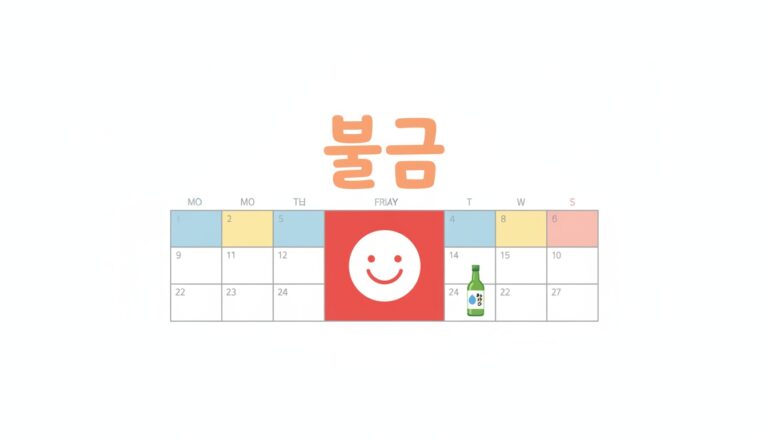
Phase 1: “Is it Friday yet?” — The Magic of 6 PM
Annyeonghaseyo! This is your Daily Hangul Editor. 👋
Picture this: You are watching a K-Drama set in a busy office in Seoul. The clock ticks to 6:00 PM on a Friday. Suddenly, the chaotic typing stops. The tense atmosphere melts away. People start grabbing their bags with a specific glint in their eyes.
One character stands up, bows slightly to the team, and says a magic phrase that signals freedom. It’s not just “Goodbye.” It carries the weight of surviving a hard week and the promise of delicious pork belly (Samgyeopsal) and Soju ahead.
If you just say “Bye” (Annyeong-hi gyeseyo), it feels incomplete. You need to acknowledge the weekend.
Today, we’re learning the phrases that turn you from a generic foreigner into an insider who knows the joy of a Korean Friday. Let’s get that weekend started!
Phase 2: Deep Dive — The Core Expressions
Here are the top 3 ways to wish someone a great weekend, ranked by usability.
1. 주말 잘 보내세요 (Jumal jal bonaeseyo)
- Pronunciation: [Ju-mal jal bo-nae-se-yo]
Tip: ‘Ju’ sounds like ‘Jewel’, ‘Mal’ sounds like ‘Mull’ over.- Meaning: Literal: Spend the weekend well. / Real: Have a great weekend!
- K-Culture Moment: Used everywhere from the end of a news broadcast to the final words a barista says to you on a Friday afternoon.
- Editor’s Insight: This is your “All-Pass Ticket.” It is polite, kind, and safe for almost everyone.
- Situation Spectrum:
[🚫 Forbidden] ———— [⚠️ Careful] ———— [✅ Go Ahead]
(Casual ✅) — (Colleague ✅) — (Boss/Elder ✅)- 🤔 Think About It: Why do we say “spend it well” instead of just “have a good one”? It implies time is a resource you need to manage wisely for rest.
2. 불금 보내세요! (Bulgeum bonaeseyo!)
- Pronunciation: [Bul-geum bo-nae-se-yo]
Tip: ‘Bul’ sounds like ‘Bull’. ‘Geum’ rhymes with ‘Gum’.- Meaning: Literal: Spend a Fire Friday! / Real: Have a burning/exciting Friday night!
- K-Culture Moment: You’ll see this in K-Pop idols’ Instagram stories or hashtags on Friday nights. It refers to burning up your energy partying or eating delicious food.
- Editor’s Insight: Use this to sound trendy and energetic. Great for friends or close coworkers. Avoid using this with your strict boss.
- Situation Spectrum:
[🚫 Forbidden] ———— [⚠️ Careful] ———— [✅ Go Ahead]
(Casual ✅) — (Colleague ✅) — (Strict Boss 🚫)3. 푹 쉬세요 (Puk swiseyo)
- Pronunciation: [Pook swi-se-yo]
Tip: ‘Puk’ sounds like the ‘Pook’ in ‘Pooky’, but shorter. It implies ‘deeply’ or ‘thoroughly’.- Meaning: Literal: Rest deeply/thoroughly. / Real: Get some good rest.
- K-Culture Moment: In medical dramas or after a long project, characters say this with a sigh of relief.
- Editor’s Insight: This is a very caring phrase. It acknowledges that the other person has worked hard. It hits the Korean sentiment of Jeong (affection/bond).
- Situation Spectrum:
[🚫 Forbidden] ———— [⚠️ Careful] ———— [✅ Go Ahead]
(Casual ✅) — (Colleague ✅) — (Boss/Elder ✅)
Phase 3: Textbook vs. Real Life
| Situation | 📖 Textbook Korean | 🗣️ Real Street Korean | 💡 Why the difference? |
|---|---|---|---|
| Leaving Office | 안녕히 계세요 (Goodbye/Stay well) | 주말 잘 보내세요~ (Have a good weekend~) | “Goodbye” feels too final/cold; wishing a good weekend shows connection. |
| Texting Friends | 주말 즐걱게 보내 (Have a fun weekend) | 불금! 🔥 (Fire Friday!) or 좐주 (Jeol-ju – Happy Weekend) | Koreans love abbreviating phrases to type faster and sound cuter. |
| To a tired friend | 휴식을 취하세요 (Take a rest) | 주말에 시체가 될 거야… (I’m going to become a corpse this weekend…) | Real life is tiring! We often exaggerate our need for sleep. |
Bottom Note: For A1 beginners, stick to 주말 잘 보내세요. It works 100% of the time.
Phase 4: Cultural Context — The Meaning of Weekend
4-1. Non-verbal: The “Leaving Bow”
When you say “Jumal jal bonaeseyo,” don’t just say it while walking out the door.
* Eye Contact: Brief soft eye contact.
* Action: A slight bow of the head (about 15 degrees).
* Vibe: Smile! You are happy about the weekend, but also happy that they get a break too.
4-2. K-Culture Connection: K-Drama & Office Life
- The “Hoesik” (Company Dinner) Effect: In older dramas, Fridays were for Hoesik. But lately, the trend is changing to Thursdays so people can enjoy their actual weekend. If you hear this phrase on a Thursday, it means “Work is done, let’s survive tomorrow, and then freedom!”
- The “Han River” Scene: In romantic dramas, couples often meet on Friday nights at the Han River park for “Chimaek” (Chicken & Beer). That feeling of cool river breeze? That is the essence of Bulgeum (Fire Friday).
Phase 5: Immersive Roleplay — Leaving the Office
Setting: It’s 6:05 PM on a Friday. You are at your desk in a sleek office in Gangnam. People are packing up. The vibe is electric.
Characters:
* YOU: An expat intern, excited to explore Seoul this weekend.
* Manager Kim: Your direct supervisor. Kind but looks very tired.
The Dialogue:
Manager Kim: (💼 Putting on his coat) 아, 이제 퇴근합시다! 고생했어요.
(Ah, ije toegun-hapsida! Gosaeng-haesseoyo.)
(Ah, let’s get off work now! You suffered/worked hard.)
YOU: 네, 고생했습니다, 매니저님!
(Ne, gosaeng-haesseumnida, Manager-nim!)
(Yes, you worked hard too, Manager!)
Manager Kim: (😊 Smiling wearily) 저는 집에 가서 잠만 잘 거예요.
(Jeoneun jibe gaseo jamman jal geoyeyo.)
(I’m just going to go home and sleep.)
🔀 Decision Point: How do you say goodbye?
- A) “안녕히 계세요!” (Goodbye / Stay well)
- B) “매니저님, 주말 푹~ 쉬세요!” (Manager, please rest deeply/well!)
- C) “불금 보내세요!” (Have a Fire Friday!)
✅ Best Choice: B
Manager Kim said he is tired and wants to sleep. Telling him to “Rest deeply” (푹 쉬세요) shows you have Nunchi (you read the room). It’s very considerate.⚠️ Choice C Analysis: Wishing a tired boss a “Fire Friday” (partying) might make him feel old or disconnected. Save that for your friends!
Phase 6: 10-Second Shadowing Drill
Let’s practice the rhythm. Korean is not a robot language; it has waves!
- The Standard Polite 😊
주말 / 잘 / 보내세요~
(Ju-mal / jal / bo-nae-se-yo~)
Note: Stretch the last ‘yo’ slightly to sound friendly. -
The Caring Vibe 🥺
집에 가서 / 푹~ / 쉬세요.
(Jibe gaseo / pook~ / swi-se-yo.)
Note: Emphasize ‘pook’ (deeply). -
The Energetic Vibe 🔥
오늘은 / 불금!
(Oneul-eun / Bul-geum!)
Note: Short and punchy! Today is Fire Friday!
Phase 7: K-Culture Mini Glossary
| Korean | Romanization | Meaning | Context |
|---|---|---|---|
| 불금 | Bulgeum | Fire Friday | Short for 불타는 금요일 (Burning Friday). Equivalent to TGIF but more intense. |
| 눈치 | Nunchi | Eye-measure | The art of sensing the mood. Essential when deciding which greeting to use. |
| 퇴근 | Toegun | Getting off work | The most beautiful word in the Korean language for office workers. |
| 치맥 | Chimaek | Chicken + Beer | The official food of a Korean Friday night. |
Phase 8: Traveler’s Survival Kit
You are traveling in Korea. It is Friday. You just bought snacks at a convenience store or got out of a taxi.
🆘 Survival Phrase #1
– 🇰🇷 “수고하세요!” (Sugohaseyoo!)
– 🗣️ Sounds like: Sue-go-ha-say-yo
– 📍 Where: Taxi, Convenience Store, Restaurant.
– 💡 Pro Tip: This literally means “Keep working hard,” but it is the standard “Goodbye/Thank you” to service workers. On a Friday, you can add “주말 잘 보내세요!” to be extra sweet. The taxi driver will love you.📌 Editor’s Travel Note
* Friday Taxi War: Catching a taxi in Gangnam or Hongdae on a Friday night (11 PM – 1 AM) is a battlefield. Use Kakao T or Uber. Do not rely on waving your hand on the street; you might wait for an hour!
Phase 9: Think Deeper — “Why are we so obsessed with rest?”
Topic: The Culture of ‘Rest’ (Hwyu-sik)
Did you notice that one of the most common greetings is “Rest deeply” (푹 쉬세요)? In many Western cultures, we say “Have fun” or “Enjoy.” But in Korea, the emphasis is often on recovery.
This reflects the high-intensity nature of Korean society, from the competitive education system to the busy work culture. When a Korean tells you to “rest well,” they are acknowledging your hard work and validating your need to recharge. It’s a form of empathy.
🧠 Think About It: In your culture, do you prioritize “fun” or “rest” when greeting someone for the weekend? What does that say about your society’s lifestyle?
Phase 10: FAQ & Troubleshooting
- Q: Can I say “Have a good weekend” on a Monday?
- A: No! It sounds sarcastic. Only use it from Friday afternoon until Sunday morning.
- Q: Can I use “Bulgeum” (Fire Friday) to my elderly neighbor?
- A: Better not. They might understand it, but it sounds a bit too slangy. Stick to “Jumal jal bonaeseyo.”
- Q: I saw “Have a honey weekend” (꿀주말) on Instagram. Can I use that?
- A: Yes! “꿀” (Honey) is slang for something sweet or great. “꿀주말” is a very cute way to say “Sweet Weekend.”
❌ Common Mistake Alert
Don’t say “주말을 가준세요” (Have a weekend – literal translation of ‘have’). Korean uses the verb 보내다 (to send/spend) time.
Phase 11: Wrap-up & Mission
One-Liner: To say “Have a good weekend,” just remember: Ju-mal Jal Bo-nae-se-yo!
🎯 Action Missions:
* 🥉 Bronze: Look in the mirror and practice the “Leaving Bow” while saying the phrase.
* 🥈 Silver: Comment on your favorite K-Pop idol’s Friday post with “불금 보내세요! 🔥”
* 🥇 Gold: Go to a Korean restaurant this Friday. When you pay the bill and leave, say “주말 잘 보내세요!” to the staff. Watch their reaction!
Phase 12: Quiz — Are You Ready for the Weekend?
- Situation: You are leaving a convenience store on a Friday night. The part-timer looks exhausted. What is the kindest thing to say?
- a) 불금! (Fire Friday!)
- b) 수고하세요, 주말 잘 보내세요. (Thank you for your work, have a good weekend.)
- c) 안녕. (Bye – Informal)
- True or False: You should say “Jumal jal bonaeseyo” to your boss on a Monday morning.
- (True / False)
- Culture Check: What food is associated with “Bulgeum” (Fire Friday)?
- a) Kimchi Stew
- b) Chimaek (Chicken + Beer)
- c) Rice Porridge
🔑 Answers:
1. (b) acknowledging their hard work is best. (a) is insensitive if they are working while others party.
2. False. On Monday, say “Have a good week” (좋은 한 주 되세요).
3. (b) Fried Chicken and Beer is the soul food of Friday.
Frequently Asked Questions (FAQ)
Q: What does "주말 잘 보내세요 (Jumal jal bonaeseyo)" mean in Korean and how do you pronounce it?
A: In Korean, "주말 잘 보내세요 (Jumal jal bonaeseyo)" is pronounced [Ju-mal jal bo-nae-se-yo] and means: Literal: Spend the weekend well. / Real: Have a great weekend!
Q: What does "불금 보내세요! (Bulgeum bonaeseyo!)" mean in Korean and how do you pronounce it?
A: In Korean, "불금 보내세요! (Bulgeum bonaeseyo!)" is pronounced [Bul-geum bo-nae-se-yo] and means: Literal: Spend a Fire Friday! / Real: Have a burning/exciting Friday night!
Q: What does "푹 쉬세요 (Puk swiseyo)" mean in Korean and how do you pronounce it?
A: In Korean, "푹 쉬세요 (Puk swiseyo)" is pronounced [Pook swi-se-yo] and means: Literal: Rest deeply/thoroughly. / Real: Get some good rest.







