

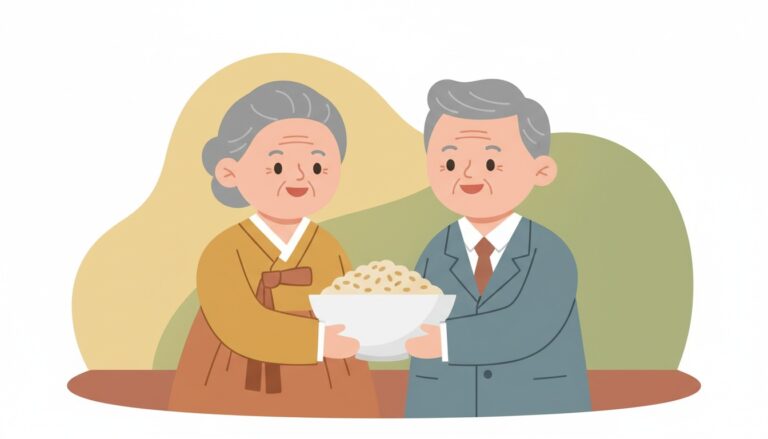
Phase 1: The ‘K-Drama’ Grandparents We All Know
Hello! It’s your editor from Daily Hangul.
Picture this: You’re watching a K-Drama. There are usually two types of grandparents.
Type A: The scary Chairman in a suit, sitting in a massive office, shouting, “Get out!”
Type B: The warm, countryside grandma wearing floral pants, piling a mountain of rice into the main character’s bowl, saying, “Eat more, you’re skin and bones!”
Whether they are scary or sweet, grandparents (Jofu-mo-nim) are the center of the Korean family structure. Today, we aren’t just learning vocabulary; we are learning how to survive a Korean family gathering (or just understand your favorite drama better).
Let’s get the titles right so you don’t accidentally call the scary Chairman “Dude.”
Phase 2: Core Expressions Deep Dive
Here are the two words you absolutely must know.
1. 할아버지 (Hal-a-beo-ji)
- Pronunciation: [Hal-lah-buh-jee]
- Hal sounds like the start of Halloween.
- beo sounds like buh (like butter).
- ji sounds like jeep.
- Meaning: Grandfather
- K-Culture Moment: Think of the wise old player 001 in Squid Game (Oh Il-nam). Everyone calls him Halabeoji with a mix of pity and respect.
- Editor’s Insight: If you say it fast, it often sounds like Harabeoji. The ‘L’ gets soft.
- Situation Spectrum:
[🚫 Casual/Friends] ———— [✅ Family/Elders]
- You use this directly to your grandfather or to refer to an elderly man on the street (politely).
🤔 Think About It: In English, we say “Grandpa” (casual) and “Grandfather” (formal). Korean Halabeoji covers both, but the tone changes everything. Why doesn’t Korean have a “casual” word for grandpa?
2. 할머니 (Hal-meo-ni)
- Pronunciation: [Hal-muh-nee]
- meo sounds like mud.
- Meaning: Grandmother
- K-Culture Moment: Youn Yuh-jung in the movie Minari. She wasn’t a typical cookie-baking grandma; she was cool, swore a little, and watched wrestling. That’s a real Halmeoni vibe.
- Editor’s Insight: In local restaurants (gukbap places), you might hear people calling the owner Halmeoni. It implies, “You feed me like family.” But be careful—use it only if the vibe is very rustic and friendly!
- Situation Spectrum:
[🚫 Young Women] ———— [✅ 70+ Ladies]
- Warning: Do not call a stylish 60-year-old woman Halmeoni. She will hate it. Stick to Sajangnim (Boss) or Eoreusin (Elder).
Phase 3: Textbook vs. Real Life
This is where Korean gets tricky for English speakers.
| Situation | 📖 Textbook Korean | 🗣️ Real Korean | 💡 Why? |
|---|---|---|---|
| Introducing your grandpa | 제 할아버지예요. (My grandfather.) |
우리 할아버지야. (Our grandfather.) |
Core Concept! Koreans prioritize the group over the individual. Even if he’s only your grandpa, he belongs to the family “group.” |
| Calling them | 할아버지! (Grandfather!) | 할아부지~ (Harabuji~) | Family members often soften the pronunciation to sound cuter (Aegyo). |
Bottom Note: If you stick to “Je” (My), you sound grammatically correct but a bit distant. Switching to “Uri” (Our) makes you sound like a true local.
Phase 4: Cultural Deep Dive — The “Halmae-nial” Trend
4-1. K-Food Connection: Halmae-nial (Grandma + Millennial)
Did you know “Grandma tastes” are trendy in Korea right now? It’s called Halmae-nial.
– The Flavor: Mugwort (Ssuk), Black Sesame (Heuk-im-ja), and Red Bean.
– The Vibe: Young Koreans flock to cafes that look like a grandma’s living room to drink grain lattes.
– Why? It’s a nostalgia trip. Even K-Pop idols post photos eating Yakgwa (traditional honey cookies). If you see these flavors, give them a try!
4-2. Non-verbal: The Bow
When you greet a Halabeoji or Halmeoni, a simple “Hello” isn’t enough.
– The 90-degree Bow: For a formal setting.
– The “Belly Button” Bow: Put hands over your belly button and bow. It’s polite and cute.
– Eye Contact: Don’t stare too intensely into their eyes while speaking; it can be seen as challenging them. Look slightly at their chin or nose.
Phase 5: Immersive Roleplay
Setting: You are showing a photo on your phone to Minji, your Korean friend, at a cafe.
Minji: 우와, 이 사진 누구야? (Wow, who is in this picture?)
YOU:
(Select your response)
🔀 Your Turn! How do you answer?
– A) 내 할머니야. (Nae Halmeoni-ya / “My grandmother.”)
– B) 우리 할머니야. (Uri Halmeoni-ya / “Our grandmother.”)
– C) 미스터 김이야. (Mr. Kim-iya / “It is Mr. Kim.”)
Analysis:
– Choice A (Nae): Grammatically okay, but sounds a bit individualistic. Minji might feel a slight distance.
– ✅ Best Choice B (Uri): Perfect! Even though she is your grandmother, using “Uri” invites Minji into your circle. It feels warm and natural.
– Choice C: Please don’t call your grandpa “Mr. Kim” to a friend. It sounds like you are introducing a business partner!
Phase 6: 10-Second Shadowing Drill
Let’s practice talking about them. Use a warm, proud tone.
- 😊 우리 할머니는 / 요리를 / 정말 잘해요!
(Uri halmeoni-neun / yori-reul / jeong~mal jal-haeyo!)
Our grandma / cooking / is rea~lly good at! (My grandma is a great cook!) -
🥺 할아버지 / 보고 싶어요.
(Halabeoji / bogo-sipeoyo.)
Grandfather / I miss you. (I miss my grandpa.)
Phase 7: K-Culture Mini Glossary
| Korean | Romanization | Meaning | Context |
|---|---|---|---|
| 효도 | Hyo-do | Filial Piety | The supreme duty of children to treat parents/grandparents well. |
| 세배 | Se-bae | New Year’s Bow | The deep bow you do to elders on Lunar New Year (usually to get allowance money!). |
| 만수무강 | Man-su-mu-gang | Long Life | A formal phrase wishing elders a long, healthy life. Used on birthdays. |
Phase 8: Traveler’s Survival Kit — The Subway
If you are traveling in Seoul, this is the #1 rule regarding elders.
🆘 Survival Rule: The Pink & The End Seats
– Context: Korean subways have designated seats at the ends of each car.
– The Rule: Even if the train is full and your legs are killing you, do not sit there unless you are elderly, disabled, or pregnant.
– The Risk: If you sit there as a young, healthy person, you will get scolded by a Halabeoji.
– Pro Tip: If you are sitting in a regular seat and an elderly person stands in front of you, pretend to sleep… just kidding! The “Korean” thing to do is stand up and offer it. You will instantly become a hero in that subway car.
Phase 9: Think Deeper — Why “Our”?
🧠 Think Deeper:
We talked about “Uri” (Our) vs. “My”. This linguistic habit comes from Korea’s history as an agrarian, collective society. You couldn’t farm rice alone; you needed the village. So, my house became our house, my mom became our mom.💬 Your Turn: Does your language have words that imply “belonging together,” or is it more individualistic? How do you address elders in your culture?
Phase 10: FAQ & Troubleshooting
Q: Can I call an elderly taxi driver ‘Halabeoji’?
A: I wouldn’t recommend it. It can sound a bit condescending or too familiar.
– Safe Bet: Gisa-nim (Driver sir) or Sajang-nim (Boss/Owner).
– Rule of Thumb: Only use Halabeoji/Halmeoni for family, or in very specific, warm contexts (like the countryside grandma giving you food).
❌ Common Mistake:
Thinking all gray-haired people want to be called Grandma/Grandpa.
✅ Fix: Korea is aging, but elders are active and young at heart. When in doubt, strictly use titles like “Sir” or “Madam” (referring to them as Eoreusin or just using polite verb endings without a title).
Phase 11: Wrap-up & Mission
Summary: Koreans use “Halabeoji/Halmeoni” for grandparents, prefer “Uri” (Our) over “My”, and respect elders deeply in public spaces like subways.
🚀 Action Mission:
– 🥉 Bronze: Say “Uri Halmeoni” (Our Grandma) out loud three times to get used to the “Uri” concept.
– 🥈 Silver: Watch a K-Drama clip (search “K-drama grandma food”) and observe the body language.
– 🥇 Gold: If you are in Korea, find a seat on the subway, see an elderly person, and offer your seat! (Or just observe the Priority Seats being empty).
Good luck, and respect your elders! (It gets you free food in Korea!).
Frequently Asked Questions (FAQ)
Q: What does "할아버지 (Hal-a-beo-ji)" mean in Korean and how do you pronounce it?
A: In Korean, "할아버지 (Hal-a-beo-ji)" is pronounced [Hal-lah-buh-jee] and means: a key conversational Korean expression covered in this lesson.
Q: What does "할머니 (Hal-meo-ni)" mean in Korean and how do you pronounce it?
A: In Korean, "할머니 (Hal-meo-ni)" is pronounced [Hal-muh-nee] and means: a key conversational Korean expression covered in this lesson.







