

Phase 1: The “Da-geun!” Sound That Changed Everything
Hello! Editor here from Daily Hangul.
If you’ve ever walked through a quiet cafe in Seoul or sat on the subway, you might have heard a distinct notification sound: “Da-geun!” (Carrot!). That’s the sound of Danggeun Market (Karrot), Korea’s obsession with second-hand trading. It’s not just an app; it’s a cultural phenomenon where neighbors trade everything from luxury bags to half-eaten jars of kimchi (yes, really).
But here is the stressful part. You find the perfect item—maybe a limited edition K-Pop photocard or a slightly used air fryer. You want it. But the price is just a little too high. Do you ask for a discount? Or will that get you blocked immediately?
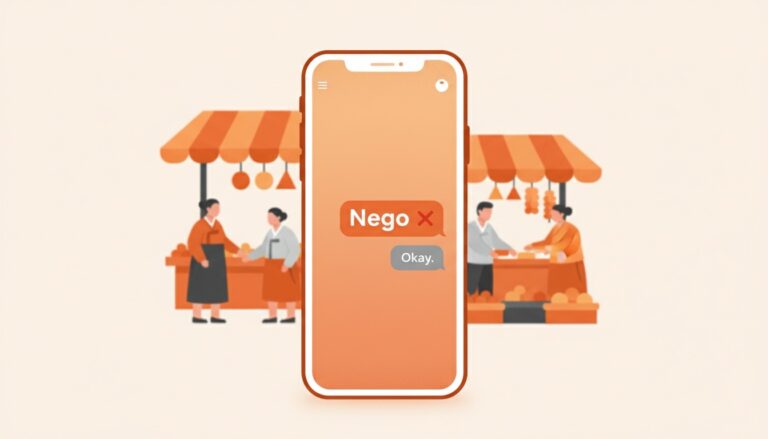
Today, we are talking about the “No Negotiation” rule. Knowing how to say (and read) this will save you from awkward silences and bad ratings on your “Manner Temperature” (we’ll get to that later).
Phase 2: The Art of Saying “No”
Here are the three phrases you will see most often. If you are selling, use these. If you are buying, respect these.
1. 네고 사절 (Nego Sajeol)
- Pronunciation: [Nego sa-jeol]
- Sound-alike: “Nego” sounds like “Lego” with an N. “Sa-jeol” sounds like “Sah-jull.”
- Meaning: “Negotiation Refused” (Firm)
- K-Culture Moment: Think of a stern shopkeeper in a K-Drama waving their hand at a rude customer. That is the energy here. ‘Nego’ comes from the English ‘Negotiation,’ but it’s pure Konglish now.
- Editor’s Insight: This is the standard, polite-but-firm way to say “Don’t even ask.” It’s not rude, but it draws a clear line.
- Situation Spectrum:
[🚫 Bosses] ———— [✅ Strangers/Apps] ———— [✅ Friends]- 🤔 Think About It: Why do Koreans love shortening English words (Negotiation → Nego)? It’s all about speed and efficiency (Palli-palli culture).
2. 쿨거래 (Kul-geore)
- Pronunciation: [Kul-geo-rae]
- Meaning: “Cool Deal” (Quick, hassle-free transaction)
- K-Culture Moment: You know those K-Pop fans who trade photocards at lightning speed outside a concert venue? That is a Cool Deal. No chatting, no haggling, just money and goods exchanging hands efficiently.
- Editor’s Insight: This is my favorite Korean slang. If a seller says “쿨거래 환영” (Cool deals welcomed), they mean: “If you don’t ask questions and pay immediately, I might even give you a small discount or a freebie.”
- Situation Spectrum:
[🚫 Formal Business] ———— [✅ Used Markets] ———— [✅ Casual]3. 에눌 불가 (Enul Bulga)
- Pronunciation: [E-nul bul-ga]
- Meaning: “No discounts allowed”
- Editor’s Insight: ‘Enul’ comes from ‘enuri’ (discount). ‘Bulga’ means impossible. This feels slightly more old-school or stiff than ‘Nego Sajeol,’ but you will see it often in descriptions.
Phase 3: Textbook vs. Real Life
In a classroom, you learn to be polite. On the street, you need to be quick.
| Situation | 📖 Textbook Korean | 🗣️ Real Korean (Street/App) | 💡 Why different? |
|---|---|---|---|
| Asking for a discount | 가격을 좀 깎아 주실 수 있나요? (Can you cut the price?) | 혹시 네고 되나요? (Is nego possible?) | The textbook version sounds like you are begging a king. The real version is casual and direct. |
| Refusing a discount | 죄송하지만 할인은 어렵습니다. (Sorry, but a discount is difficult.) | 죄송요, 네고 X (Sorry, Nego X) | Mobile chat culture hates long sentences. ‘X’ is a universal sign for NO. |
| Closing the deal | 그럼 이것으로 사겠습니다. (Then I will buy this one.) | 저 살게요! 계좌 주세요. (I’ll buy! Give me acct #.) | Speed is key. Asking for the bank account immediately proves you are serious. |
Bottom Note: If you see “네고 X” in the title, asking “혹시 네고 되나요?” is the fastest way to get ignored. Koreans value “nunchi” (reading the room). The text was the room, and you didn’t read it!
Phase 4: Cultural Context — The “Manner Temperature”
4-1. The Thermometer of Trust
On the Danggeun Market app, every user has a “Manner Temperature” (매너온도). Everyone starts at 36.5°C (body temperature).
- Rude (Bad Nunchi): Temperature drops. 🥶
- Kind & Fast (Cool Deal): Temperature rises. 🔥
If you ignore the “No Negotiation” sign and keep pestering for a lower price, the seller might report you, dropping your temperature. If you fall below 36.5°C, people might hesitate to trade with you. It’s like a credit score, but for social etiquette.
4-2. K-Drama Trope: The “Rich Guy” Discount
In dramas, you often see a rich CEO (Chaebol) buying street food and awkwardly trying to pay with a “Black Card,” or asking “How much for the whole cart?”
Real life is the opposite. Even wealthy people use second-hand apps because it’s considered “smart consumerism” (smart shopping). But the etiquette remains: respect the seller’s time. Time is money in Korea.
Phase 5: Roleplay — The K-Pop Photocard Deal
Setting: It’s Tuesday, 10 PM. You found a rare photocard of your favorite idol on an app. The description says: “Limited Edition. 50,000 won. Nego X.”
Characters:
* YOU: A desperate fan who needs this card to complete the collection.
* Seller (Minji): A pragmatic fan who wants a quick sale to buy concert tickets.
Dialogue:
YOU: 안녕하세요! 포카 아직 있나요?
(Annyeonghaseyo! Poka ajik innayo?)
(Hello! Is the photocard still available?)
Minji: 네, 있어요. 상세 설명 읽으셨죠?
(Ne, isseoyo. Sangse seolmyeong ilgeusyeotjjo?)
(Yes, it is. You read the description, right?)
(🎭 Minji replies instantly but sounds guarded.)
🔀 Decision Point: How do you respond?
- A) “네! 4만 원에 쿨거래 가능할까요?” (Yes! Can we do a cool deal for 40,000 won?)
- B) “네! 지금 바로 입금할게요.” (Yes! I will deposit the money right now.)
- C) “학생인데… 좀 깎아주세요 ㅠㅠ” (I’m a student… please discount ㅠㅠ)
⚠️ Choice A Analysis: DANGEROUS. You used the word “Cool Deal” but then asked for a discount on a “Nego X” item. Minji will likely ignore you.
❌ Choice C Analysis: The “I’m a student” card doesn’t work well in 2024. It’s considered a cliché annoyance.
✅ Best Choice: B. This is the definition of a Cool Deal. You respect the price and pay fast. Minji might even slip in some free stickers because she likes your attitude.
Phase 6: 10-Second Shadowing Drill
Let’s practice the magic phrase that makes sellers love you. Say this with confidence and speed!
😊 밝고 빠르게 (Brightly & Quickly)
네! / 쿨거래 / 원해요! / 계좌 주세요!
(Ne! / Kul-geo-rae / won-hae-yo! / Gye-jwa ju-se-yo!)“Yes! I want a cool deal! Please give me your account number!”
Phase 7: K-Culture Mini Glossary
| Korean | Romanization | Meaning | Context |
|---|---|---|---|
| 득템 | Deuk-tem | Rare Item Get | Slang for getting a really good item/deal. Like an RPG game drop. |
| 찔러보기 | Jjilleo-bogi | Just poking | Asking “is this available?” or “can you discount?” with no intention to buy. Highly hated behavior. |
| 벽돌 | Byeok-dol | Brick | A scam where you buy a phone but receive a brick in the box. |
| 직거래 | Jik-geo-rae | Direct Trade | Meeting in person to trade. Often done at subway station exits. |
Phase 8: Traveler’s Survival Kit
You might not use an app while traveling, but you will visit markets (like Namdaemun or Dongmyo).
🆘 Survival Phrases for Market Shopping
- 🇰🇷 “이거 정찰제예요?” (Igeo jeong-chal-je-yeyo?)
- Meaning: “Is this a fixed-price item?”
- Use: Use this before trying to haggle. If they say “Yes,” don’t push it.
- 🇰🇷 “현금으로 하면 좀 깎아주시나요?” (Hyeon-geum-euro hamyeon jom kkakka-jusinayo?)
- Meaning: “If I pay cash, can you give a discount?”
- Pro Tip: Cash is king in traditional markets. Often gets you 1,000~2,000 won off.
📌 Editor’s Travel Note:
Don’t try to haggle at department stores (Hyundai, Lotte) or franchise shops (Olive Young). The clerks there cannot change the price. Save your negotiating skills for the street markets!
Phase 9: Think Deeper — The Death of “Jeong”?
Food & Identity: You might have heard of Jeong (정) — the Korean concept of affection, attachment, and community connection. Historically, haggling in markets was a form of Jeong. It was a conversation, a social dance.
But the rise of “No Negotiation” tags and “Cool Deals” suggests a shift. Young Koreans prioritize efficiency and fairness over social friction. Negotiating is now seen as “emotional labor” rather than connection.
🧠 Think Deeper:
Does asking for a discount feel like a friendly game or a rude confrontation in your culture? Is efficiency killing the “human touch” of trading in your country too?
Phase 10: FAQ & Troubleshooting
- Q: Can I use polite language (Honorifics) to soften a low-ball offer?
- A: No. Even if you say it politely like a Joseon Dynasty scholar, asking for a discount when it says “Nego X” is considered rude. The content matters more than the tone here.
- Q: What if the item has a scratch they didn’t mention?
- A: That is the only time you can negotiate on a “Nego X” item. Point it out politely: “This scratch wasn’t in the photo.” (사진이랑 다르네요).
❌ Common Mistake: saying “I saw this cheaper somewhere else.”
✅ Fix: Just go buy it somewhere else. Telling the seller this will just annoy them.
Phase 11: Wrap-up & Mission
Summary: Today we learned that “Nego Sajeol” means “Don’t ask,” and “Cool Deal” is the fastest way to become a trusted buyer.
🔥 Your Mission:
* 🥉 Bronze: Say “Nego Sajeol” out loud 3 times pretending to be a tough shopkeeper.
* 🥈 Silver: Go to Instagram, search hashtags #벼룩 (flea market) or #양도 (transfer), and see if you can find “에눌” or “쿨거” in the captions.
* 🥇 Gold: Next time you buy something at a street market in Korea (or anywhere cash is used), try the “Cash Discount” phrase!
💬 Your Turn: Have you ever messed up a deal because of a misunderstanding? Tell me your story in the comments!
Frequently Asked Questions (FAQ)
Q: What does "네고 사절 (Nego Sajeol)" mean in Korean and how do you pronounce it?
A: In Korean, "네고 사절 (Nego Sajeol)" is pronounced [Nego sa-jeol] and means: "Negotiation Refused" (Firm)
Q: What does "쿨거래 (Kul-geore)" mean in Korean and how do you pronounce it?
A: In Korean, "쿨거래 (Kul-geore)" is pronounced [Kul-geo-rae] and means: "Cool Deal" (Quick, hassle-free transaction)
Q: What does "에눌 불가 (Enul Bulga)" mean in Korean and how do you pronounce it?
A: In Korean, "에눌 불가 (Enul Bulga)" is pronounced [E-nul bul-ga] and means: "No discounts allowed"







