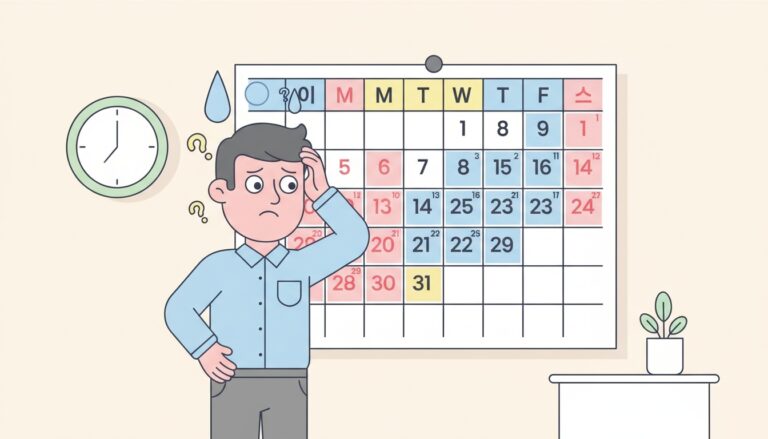
Phase 1: The Panic of the Empty Calendar
Hello! Daily Hangul editor here.
Picture this: You are sitting at your desk in Seoul. Suddenly, three of your colleagues stand up in unison, grab their notebooks, and march toward the meeting room. You look at your screen. Your calendar is blank.
Panic sets in. Did you miss an email? Is this a secret club? Or—most likely—did someone shout the schedule change across the room while you had your noise-canceling headphones on listening to NewJeans?
In Korean office culture, schedules change faster than the weather. Being able to ask “When is it?” or “Do you have time?” isn’t just about logistics; it’s about survival. If you don’t ask, nobody might tell you until it’s too late.
Today, let’s learn how to sync your internal clock with Korean business time.
Phase 2: Deep Dive into Core Expressions
Here are the three phrases that will save you from sitting alone at your desk while everyone else is in a meeting.
1. 언제예요? (When is it?)
- Pronunciation: [Eon-je-ye-yo?] (Sounds like ‘On-jay’ + ‘yay-yo’)
- Meaning: When is it?
- Context: The universal question. Use this for meetings, deadlines, or company dinners.
- Editor’s Insight: You can add a noun before it. “회의 언제예요?” (When is the meeting?) or “점심 언제예요?” (When is lunch?). In Korea, asking about lunch time is practically a love language.
- Situation Spectrum:
[🚫 Formal Presentation] ———— [⚠️ Senior Boss] ———— [✅ Colleagues/Team]- 🤔 Think About It: In English, we often say “What time is the meeting?” In Korean, “When is it?” (언제예요?) is often preferred over asking for the specific clock time because it covers dates and times.
2. 시간 되세요? (Do you have time?)
- Pronunciation: [Si-gan doe-se-yo?] (Sounds like ‘She-gan’ + ‘dwe-say-yo?’)
- Meaning: Literally “Does time become?” (Are you available?)
- K-Culture Moment: You see this in dramas constantly. A junior employee approaches a manager’s desk, hesitates, looks at the floor, and quietly asks, “Bu-jang-nim (Manager), sigan doeseyo?”
- Editor’s Insight: This is the polite way to interrupt someone. Never just walk up and start talking business. Ask this first.
- Situation Spectrum:
[🚫 Best Friend] ———— [⚠️ Busy Colleague] ———— [✅ Boss/Client]3. 일정 확인해 볼게요. (I will check the schedule.)
- Pronunciation: [Il-jeong hwag-in-hae bol-ke-yo]
- Meaning: I’ll check the schedule / I’ll let you know after checking.
- Editor’s Insight: This is your shield. If a boss asks if you can do something, but you are overwhelmed, don’t say “No.” Say “I’ll check my schedule first.” It buys you time to think!
- 🤔 Think About It: Why do Koreans rarely say a direct “No” to a request? Using “I’ll check the schedule” is a soft, indirect way to avoid immediate commitment (or rejection).
Phase 3: Textbook vs. Real Life
Korean in books is often robotic. Here is how we actually talk in the office break room.
| Situation | 📖 Textbook Korean | 🗣️ Real Korean | 💡 Why different? |
|---|---|---|---|
| Asking meeting time | 회의는 몇 시입니까? (Hoe-ui-neun myeot-si-im-nikka?) | 회의 몇 시예요? (Hoe-ui myeot-si-yeyo?) | The textbook version sounds like a soldier reporting for duty. The real version is efficient. |
| Asking availability | 당신은 시간이 있습니까? (Dangsin-eun sigan-i iss-seumnikka?) | 지금 시간 괜찮으세요? (Jigeum sigan gwaenchaneuseyo?) | “Dangsin” (You) is rude/awkward in 99% of spoken Korean. Never use it! |
| Confirming | 확인했습니다. (Hwagin-haess-seumnida.) | 넵! 알겠습니다. (Nep! Algesseumnida.) | “Nep” is the universal office word for “Roger that.” It’s softer than “Ne.” |
Bottom Note: If you use “Dangsin” to your boss, things will get awkward very fast. Just drop the “you” subject entirely.
Phase 4: Cultural Context — The “10 Minutes Early” Rule
4-1. Korean Time vs. Appointment Time
You might have heard of “Korean Time” (being late is okay), but that applies to drinking parties with friends. In the workplace? It is the opposite.
If the meeting is at 2:00 PM, arriving at 2:00 PM is considered “late” by many older bosses. You should be seated with your notebook open at 1:55 PM. This is part of Nunchi (sensing the atmosphere). If the boss is sitting there, you should be there too.
4-2. The “Lunch Schedule” is Sacred
In many Western offices, people eat a sandwich at their desk alone. In Korea, lunch is a communal scheduled event. “What are we eating?” is discussed as seriously as the quarterly budget. If someone asks “Lunch schedule eotteokhae doeyo?” (What’s the lunch schedule?), they usually mean “Who are we going with and where?”
Phase 5: Roleplay Scenario
Setting: Tuesday morning. The office pantry. You run into Min-ji, a helpful coworker.
Characters:
– YOU: New employee, confused about the team meeting.
– Min-ji: Your savior. Smart, quick, drinks 3 iced Americanos a day.
Min-ji: (Stirring coffee) Good morning! Are you ready for the meeting?
YOU: 어… 회의요? 언제예요?
(Eo… hoe-ui-yo? Eonjeyeyo?)
(Uh… meeting? When is it?)
Min-ji: Oh, you didn’t see the message? It’s at 2 PM.
YOU: 2시요? 아, 일정 확인해 볼게요.
(Du-si-yo? Ah, iljeong hwag-in-hae bol-ke-yo.)
(2 o’clock? Ah, let me check my schedule.)
(🎭 Action: You check your phone. You have a dentist appointment at 2:30!)
🔀 Decision Point: What do you say?
– A) 안 돼요. (No.)
– B) 저 2시 30분에 병원 가요. (I go to hospital at 2:30.)
– C) 팀장님, 시간 되세요? 말씀드릴 게 있어요. (Team leader, do you have time? I have something to tell you.)✅ Best Choice: C. Never just skip a meeting. Approach the boss politely using the “Do you have time?” phrase to explain the conflict.
⚠️ Choice A Analysis: Too direct. It sounds like you are rejecting the team.
Phase 6: 10-Second Shadowing Drill
Don’t just read it. Feel the anxiety of being late!
- Thinking/Checking: (Muttering to yourself while looking at phone)
🤔 회의가 / 언제더라…?
(Hoe-ui-ga / eon-je-deo-ra…?)
(When was… the meeting?) -
Polite Asking: (Softly, leaning in)
🥺 혹시 / 시간 / 되세요?
(Hok-si / si-gan / doe-se-yo?)
(By any chance… do you have time?) -
Confirming: (Bowing slightly)
😊 네 / 일정 / 확인했습니다!
(Ne / il-jeong / hwag-in-haess-seum-ni-da!)
(Yes, I confirmed the schedule!)
Phase 7: K-Culture Glossary
| Word | Pronunciation | Meaning | Context |
|---|---|---|---|
| 칼퇴 | Kal-toe | Leaving exactly on time | Literally “Knife Leave.” Leaving right at 6:00 PM. Used to be taboo, now Gen Z loves it. |
| 월요병 | Wol-yo-byeong | Monday Sickness | The universal dread of checking the schedule on Monday morning. |
| 스케줄 | Seu-ke-jul | Schedule | Yes, we use the English word mostly for daily plans! |
Phase 8: Traveler’s Survival Kit
Even if you aren’t working in Korea, you have a schedule to keep (trains, tours, reservations).
🆘 Survival Expression #1
– 🇰🇷 “몇 시에 시작해요?” (Myeot-si-e si-jak-hae-yo?)
– 🗣️ Meaning: What time does it start?
– 📍 Where to use: Concerts, tours, or waiting for a restaurant to open.
– 💡 Pro Tip: If you are late for a tour, don’t just run. Text or call. Koreans appreciate communication more than just speed.📌 Editor’s Note
– Apps: Google Calendar is fine, but for directions to your meeting, Naver Map is the only truth. Google Maps might send you to a building that was demolished 3 years ago.
Phase 9: Think Deeper — “Why so many questions?”
Language & Hierarchy
In English, a calendar is just a calendar. In Korean, whose calendar it is changes how you speak. You ask a friend “Sigan isseo?” (Have time?) but you ask a boss “Sigan doeseyo?” (Does time become?).
This isn’t just grammar; it’s a constant acknowledgment that the other person’s time is more valuable than yours. It feels rigid at first, but it also creates a clear structure of respect. When you use the polite form, you are saying, “I know you are busy, and I appreciate your attention.”
💬 Your Turn: In your country, is it rude to drop by a colleague’s desk without asking, or is it friendly? Let me know in the comments!
Phase 10: FAQ & Troubleshooting
Q: Can I use “When is it?” (언제예요?) to my CEO?
A: It is grammatically polite, but a bit too direct. For a CEO, it’s better to add “si” (honorific marker): “언제이시죠?” (Eonje-i-si-jyo?). But as an A2 learner, simple polite language (honorifics ending in -yo) is usually accepted with a smile.
❌ Common Mistake: Confusing “Have time” (availability) with “What time is it?”
– “Do you have time?” (Can we talk?) = 시간 되세요?
– “Do you have the time?” (Current clock time) = 지금 몇 시예요?
Don’t ask a stranger “Sigan doeseyo?” unless you want to recruit them for a cult (a common tactic in Seoul streets!). Just ask “Myeot si-yeyo?” if you need the clock time.
Phase 11: Wrap-up & Action Mission
Summary: To survive the office, ask “Eonjeyeyo?” (When?), respect the “Nunchi” of the schedule, and never say “Dangsin.”
Action Missions:
– 🥉 Bronze: Look at your watch and say “Myeot si-yeyo?” out loud.
– 🥈 Silver: Text a friend who loves K-Pop/K-Drama: “Oneul sigan doeseyo?” (Do you have time today?)
– 🥇 Gold: Open a Korean calendar app (like Naver Calendar) and try to read the days of the week in Hangul.
K-Culture Mission: Watch a clip of the variety show “Infinite Challenge” (Muhan-dojeon) regarding their “Early Arrival” chase. You will see how stressful (and funny) checking the schedule and being on time is in Korea!
Phase 12: Quiz — The “Nunchi” Test
1. Your boss is rushing out the door. You need to ask a question. What do you say?
– A) Hey! Where are you going?
– B) Bujang-nim, sigan doeseyo? (Manager, do you have time?)
– C) Sit down, please.
2. A stranger on the street approaches you and asks “Sigan doeseyo?” (Do you have time?). What is likely happening?
– A) They want to know the time.
– B) They want to give you money.
– C) They might be trying to preach a religion or sell something.
(Answers: 1-B, 2-C)
Frequently Asked Questions (FAQ)
Q: What does "언제예요? (When is it?)" mean in Korean and how do you pronounce it?
A: In Korean, "언제예요? (When is it?)" is pronounced [Eon-je-ye-yo?] and means: When is it?
Q: What does "시간 되세요? (Do you have time?)" mean in Korean and how do you pronounce it?
A: In Korean, "시간 되세요? (Do you have time?)" is pronounced [Si-gan doe-se-yo?] and means: Literally "Does time become?" (Are you available?)
Q: What does "일정 확인해 볼게요. (I will check the schedule.)" mean in Korean and how do you pronounce it?
A: In Korean, "일정 확인해 볼게요. (I will check the schedule.)" is pronounced [Il-jeong hwag-in-hae bol-ke-yo] and means: I'll check the schedule / I'll let you know after checking.