

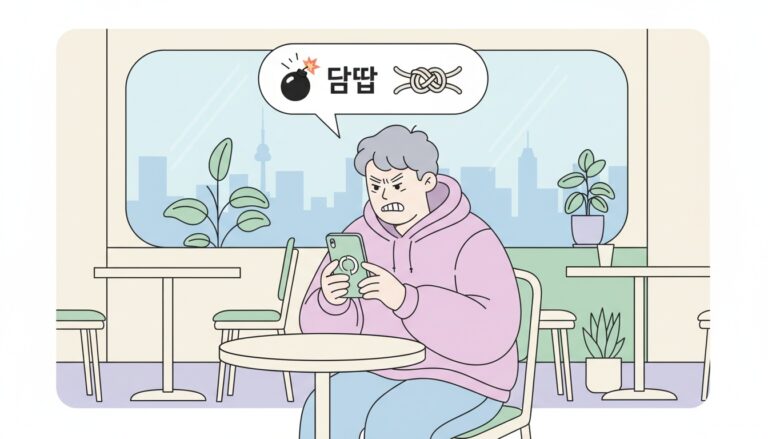
Phase 1: The “Buffering” Nightmare 😱
Hello! Daily Hangul Editor here.
Imagine this: You are at a hip cafe in Seongsu-dong. You’ve just ordered an Iced Americano and you open your phone to watch the latest episode of your favorite K-Drama (or maybe a live stream from your bias). The moment gets intense, the main characters lean in for a kiss, and then…
The spinning wheel of death.
Your screen freezes. The video buffers. You check the Wi-Fi bars. One bar? None?
In Korea, the land of the world’s fastest internet, this isn’t just an inconvenience; it’s an emergency. Koreans have a very specific physical reaction to slow internet—a tight feeling in the chest.
Today, we’re going to learn how to express that frustration like a local. No more robot language like “The internet connection is unstable.” We’re going to complain with feeling.
Phase 2: Deep Dive into Frustration 😤
Here are the three phrases you need when technology betrays you.
1. 와이파이가 안 터져요 (Waipai-ga an teojyeoyo)
- Pronunciation: [Wa-i-pa-i-ga an tuh-juh-yo]
- Meaning:
- Literal: The Wi-Fi isn’t exploding/bursting.
- Real nuance: The Wi-Fi isn’t working / The signal is weak.
- K-Culture Moment: Think of that scene in Crash Landing on You where the soldiers hold their phones up to the sky, desperately trying to catch a signal. They are praying for the signal to “burst” (pop up).
- Editor’s Insight: Why “explode” (터지다)? In Korean, we view signals, luck, and potential as things that accumulate and then “burst” open. If the signal doesn’t “burst,” it means it’s stuck inside the router!
- Situation Spectrum:
[🚫 Formal Speech] ———— [⚠️ Colleagues] ———— [✅ Friends/Cafe Staff]
(Note: Generally safe to use with staff to report a problem, just add ‘yo’ at the end.)
2. 답답해 (Dapdaphae)
- Pronunciation: [Dap-dap-hae]
- Meaning:
- Literal: It is stuffy/suffocating.
- Real nuance: I’m frustrated! / It’s taking too long! / I feel physically blocked.
- K-Culture Moment: This is the #1 emotion in K-Dramas when a misunderstanding isn’t resolved for 10 episodes. Viewers often comment online: “Ah, so dapdap! Give me cider (Sprite)!”
- Editor’s Insight: Use this when the page loads at 99% and stops. You can tap your chest with your fist while saying it for maximum effect.
- Situation Spectrum:
[🚫 Boss] ———— [⚠️ To yourself] ———— [✅ Friends]
3. 데이터가 너무 느려 (Deiteo-ga neomu neuryeo)
- Pronunciation: [De-i-tuh-ga nuh-moo neu-ryuh]
- Meaning: The data is too slow.
- Editor’s Insight: Korea is the land of 5G. Anything slower than instant is considered “too slow.” If a web page takes 3 seconds to load, a Korean might restart their phone.
- 🤔 Think About It: Why is speed so linked to emotional well-being in Korea? Is it the “Palli-palli” (Hurry hurry) culture?
Phase 3: Textbook vs. Real Life 🥊
| Situation | 📖 Textbook Korean | 🗣️ Real Korean | 💡 Why different? |
|---|---|---|---|
| Connection failed | 인터넷 연결이 안 됩니다. (Internet connection is not possible.) | 아, 와이파이 왜 이래? (Ah, why is the Wi-Fi like this?) | The textbook is a status report; real life is a complaint. |
| Asking for PW | 비밀번호가 무엇입니까? (What is the password?) | 혹시 비번 뭐예요? (By chance, what is the ‘bibeon’?) | ‘Bibeon’ is the standard slang for password. Saves time! |
| Lagging video | 비디오가 멈췄습니다. (The video stopped.) | 아, 렉 걸려. (Ah, it’s lagging / caught in lag.) | Borrowed from gaming culture (Lag). |
Bottom Note: If you use the textbook version at a PC Bang (gaming cafe), people might think you are an AI NPC.
Phase 4: Cultural Deep Dive — The “Palli-Palli” Syndrome 🏃♂️💨
The 3-Second Rule:
In many countries, waiting 10 seconds for a website to load is normal. In Korea, if a page doesn’t load in 3 seconds, people assume the phone is broken. This is the “Palli-palli” (Hurry hurry) culture in action.
K-Pop Connection:
Think about “Ticketing” (buying concert tickets). Millions of fans refreshing the page at the exact same millisecond. If your Wi-Fi doesn’t “burst” (터지다) at that moment, you fail. That specific anxiety? That is dapdap.
Non-verbal Tip:
When the internet is slow, Koreans often let out a deep sigh (Haaa…) and look at their phone with betrayal in their eyes. You don’t need to scream; just look deeply disappointed at your device.
Phase 5: Roleplay Scenario 🎬
Setting: A crowded cafe in Hongdae. You are trying to upload a photo to Instagram, but it keeps failing. You approach the counter.
Characters:
* YOU: A thirsty traveler who needs internet.
* Barista: Busy part-timer cleaning a blender.
Dialogue:
(You approach the counter holding your phone)
YOU: 저기요, 와이파이가 자꾸 끊겨요.
(Jeogiyo, waipaiga jakku kkeun-gyeo-yo.)
[Excuse me, the Wi-Fi keeps cutting out.]
Barista: 아, 그래요? 지금 사람이 많아서 그럴 수 있어요.
(Ah, geuraeyo? Jigeum sarami manaseo geureol su isseoyo.)
[Ah, really? It might be because there are too many people right now.]
🔀 Decision Point! How do you respond?
- A) “네, 알겠습니다.” (Okay, understood.) – Polite but you still have no internet.
- B) “데이터도 안 터져서 답답해 죽겠어요…” (Even my data isn’t working, I’m dying of frustration…) – Appeal to emotion.
- C) “환불해 주세요.” (Give me a refund.) – Too aggressive!
✅ Best Choice: B.
Why? Koreans respond well to shared suffering. Expressing your frustration (dapdap) might make the barista empathetic enough to suggest a solution, like “Try the 5G network instead of the 2.4G one.”
Barista: (Sympathetic) 아이고… 그럼 ‘KT_GIGA_5G’로 다시 잡아보시겠어요?
(Aigo… Then would you like to try connecting to ‘KT_GIGA_5G’ again?)
Phase 6: 10-Second Shadowing Drill 🎤
Practice saying this with a sigh of annoyance!
😤 아… / 와이파이가 / 왜 이렇게 / 안 터지지?
(Ah… / waipaiga / wae ireoke / an teojiji?)
[Ah… / the Wi-Fi / why is it / not working (bursting) like this?]
Phase 7: K-Culture Mini Glossary 📖
| Korean | Romanization | Meaning | Context |
|---|---|---|---|
| 비번 | Bibeon | Password | Short for 비밀번호 (Bimil-beonho). Used everywhere. |
| 핫스팟 | Hat-seu-pat | Hotspot | “Can you turn on your hotspot?” (핫스팟 좀 켜줘) |
| 데이터 | De-i-teo | Mobile Data | “I’m out of data.” (나 데이터 다 썼어) |
| 충전기 | Chung-jeon-gi | Charger | Cafes usually have outlets everywhere. |
Phase 8: Traveler’s Survival Kit 🧳
Wi-Fi is life when you are traveling. Keep these handy.
🆘 Survival Phrase #1
* 🇰🇷 “혹시 와이파이 비번 뭐예요?” (Hoksi waipai bibeon mwo-yeyo?)
* 🗣️ Meaning: By any chance, what is the Wi-Fi password?
* 📍 Where: Cafes, Restaurants, Airbnbs.
* 💡 Pro Tip: Look for the receipt! The password is almost always printed at the bottom of the receipt in Korean cafes.📌 Editor’s Travel Note
* Subways: Seoul subway Wi-Fi is free but often requires a Korean phone number to log in. Don’t rely on it for critical tasks.
* Public Spaces: Look for “Public WiFi Secure”. It’s surprisingly fast.
Phase 9: Think Deeper — Speed as a Virtue? 🧠
Think About It:
In Korea, “fast” (빠르다) is often synonymous with “good” or “competent.” If an app loads slowly, it’s not just a technical flaw; it feels like a service failure.
Does this intense focus on speed and efficiency make life better, or does it create unnecessary stress? How does this compare to the pace of life in your home country? Is “waiting” seen as patience or waste?
💬 Your Turn: Have you ever felt dapdap in your own country because of slow service? Tell me in the comments!
Phase 10: FAQ & Troubleshooting 🛠️
Q: Can I ask a stranger to turn on their hotspot for me?
A: Generally No. Data plans can be expensive. Unless it’s a genuine emergency (lost, injured), asking a stranger for a hotspot is considered rude. Stick to cafes.
Q: Can I leave my phone on the table while I go to the bathroom?
A: Yes! Korea is famous for this. You can leave your laptop and phone on the cafe table for 10 minutes, and 99.9% of the time, it will still be there. (But don’t try this with your wallet or cash!)
❌ Common Mistake:
* Saying “Open the Wi-Fi” (Open literally).
* Correct: “Turn on” (켜다) or “Connect” (연결하다/잡다).
Phase 11: Wrap-up & Mission 🎁
Summary: Today we learned that signals “burst” (터지다), frustration feels like a blocked chest (답답하다), and passwords are just “bibeon” (비번).
🚀 Action Mission:
* 🥉 Bronze: Look at your phone when it loads slowly and sigh “Ah… dapdaphae.”
* 🥈 Silver: Go to a Korean cafe (or any cafe) and check if the password is on the receipt.
* 🥇 Gold: Ask a Korean friend or tutor, “너는 언제 제일 답답해?” (When do you feel most frustrated?)
K-Culture Mission: Watch a K-Pop idol’s live stream replay. Fast forward to a part where the video lags. Look at the comments. How many fans are typing “???” or “Lag” or “렉”?
Frequently Asked Questions (FAQ)
Q: What does "와이파이가 안 터져요 (Waipai-ga an teojyeoyo)" mean in Korean and how do you pronounce it?
A: In Korean, "와이파이가 안 터져요 (Waipai-ga an teojyeoyo)" is pronounced [Wa-i-pa-i-ga an tuh-juh-yo] and means: Literal: The Wi-Fi isn't exploding/bursting.
Q: What does "답답해 (Dapdaphae)" mean in Korean and how do you pronounce it?
A: In Korean, "답답해 (Dapdaphae)" is pronounced [Dap-dap-hae] and means: Literal: It is stuffy/suffocating.
Q: What does "데이터가 너무 느려 (Deiteo-ga neomu neuryeo)" mean in Korean and how do you pronounce it?
A: In Korean, "데이터가 너무 느려 (Deiteo-ga neomu neuryeo)" is pronounced [De-i-tuh-ga nuh-moo neu-ryuh] and means: The data is too slow.







