

Phase 1: The ’10 Million’ Club
Hello! It’s your editor from Daily Hangul.
Picture this: You’re in a packed elevator in Seoul. Two office workers are chatting. One asks, “Did you see it yet?” The other gasps, “Not yet! Don’t spoil it!”
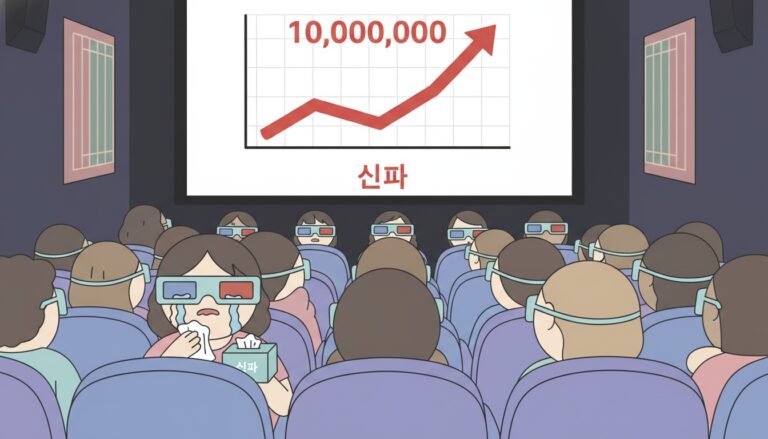
They aren’t talking about a secret government project. They are talking about the latest “Cheonman Yeonghwa” (천만 영화)—a movie that has reached 10 million viewers.
In a country with a population of roughly 51 million, 10 million tickets means 1 in 5 people saw that movie. It’s not just a film; it’s a national event. If you don’t see it, you’re out of the conversation at lunch, at coffee, and on blind dates.
I remember when Parasite swept the Oscars. But before that, movies like Train to Busan or The Admiral: Roaring Currents dominated the conversation for months. To understand Korean cinema, you have to understand what makes these blockbusters tick. Is it the action? The stars? Or is it something deeper—a specific emotional trigger called Sinpa?
Today, we’re going to break down the language of the Korean blockbuster. Let’s get into the ticket line.
Phase 2: The Blockbuster Vocabulary (Deep Dive)
Here are the three words you’ll hear constantly when a movie is blowing up in Korea.
1. 천만 영화 (Cheonman yeonghwa)
- Pronunciation: [Cheon-man yeong-hwa] ‘Cheon’ sounds like ‘Chun’ in ‘Chun-Li’.
- Meaning: Literal: 10 Million Movie. Real Nuance: A mega-blockbuster that defined the year.
- K-Culture Moment: When a movie hits this milestone, the cast usually posts a photo on Instagram holding a “1000” balloon. It’s a huge badge of honor.
- Editor’s Insight: This isn’t just about money. It’s about cultural impact. If someone asks, “Is it a Cheonman movie?” they are asking, “Is it worth my time?”
- Situation Spectrum:
[🚫 Formal] ———— [✅ Casual/Polite] ———— [✅ Standard]
(Safe to use with everyone)- 🤔 Think About It: Does your country measure success by box office revenue ($) or ticket sales (headcount)? Why does Korea focus on the number of people?
2. 입소문 (Ipsomun)
- Pronunciation: [Ip-so-mun] ‘Ip’ means mouth. ‘Somun’ means rumor.
- Meaning: Word of mouth / Viral buzz.
- K-Culture Moment: You check a movie on Naver, and the rating is 9.5/10. The comments say, “Trust the ipsomun!” (입소문 믿고 봤어요!).
- Editor’s Insight: Marketing helps, but in Korea, ipsomun is God. If the first audiences say it’s boring, the movie dies in 3 days. If they say “Daebak,” it lasts 3 months.
- Situation Spectrum:
[🚫 Formal Reports] ———— [✅ Daily Chat] ———— [✅ Reviews]- 🤔 Think About It: Why is “mouth rumor” more powerful than a trailer? Because Koreans trust the collective opinion (Netizens) often more than critics.
3. 신파 (Sinpa)
- Pronunciation: [Sin-pa]
- Meaning: Overly emotional, tear-jerker scenes (often forced).
- K-Culture Moment: The zombie is about to eat the dad, but suddenly sad piano music plays, and we get a 5-minute flashback of the dad buying shoes for his daughter. That is Sinpa.
- Editor’s Insight: This is a tricky word. Critics use it as an insult (“Ugh, too much Sinpa”). But secretly? Millions of people go because they want to cry. It’s a love-hate relationship.
- Situation Spectrum:
[🚫 To Director's Face] ———— [✅ Movie Review] ———— [✅ Friend Chat]- 🤔 Think About It: Why do so many Korean hits involve tragedy or sacrifice? Is crying in a theater a form of stress relief for a high-pressure society?
Phase 3: Textbook vs. Real Life
When you walk out of the theater, here is how you sound natural.
| Situation | 📖 Textbook Korean | 🗣️ Real Korean (Insider) | 💡 Why the difference? |
|---|---|---|---|
| Recommending | 이 영화는 아주 인기가 많아요. (This movie is very popular.) |
“완전 대세야! 안 보면 간첩이야.” (It’s the trend! If you don’t see it, you’re a spy.) |
“Spy” is an old joke meaning you are so out of touch, you must be from North Korea. |
| Crying | 영화가 너무 슬펐어요. (The movie was very sad.) |
“휴지 한 통 다 썼어… 눈물 콧물 뺐어.” (Used a whole tissue box… drained tears and snot.) |
Koreans love visceral descriptions of emotion. |
| Boring | 영화가 지루했어요. (The movie was boring.) |
“졸다가 나왔어. 돈 아까워.” (I dozed off and left. Waste of money.) |
Honesty about money is very common in reviews. |
💡 Bottom Note: Use “눈물 콧물 뺐어” (drained tears and snot) only with friends. It’s vivid, but maybe too graphic for your boss!
Phase 4: Cultural Deep Dive — The ‘Sing-along’ & The ‘Nunchi’
4-1. The Collective Experience
Unlike some cultures where movies are a solitary escape, watching a blockbuster in Korea is a communal event. For musical movies (like Bohemian Rhapsody or Frozen), Korea invented the “Sing-along Screening” (싱어롱 상영). You are encouraged to sing, clap, and wave glow sticks. It’s basically a concert. If you go to a regular screening and start singing? You will get the glare of death.
4-2. The ‘Gukppong’ (국뽕) Factor
Many “Cheonman” movies deal with Korean history (fighting against invaders, overcoming national crises). We call this satisfying feeling of patriotism “Gukppong” (Nationalism + Philopon/Drug). It gets your blood pumping. The Admiral: Roaring Currents is the ultimate Gukppong movie. Knowing this context helps you understand why people leave the theater looking so intense.
Phase 5: Roleplay Scenario
Setting: A cafe after watching a hit movie. You are with Minji, your Korean friend who loves sentimental movies.
Minji: 와, 진짜 대박이지 않냐? 마지막 장면에서 나 펑펑 울었어. 😭
(Wa, jinjja daebakiji anya? Majimak jangmyeon-eseo na peongpeong ureosseo.)
“Wow, wasn’t that amazing? I cried my eyes out at the last scene.”
🔀 Your Turn! How do you react to the ‘Sinpa’?
Option A (Agree/Empathic):
“나도! 휴지 없었으면 큰일 날 뻔했어.”
(Me too! If I didn’t have tissues, I would have been in trouble.)Option B (The Critic):
“음… 연기는 좋았는데, 너무 신파 아니야?”
(Hmm… the acting was good, but wasn’t it too ‘Sinpa’?)
Decision Point:
* Choose A if you want to bond and share the emotional release. Koreans love sharing emotions (Jeong).
* Choose B if you want to sound like a film critic. Warning: If Minji is still wiping tears, this might kill the mood!
Minji’s Response (If you chose B):
Minji: 에이, 넌 감정이 메말랐어! 그게 한국 영화의 매력이라고!
(Ei, neon gamjeong-i memallasseo! Geuge hanguk yeonghwa-ui maeryeok-irago!)
“Hey, your emotions have dried up! That’s the charm of Korean movies!”
Phase 6: 10-Second Shadowing
Let’s practice the “Reviewer” vibe. Focus on the stress on “Trust.”
🗣️ Expression: “Honestly, just trust the word of mouth and go see it.”
🇰🇷 Korean: “솔직히 / 그냥 입소문 믿고 / 한번 보세요!”
Romanization: Soljiki / geunyang ipsomun mitgo / hanbeon boseyo!
Sound Guide: [Sol-jik-ee] / [Geu-nyang Ip-so-moon mit-go] / [Han-bun bo-seh-yo]
🎭 Emotion: 😊 Enthusiastic & Confident (Like you are doing them a favor)
Phase 7: K-Culture Mini Glossary
| Korean | Word | Meaning & Context |
|---|---|---|
| 국뽕 | Gukppong | Excessive national pride. Used often for history movies where Korea wins against all odds. |
| 쿠키 영상 | Kuki Yeongsang | Post-credit scene. (Literally “Cookie Video”). Don’t leave until the lights go up! |
| 정주행 | Jeongjuhaeng | Binge-watching. If a movie has sequels, you might do this for the previous ones. |
| 스포 | Seupo | Spoiler. Short for ‘Spoiler’. Say “No Seupo!” (스포 금지!) |
Phase 8: Traveler’s Survival Kit (The Cinema Edition)
Going to a CGV, Lotte Cinema, or Megabox? Here is what you need.
🆘 Survival Phrases
1. “성인 두 명이요.” (Seong-in du myeong-iyo) — “Two adults, please.”
2. “자막 있어요?” (Jamak isseoyo?) — “Are there subtitles?” (Crucial! Most Korean movies don’t have English subs in theaters, but foreign movies do have Korean subs).
3. “반반 팝콘 주세요.” (Ban-ban papkon juseyo) — “Half-and-half popcorn, please.”📌 Editor’s Pro Tip:
Sweet Popcorn Warning! The default or most popular popcorn in Korea is often Caramel/Sweet or Onion/Garlic. If you want salty, ask for “General” (일반/Ilban) or “Original.” But try the “Ban-ban” (Half Sweet, Half Salty). It’s life-changing.
Phase 9: Think Deeper — “Han” and The Box Office
Topic: Why do we love to cry?
Western blockbusters often end with the hero triumphing and getting the medal. Korean blockbusters often end with the hero dying to save others, or a bittersweet separation. This connects to “Han” (한)—a unique cultural concept of internalized sorrow, resentment, and resilience.
Even in a fun zombie movie, the focus shifts to family tragedy. It’s not just bad writing; it’s a cultural reflection. We find catharsis not just in winning, but in enduring sacrifice together. When 10 million people cry at the same scene, it validates that shared history of struggle.
💬 Your Turn: Does a “sad ending” make a movie better or worse in your culture? Tell me in the comments!
Phase 10: FAQ & Troubleshooting
Q: Can I laugh loudly in a Korean theater?
A: Yes! But talking is a big NO. Koreans are very strict about theater etiquette (Gwan-keu / 관크 – audience critical). Don’t check your phone, don’t whisper excessively. But reacting to the movie (laughing, gasping) is totally fine.
Q: Do Korean movies in Korea have English subtitles?
A: Usually, no. Unless you go to a special “Foreigner Friendly” screening or a film festival (like Busan International Film Festival). If your listening isn’t B2+, you might struggle with a plot-heavy political thriller. Action movies are your best bet!
Q: Why do people eat dried squid in the theater?
A: That smell? It’s Ojing-eo (Grilled Squid). It’s the Korean equivalent of nachos. Don’t be scared—try the “Butter Grilled Squid” (버터구이 오징어). It’s delicious, though a bit chewy.
Phase 11: Wrap-up
One-Liner: A “Cheonman” movie is more than a film; it’s a social requirement fueled by “Ipsomun” and often sealed with tears of “Sinpa.”
🔥 Action Missions:
– 🥉 Bronze: Say “입소문” (Ipsomun) three times while imagining whispering a secret.
– 🥈 Silver: Go to a Korean movie trailer on YouTube and comment (in English or Korean) asking, “Is there a lot of Sinpa?”
– 🥇 Gold: Find a Korean movie on Netflix (like Train to Busan or Along with the Gods). Watch the ending. Did you cry? Text a friend: “I watched a Korean movie and drained my tears and snot.” (Translate it to Korean if you dare!)
Phase 12: Quiz — Are you a Movie Insider?
- Situation: Your friend invites you to a movie that 11 million people have seen. You ask:
- A) Is it a Cheonman movie?
- B) Is it an indie movie?
- (Answer: A. 10 million+ is the definition of Cheonman.)
- True or False: “Sinpa” is always considered a compliment by film critics.
- (Answer: False. Critics often dislike it for being forced, but audiences often enjoy the emotional release.)
- Survival: You are at the snack bar. You want both Sweet and Salty popcorn. What do you say?
- A) Mix Popcorn 주세요.
- B) Ban-ban (Half-half) Popcorn 주세요.
- (Answer: B. “Ban-ban” is the magic word for chicken, pizza, and popcorn!)
Frequently Asked Questions (FAQ)
Q: What does "천만 영화 (Cheonman yeonghwa)" mean in Korean and how do you pronounce it?
A: In Korean, "천만 영화 (Cheonman yeonghwa)" is pronounced [Cheon-man yeong-hwa] and means: Literal: 10 Million Movie. Real Nuance: A mega-blockbuster that defined the year.
Q: What does "입소문 (Ipsomun)" mean in Korean and how do you pronounce it?
A: In Korean, "입소문 (Ipsomun)" is pronounced [Ip-so-mun] and means: Word of mouth / Viral buzz.
Q: What does "신파 (Sinpa)" mean in Korean and how do you pronounce it?
A: In Korean, "신파 (Sinpa)" is pronounced [Sin-pa] and means: Overly emotional, tear-jerker scenes (often forced).







