

Phase 1: The Immersive Hook
Greeting: Hello, Daily Hangul readers. It’s your editor here.
Picture this: It’s 11:30 PM in Seoul. You’ve just binge-watched three episodes of a K-Drama where the characters are eating crispy fried chicken (chimaek). Your stomach growls. You open an app, tap a few buttons, and wait.
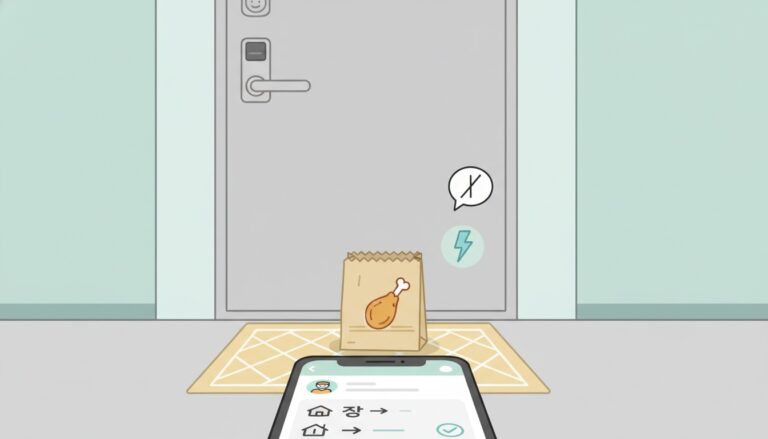
Twenty minutes later, your phone buzzes. No doorbell. No knocking. No shouting “Delivery!” just a silent vibration.
You open your door, and there it is—a steaming box of chicken sitting on your doormat like a secret gift from a ninja. No human in sight. Just a photo on your phone proving it arrived.
Welcome to the world of ‘Bidaemyeon’ (Non-face-to-face) delivery.
If you’re from a culture where handing food over with a smile and a tip is mandatory, this might feel cold or even rude. But here’s the twist: in Korea, this silence is the ultimate form of manners. It’s a complex mix of high-tech efficiency, extreme safety, and a modern desire for privacy. Today, we’re decoding the language of the Ghost Delivery.
Phase 2: Deep Dive Expressions
Here are the C2-level expressions you need to master to navigate this silent transaction proficiently.
1. 문 앞에 두고 가세요 (Mun ape dugo gaseyo)
- Pronunciation: [Mun ape dugo gaseyo]
- Sound Analogy: Moon (like the satellite) + Ah-peh (sounds like ‘apple’ without the ‘le’) + Doo-go + Ga-seh-yo.
- Meaning:
- Literal: Please put it in front of the door and go.
- Nuance: “Please leave it at the door.” (Standard default request).
- K-Culture Moment: You’ll see this as a pre-selected checkbox in every major delivery app (Baemin, Coupang Eats). It became the golden rule during the pandemic, but it stayed because, frankly, Koreans love the efficiency. No need to dress up or put on a wig just to get your tteokbokki.
- Editor’s Insight: Grammatically, the structure -고 가다 (do X and go) is interesting. It emphasizes the completion of the action (leaving it) and the separation (leaving the scene). It implies, “Don’t wait for me to open the door.”
- Situation Spectrum:
[🚫 Casual Friends] ———— [✅ Delivery Apps/Couriers] ———— [⚠️ Formal Guests]
(Note: You wouldn’t say this to a friend visiting you, but it is perfect for service personnel.)- 🤔 Think About It: Why is this phrase considered polite rather than dismissive? It respects the courier’s time (time is money in the delivery gig economy) and the customer’s privacy.
2. 비대면 (Bidaemyeon)
- Pronunciation: [Bi-dae-myeon]
- Meaning:
- Literal: Non-facing-face.
- Nuance: Contactless / Remote / Untact.
- Editor’s Insight: This is a Sino-Korean word (Hanja: 非對面). Before 2020, this was technical jargon. Now, it’s everyday vocabulary used for delivery, banking, and even hotel check-ins. If you see ‘비대면 수령’ (contactless receipt), it means you won’t see a human.
- K-Culture Moment: In news reports about the “Untact Era,” this word is the headline. It represents a shift in Korean society from jeong (deep connection) to pyeonli (convenience) in service sectors.
3. 조심스럽게 놓아 주시면 감사하겠습니다 (Josimseureopge noa jusimyeon gamsahagetseumnida)
- Meaning: I would appreciate it if you could place it down carefully.
- Editor’s Insight: This is Advanced (C2) politeness. You use this when ordering soup, coffee, or something that spills easily. The standard “Leave it at the door” might result in a rushed drop. Adding “carefully” (조심스럽게) acts as a gentle “Handle with Care” sticker.
Phase 3: Textbook vs. Real Life
| Situation | 📖 Textbook Korean | 🗣️ Real Korean (App/Text) | 💡 Why the difference? |
|---|---|---|---|
| Requesting drop-off | 배달원님, 음식을 문 앞에 놓아주시겠습니까? (Too long, too formal) | 문 앞이요. / (Checkbox) 문 앞에 두기 | Speed. In the “Pali-pali” (Hurry-hurry) culture, concise text is polite text. |
| Missing Item | 죄송하지만 음료수가 오지 않았습니다. | 사장님, 콜라 누락됐어요. (Boss, Cola is omitted.) | ‘누락’ (Omission) is the specific business term used to get a refund quickly. |
| Wrong House | 주소를 잘못 찾으신 것 같아요. | 오배송 된 것 같아요. (It seems like a mis-delivery.) | 오배송 (Mis-delivery) is the precise jargon to trigger an immediate redelivery. |
Bottom Note: Using words like 누락 (Omisison) and 오배송 (Mis-delivery) instead of simple descriptions marks you as a sophisticated speaker who understands the system.
Phase 4: Cultural Context — The “Trust” Infrastructure
Why does Bidaemyeon work in Korea but fails in many other countries?
4-1. The CCTV Panopticon & High Trust
Leaving a $50 order of Sushi on a doormat in a busy apartment complex requires immense social trust. In Korea, package theft is incredibly rare. Why?
– The “Black Box” Culture: Almost every corridor, elevator, and street corner has CCTV.
– The Delivery Photo: When the rider drops the food, they take a photo and upload it to the app. This isn’t just a notification; it’s a digital chain of custody.
4-2. The Introvert’s Paradise (K-Variety Connection)
Have you seen the show Home Alone (I Live Alone)? Many celebrities show their unfiltered home life. You’ll often see them grab a delivery box from the door in their pajamas with messy hair. This normalized the idea that home is a backstage area. Maintaining the “public face” requires energy; Bidaemyeon delivery protects your “backstage” relaxation mode.
Phase 5: Immersive Roleplay — The “Missing” Chicken
Setting: Friday night, 8:00 PM. You are hungry. The app says “Delivery Complete,” but your doorstep is empty. Panic sets in.
Characters:
– YOU: An expat living in a large apartment complex (Building 101).
– RIDER: A busy delivery driver (via text/chat).
The Dialogue:
YOU: (Checking the app photo) This isn’t my door… the tiles are different.
YOU (Texting Rider):
기사님, 배달 완료라고 뜨는데 문 앞에 음식이 없어요.
(Gisanim, baedal wallyorago tteuneunde mun ape eumsigi eopseoyo.)
(Driver, it says delivery complete, but there is no food at the door.)
RIDER:
사진 보셨나요? 101동 1503호 문 앞 맞는데요.
(Sajin bosyeonnayo? 101-dong 1503-ho mun ap manneundeyo.)
(Did you see the photo? It is indeed in front of 101-1503.)
🔀 Decision Point: How do you respond?
– A) Are you sure? You made a mistake. (Direct accusation)
– B) Ah, I live in 102 building. Sorry, I think the GPS was wrong. (Self-check)
– C) 혹시 옆 동으로 가신 거 아닐까요? 사진의 타일 색깔이 달라요. (Polite deduction)
✅ Best Choice: C
“Could it be that you went to the next building? The tile color in the photo is different.”
Why? Korean apartment buildings often look identical. Suggesting a specific visual cue (tile color) helps the driver solve the puzzle without accusing them of incompetence.
YOU:
혹시 옆 단지 102동으로 가신 건 아닐까요? 저희 집 문 앞 타일은 회색이거든요.
(Hoksi yeop danji 102-dong-euro gasin geon anilkkayo? Jeohui jip mun ap taireun hoesaegigeodeunyo.)
RIDER:
아, 죄송합니다. 바로 다시 이동하겠습니다.
(Ah, sorry. I will move it right away.)
Phase 6: 10-Second Shadowing Drill
Let’s practice the “Rider Request” box. Say this with a polite but firm tone.
Tag: 😌 Polite Request (Considerate of the baby/dog)
“벨은 / 누르지 마시고 / 문 앞에 / 놔주세요.”
(Bereun / nureuji masigo / mun ape / nwajuseyo.)
“Please don’t press the bell, just leave it at the door.”
Phase 7: K-Culture Mini Dictionary
| Korean | Romanization | Meaning | Context |
|---|---|---|---|
| 배달비 | Baedal-bi | Delivery Fee | Koreans are sensitive to this. If it exceeds 3,000 KRW, people hesitate. |
| 리뷰 이벤트 | Review Event | Freebie for Review | “Promise 5 stars, get a free Coke.” Essential part of K-delivery culture. |
| 일회용품 X | Ilhoeyong-pum X | No disposables | An option to decline plastic spoons/forks for eco-friendliness. |
| 공동현관 | Gongdong-hyeongwan | Common Entrance | The main lobby door with a passcode. You must give this code to the rider. |
Phase 8: Traveler’s Survival Kit
Scenario: You are staying at a Hotel or Airbnb. Riders usually cannot come up to your hotel room floor due to security cards.
🆘 Survival Expression #1
– 🇰🇷 “로비에서 받을게요.” (Robieseo badeulgeyo.)
– 🗣️ Meaning: “I will receive it at the lobby.”
– 📍 Use: When the rider calls you because they can’t get in.
– 💡 Pro Tip: Most Korean delivery apps require a Korean phone number. If you use a concierge or a service like ‘Shuttle Delivery,’ simply write: “Lobby Pick-up” in English. They understand.
Phase 9: Think Deeper — Technology vs. Humanity
Topic: Does efficiency kill human warmth (Jeong)?
Historically, Korean delivery was loud and interactive. The Cheolgabang (metal delivery box) arriving was an event. Now, we have maximum convenience but zero interaction. Some sociologists argue that in a hyper-dense city like Seoul, where you are physically close to millions of people, anonymity is the ultimate luxury. The “Contactless” culture isn’t about being cold; it’s about granting each other the space to breathe in a crowded society.
💬 Your Turn: Does your culture value the chat with the delivery person, or would you prefer the “Ghost Delivery”? Tell us in the comments!
Phase 10: FAQ & Troubleshooting
Q: Should I tip the delivery driver in Korea?
A: NO. Stop! 🛑. In Korea, tipping is not expected and can sometimes be confusing. The delivery fee (배달비) is already calculated. Just paying the app price is perfect etiquette.
Q: Can I leave the dirty dishes outside for them to collect?
A: Mostly No. In the old days (Chinese food / Jajangmyeon), yes. But nowadays, 99% of deliveries come in disposable containers (plastic). You must rinse them and recycle them yourself. Only leave dishes if the restaurant specifically delivered in reusable melamine plates (very rare now).
Q: The rider is wearing a helmet and won’t make eye contact. Is he angry?
A: No. He is just optimizing his time. He has likely 3 other deliveries in his box. His speed is his service.
Phase 11: Wrap-up & Action Mission
Summary: Modern Korean delivery is silent, secure, and precise. Use “문 앞에 놔주세요” to blend in like a local.
🚀 Action Missions:
– 🥉 Bronze: Practice saying “벨 누르지 마세요” (Don’t press the bell) out loud.
– 🥈 Silver: Next time you order (even in your home country), try the “Leave at door” option and experience the bidaemyeon vibe.
– 🥇 Gold: If you are in Korea, find the “Rider Request” (요청사항) box in the app and type a custom message in Korean!
Phase 12: Quiz — Are you a Delivery Pro?
- Situation: You have a sleeping baby at home. Which request do you select?
- A) 도착하면 전화주세요 (Call me upon arrival)
- B) 벨 누르고 노크해주세요 (Ring bell and knock)
- C) 벨X, 문 앞에 놔주세요 (No Bell, Leave at door)
- Culture: You see a bag of food sitting in front of your neighbor’s door for 3 hours. What should you do?
- A) Take it inside for them.
- B) Call the police.
- C) Ignore it. It’s safe there.
Answers:
1. C (A is also okay, but C is safest for noise).
2. C (In Korea, it’s considered safe. Touching it might be misunderstood!)
Frequently Asked Questions (FAQ)
Q: What does "문 앞에 두고 가세요 (Mun ape dugo gaseyo)" mean in Korean and how do you pronounce it?
A: In Korean, "문 앞에 두고 가세요 (Mun ape dugo gaseyo)" is pronounced [Mun ape dugo gaseyo] and means: Literal: Please put it in front of the door and go.
Q: What does "비대면 (Bidaemyeon)" mean in Korean and how do you pronounce it?
A: In Korean, "비대면 (Bidaemyeon)" is pronounced [Bi-dae-myeon] and means: Literal: Non-facing-face.
Q: What does "조심스럽게 놓아 주시면 감사하겠습니다 (Josimseureopge noa jusimyeon gamsahagetseumnida)" mean in Korean and how do you pronounce it?
A: In Korean, "조심스럽게 놓아 주시면 감사하겠습니다 (Josimseureopge noa jusimyeon gamsahagetseumnida)" is pronounced [see lesson guide] and means: I would appreciate it if you could place it down carefully.







