

Phase 1: Immersive Hook
Hello! Daily Hangul Editor here. 👋
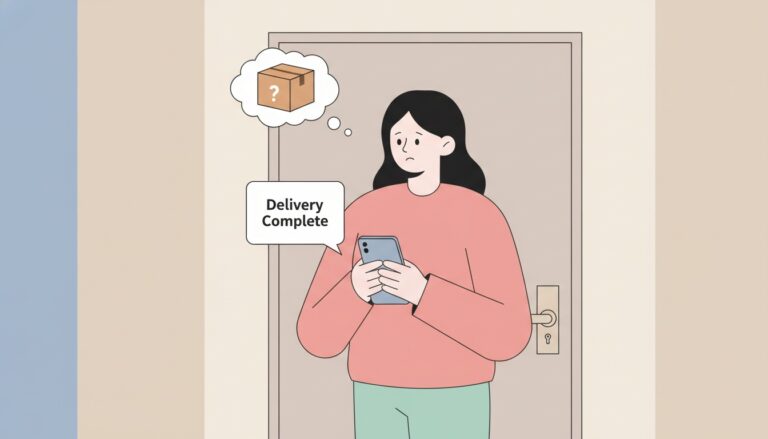
Picture this: You’ve been waiting weeks for that limited edition K-Pop album or those viral Korean skincare products. Your phone finally buzzes. Ding! It’s a KakaoTalk message: “[CJ Logistics] Delivery Complete.”
Your heart races. You rush to your door, ready to tear open the box like a kid on Christmas morning. But when you open the door… nothing. Just empty hallway air and the faint smell of your neighbor’s doenjang-jjigae.
Panic sets in. Did someone steal it? Did the driver leave it at the wrong house? In K-Dramas, a missing item usually leads to a romantic encounter with a handsome neighbor. In reality? It just leads to a headache.
Don’t freak out. Korea’s delivery system is insanely fast—sometimes too fast—and mistakes happen. Today, I’m going to teach you how to track down your missing loot like a calm, collected Seoulite, not a confused tourist.
This guide comes straight from my own experience of frantically calling a delivery driver because my box of frozen dumplings was melting somewhere in Mapo-gu.
Phase 2: Deep Dive (Core Expressions)
Here are the three phrases that will save your sanity.
1. 배송 완료라고 뜨는데요 (Baesong wallyorago tteuneundeyo)
- Pronunciation: [Bae-song wal-lyo-ra-go tteu-neun-de-yo] / Sounds like: “Bay-song wal-yo-ra-go…”
- Meaning: “It says ‘delivery complete’ (but I don’t have it).”
- Context: You use this when checking the app. It’s not an accusation; it’s a statement of confusion. You start the conversation with this fact.
- Editor’s Insight: The verb 뜨다 (tteuda) here means “to pop up” or “appear on screen.” It’s the perfect tech-savvy verb for anything involving apps or websites.
- Situation Spectrum:
[🚫 Formal(CEO)] ———— [⚠️ Semi-formal(Driver)] ———— [✅ Casual]
- Use this with Customer Service or the Driver (add ‘…unde’ at the end to sound softer).
- 🤔 Think About It: Why do Koreans end sentences with “-nundeyo” (…는데요)? It leaves the sentence open-ended, inviting the other person to solve the problem without you having to demand a solution directly. It’s the art of indirect pressure.
2. 혹시 문 앞에 두셨나요? (Hoksi mun ape dusyeonnayo?)
- Pronunciation: [Hok-si mun a-pe du-syeon-na-yo]
- Meaning: “Did you happen to leave it in front of the door?”
- K-Culture Moment: In Korea, “contactless delivery” was a thing long before the pandemic. Drivers drop packages and run (literally, they are busy!).
- Editor’s Insight: 혹시 (Hoksi) is your magic shield. It means “by any chance.” It softens any question so you don’t sound like you’re interrogating the poor driver who delivered 200 boxes today.
- Situation Spectrum:
[🚫 Casual(Friend)] ———— [⚠️ Semi-formal] ———— [✅ Standard]
- Perfect for texting the driver.
3. 확인 부탁드립니다 (Hwagin butakdeurimnida)
- Pronunciation: [Hwa-gin bu-tak-deu-rim-ni-da]
- Meaning: “Please check it for me.”
- Context: Use this to close your message. It’s polite, professional, and firm.
- Editor’s Insight: You will hear “Hwagin” (Confirm/Check) a million times in Korea. In offices, banks, and shops. It’s the button that makes people move.
- 🤔 Think About It: Compare this to English “Can you check?” The Korean phrase uses the noun “Request” (butak), making it sound more objective and respectful.
Phase 3: Textbook vs. Real Life
Let’s see how a robot talks vs. how a Seoul local talks.
| Situation | 📖 Textbook Korean | 🗣️ Real Korean (Survival Mode) | 💡 Why different? |
|---|---|---|---|
| Reporting Missing Item | 제 택배가 분실되었습니다. (My package has been lost.) | 기사님, 택배가 아직 안 와서요. (Driver, the package hasn’t come yet.) | Direct accusation vs. Soft approach to get help faster. |
| Asking Location | 택배를 어디에 두셨습니까? (Where did you place the package?) | 혹시 경비실에 맡기셨나요? (Did you perhaps leave it at the security office?) | Giving a specific option (security office) helps them remember. |
| Checking Status | 운송장 번호를 확인해 주세요. (Please verify the tracking number.) | 송장 번호 인데 확인 좀 부탁드려요. (Here’s tracking #, please check.) | “좀” (a little) softens the request immediately. |
💡 Editor’s Note: In B2 level, you should start using “기사님” (Gi-sa-nim) instead of “아저씨” (Mister). It shows respect for their profession (Driver/Technician) and guarantees better service.
Phase 4: Cultural Deep Dive — The “CCTV Republic”
4-1. Why packages sit outside for days
If you visit a Korean apartment complex, you’ll see piles of Coupang boxes sitting in front of doors. No one steals them. Why?
1. CCTV Everywhere: Korea is covered in cameras. Stealing a box is basically asking to be caught in 4K resolution.
2. Trust Culture: There is a strong social contract. “Not my box, not my business.”
4-2. The “Security Office” (Gyeong-bi-sil) Factor
If your package isn’t at your door, 90% of the time it’s at the 경비실 (Security Office). Especially in older apartments without automatic door codes. The security guard (Gyeong-bi ajeossi) is the gatekeeper of all lost items.
K-Drama Connection: You know those scenes where the protagonist leaves a gift of kimchi or side dishes at the security office for their crush? That’s real life. The security office is the hub of the community.
Phase 5: Roleplay — Texting the Driver 📱
Setting: It’s 8 PM. You are at home. The app says “Delivered,” but your door is empty. You decide to text the delivery driver (contact info is usually in the app).
Characters:
* YOU: Anxious but polite B2 learner.
* Gi-sa-nim: Busy delivery driver, terse but helpful.
(Text Message Dialogue)
YOU: 기사님, 안녕하세요. 101호 입주민입니다. 앱에는 배송 완료라고 뜨는데, 문 앞에 없어서요.
(Gisa-nim, hello. Resident of unit 101. App says delivery complete, but it’s not at the door.)
Gi-sa-nim: 아, 101호요? 제가 소화전 안에 넣어뒀습니다.
(Ah, 101? I put it inside the fire hydrant box.)
🔀 Decision Point: What is a “Fire Hydrant Box”?
* A) A box full of water?
* B) The little cabinet in the hallway wall next to your door.✅ Correct Answer: B. In Korean apartments, the 소화전 (Sohwajeon) is a secret locker for deliveries! Check there immediately.
YOU: 아! 확인했습니다. 감사합니다, 수고하세요!
(Ah! I checked and found it. Thank you, keep up the good work!)
Gi-sa-nim: 넵.
(Yup.)
Phase 6: 10-Second Shadowing Drill
Practice this until it rolls off your tongue. Emotional setting: Confused but polite.
- 혹시 / 옆집에 / 잘못 간 건 아닐까요? 😟
(Hoksi / yeop-ji-be / jal-mot gan geon a-nil-kka-yo?)
Could it possibly have gone to the neighbor’s house by mistake? -
경비실에도 / 없다고 / 하는데요… 😥
(Gyeong-bi-si-re-do / eop-da-go / ha-neun-de-yo…)
They say it’s not at the security office either…
Phase 7: K-Culture Glossary 📚
| Korean | Romanization | Meaning | Context |
|---|---|---|---|
| 운송장 번호 | Unsongjang beonho | Tracking Number | The ID number you need for any inquiry. |
| 택배 | Taekbae | Delivery/Package | The lifeblood of modern Korea. |
| 착불 | Chakbul | Cash on Delivery (COD) | Receiver pays for shipping upon arrival. Rare for shopping, common for second-hand deals. |
| 경비실 | Gyeongbisil | Security Office | The first place to check if a package is missing. |
| 문앞 배송 | Mun-ap baesong | Doorstep Delivery | The default setting in Korea. |
Phase 8: Traveler’s Survival Kit 🧳
Even if you don’t live here, you might order items (SIM cards, souvenirs) to your hotel.
🆘 Survival Phrases for Hotels
* 🇰🇷 “제 이름으로 택배 온 거 있나요?” (Je ireumeuro taekbae on geo innayo?)
* “Is there a package that came under my name?”
* 📍 Where: Hotel Front Desk / Airbnb Host
* 💡 Pro Tip: Always put your Room Number in the address line (e.g., Room 204).📌 Editor’s Travel Note
If you are staying at an Airbnb, finding the exact building can be hard for drivers. Send a photo of your front door/gate to the driver if they call you looking lost. It saves everyone time.
Phase 9: Think Deeper — Trust & Technology
Topic: Why don’t Koreans steal packages?
It’s a mix of high-tech surveillance and old-school community values. Most buildings have CCTV at the entrance and in elevators. But beyond that, there’s a cultural concept of “civic pride.” Taking someone else’s kimchi or rice delivery feels… petty.
However, this is changing slightly with more impersonal high-rises. Still, compared to many Western countries where “porch pirates” are a plague, Korea remains a safe haven for doorstep drops.
💬 Your Turn: In your country, if a package is left outside, how long does it last before disappearing? 10 minutes? 10 hours? Let me know in the comments!
Phase 10: FAQ & Troubleshooting
Q: The driver keeps calling me and speaking rapid-fire Korean! What do I do?
A: Don’t panic. He is likely asking for the entry code (password) to your building. Just say: “문자로 보내드릴게요” (Munjaro bonaedeurilgeyo – I’ll send it via text). Then hang up and text him the code. It’s safer and easier.
Q: Can I use these phrases for food delivery (Baedal) too?
A: Yes! “배달 완료라고 뜨는데요” works perfectly for your missing fried chicken too.
❌ Common Mistake:
Don’t call the driver late at night (after 9 PM). They work long hours, but late calls are rude. Text is always better.
Phase 11: Wrap-up & Mission
Summary:
Today we learned how to track down a ghost package using “뜨는데요” (It says…) and “혹시” (By any chance).
🚀 Action Mission:
* 🥉 Bronze: Save the number of your local “CJ Logistics” or “Post Office” driver in your phone as “Gi-sa-nim.”
* 🥈 Silver: Next time you get a package, text the driver: “감사합니다!” (Thank you!). Building rapport helps when things go wrong later.
* 🥇 Gold: If you have a missing package, use the “fire hydrant” or “security office” phrases to find it yourself before calling.
K-Culture Mission:
Watch a scene from the drama “Strong Woman Do Bong-soon” or similar rom-coms. Look for how casual they are about leaving expensive items on doorsteps!
Phase 12: Interactive Quiz
Scenario: You ordered a BTS lightstick. The app says “Delivered,” but it’s not there. You check the photo the driver uploaded, and it’s a door that isn’t yours. What do you text the driver?
- 야! 이거 우리 집 아니잖아! (Hey! This isn’t my house!)
- 기사님, 사진 속 현관이 저희 집이 아닌 것 같아요. 확인 부탁드려요. (Driver, the door in the photo doesn’t look like mine. Please check.)
- 경찰에 신고하겠습니다. (I will report this to the police.)
🔽 Answer:
2. Always assume it’s a mistake first. Option 1 is rude (fighting words). Option 3 is an escalation that will make things very awkward very fast.
Frequently Asked Questions (FAQ)
Q: What does "배송 완료라고 뜨는데요 (Baesong wallyorago tteuneundeyo)" mean in Korean and how do you pronounce it?
A: In Korean, "배송 완료라고 뜨는데요 (Baesong wallyorago tteuneundeyo)" is pronounced [Bae-song wal-lyo-ra-go tteu-neun-de-yo] and means: "It says 'delivery complete' (but I don't have it)."
Q: What does "혹시 문 앞에 두셨나요? (Hoksi mun ape dusyeonnayo?)" mean in Korean and how do you pronounce it?
A: In Korean, "혹시 문 앞에 두셨나요? (Hoksi mun ape dusyeonnayo?)" is pronounced [Hok-si mun a-pe du-syeon-na-yo] and means: "Did you happen to leave it in front of the door?"
Q: What does "확인 부탁드립니다 (Hwagin butakdeurimnida)" mean in Korean and how do you pronounce it?
A: In Korean, "확인 부탁드립니다 (Hwagin butakdeurimnida)" is pronounced [Hwa-gin bu-tak-deu-rim-ni-da] and means: "Please check it for me."







