

Phase 1: The “Buffering” Nightmare (Immersive Hook)
Hello! This is your Daily Hangul Editor.
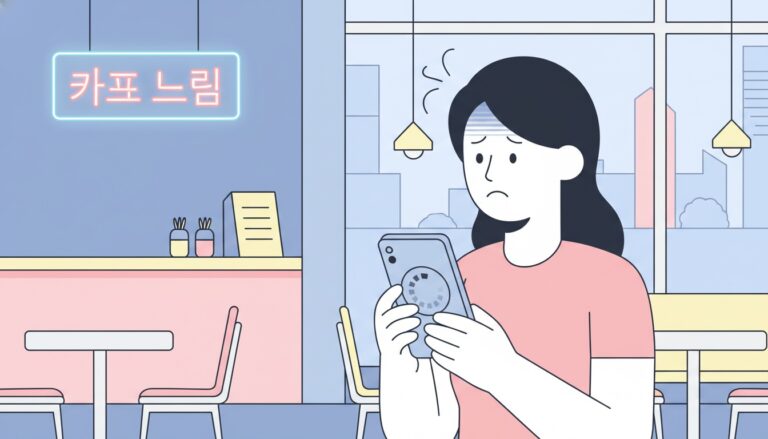
Picture this: You are in a hip cafe in Seongsu-dong. You’ve just ordered a nice iced Americano, opened your laptop, and you’re ready to book that KTX ticket to Busan or maybe stream the latest episode of Squid Game.
Suddenly, the spinning wheel of death appears. 😱
In K-Dramas, a dropped call usually means the villain is about to kidnap the protagonist. In real life Seoul, a dropped connection just means you might miss out on a concert ticket that sells out in 30 seconds. Korea is obsessed with speed—we call it “Pali-pali” (Hurry, hurry) culture. So, when the internet lags, we don’t just get annoyed; we get desperate.
Today, we aren’t learning how to politely ask for the internet. We are learning how to express the frustration of a connection that was there, but keeps disappearing.
Phase 2: Core Expressions (Deep Dive)
Here are the three ways to say “Fix my Wi-Fi, please” without sounding like a robot.
1. 인터넷이 자꾸 끊겨요.
(Inteonet-i jakku kkeun-kyeo-yo)
- Pronunciation: In-tuh-net-ee jah-kkoo kkeun-kyuh-yo
(Tip: ‘Kkeun’ requires a tense throat, like you’re lifting something heavy.)- Meaning: “The internet keeps cutting out/disconnecting.”
- Context: Use this when the connection is unstable—it works for a second, then stops, then works again.
- Editor’s Insight: The magic word here is 자꾸 (jakku). It means “repeatedly” or “keep doing.” If you just say “Internet is bad,” it sounds static. “Jakku” adds the nuance that it’s an annoying, recurring problem.
- Situation Spectrum:
[Friend: 끊겨 (Kkeun-kyeo)] — [Colleague: 끊겨요 (Kkeun-kyeo-yo)] — [Boss: 끊깁니다 (Kkeun-gim-nida)]- 🤔 Think About It: Why do you think Korean has a specific adverb (jakku) just to emphasize repetition in complaints? Does it sound more complaining than just stating the fact?
2. 와이파이가 잘 안 잡혀요.
(Waipaiga jal an jap-hyeo-yo)
- Pronunciation: Wai-pai-ga jal an jap-hyuh-yo
- Meaning: “The Wi-Fi isn’t picking up well.” (Literal: Wi-Fi isn’t being caught well.)
- Context: You see the signal bars, but they are weak (1 bar). Or your phone can’t find the network at all.
- K-Culture Moment: You’ll hear this in variety shows when celebrities go to remote countryside villages and panic because they can’t play games on their phones.
- Editor’s Insight: We use the verb 잡히다 (to be caught) for signals. It’s like fishing. You are trying to catch the signal, but it keeps swimming away.
3. 데이터가 너무 느려요.
(Deiteoga neomu neuryeoyo)
- Pronunciation: Day-ee-tuh-ga nuh-moo neu-ryuh-yo
- Meaning: “The data is too slow.”
- Context: Connected, but that Instagram photo is taking 10 seconds to load. In Korea, 10 seconds is an eternity.
Phase 3: Textbook vs. Real Life
Let’s be honest. Nobody speaks like a textbook when they are frustrated.
| Situation | 📖 Textbook Korean | 🗣️ Real Korean (Daily Hangul Style) | 💡 Why the difference? |
|---|---|---|---|
| Wi-Fi is slow | 인터넷 연결 속도가 느립니다. (The internet connection speed is slow.) | 아, 와이파이 왜 이래? (Ah, why is the Wi-Fi like this?) | Because frustration needs emotion, not a report. |
| Signal is weak | 신호가 약합니다. (The signal is weak.) | 안 터져요. (It doesn’t ‘burst/pop’.) | Koreans say signals “burst” (터지다) when they work well. |
| asking Staff | 와이파이 연결이 안 됩니다. (Wi-Fi connection is not working.) | 저기요, 와이파이 혹시 고장 났나요? (Excuse me, is the Wi-Fi broken by any chance?) | Asking if it’s broken is a softer way to complain than saying “It doesn’t work.” |
Note: B1 learners, feel free to use “안 터져요” (An teo-jyeo-yo) with friends. It’s the most natural slang for “no signal.”
Phase 4: Cultural Deep Dive — The “Pali-Pali” Speed Trap
4-1. The “IT Powerhouse” Pride
Koreans take immense pride in having some of the fastest internet speeds in the world. Walk into any PC Bang (gaming cafe), and you will experience internet speeds that feel like teleportation. Because of this high standard, a “slow” connection in Korea might be considered “normal” in other countries. If a webpage takes more than 3 seconds to load, you might hear a Korean sigh deeply.
4-2. The Cafe “Wi-Fi Hunter” Etiquette
In many Western countries, you might ask for the Wi-Fi password. In Korea, asking is often unnecessary. Look at the receipt. The password is almost always printed at the bottom, or on a small standee near the register. Asking the busy staff “What is the password?” before checking the receipt is a rookie mistake!
Phase 5: Immersive Roleplay
Setting: A boutique Airbnb in Hongdae. It’s 10 PM. You have a Zoom meeting in 5 minutes, but the Wi-Fi just died.
Characters:
* YOU: Desperate guest.
* Host (Jimin): Friendly, but texting via KakaoTalk app.
The Dialogue:
YOU: (Texting) 안녕하세요, 지민 씨. 지금 인터넷이 자꾸 끊겨요. ㅠㅠ
(Annyeonghaseyo, Jimin-ssi. Jigeum inteonesi jakku kkeun-kyeo-yo. ㅠㅠ)
(Hello Jimin. The internet keeps cutting out right now. crying face)
Host (Jimin): 아, 그래요? 공유기 껐다 켜 보셨나요?
(Ah, geuraeyo? Gongyugi kkeotda kyeo bosyeonnayo?)
(Ah, really? Have you tried turning the router off and on?)
🔀 Decision Point! How do you reply?
- A) 네, 했는데도 안 돼요. (Yes, I did, but it still doesn’t work.)
- B) 공유기가 어디 있어요? (Where is the router?)
- C) 빨리 와서 고쳐주세요! (Come fix it quickly!)
✅ Best Choice: B. Most Airbnbs hide the router. Asking where it is shows you are willing to try fixing it yourself first.
⚠️ Why not C? Unless it’s a hotel, demanding the host to come over immediately at 10 PM is considered rude/aggressive in Korean culture.
Phase 6: 10-Second Shadowing Drill
Repeat after me. Focus on the annoyance in your tone!
- 😫 (Frustrated): 아 / 와이파이가 / 왜 이렇게 / 안 잡히지?
(Ah / Waipaiga / wae ireoke / an jap-hi-ji?)
(Ah, why is the Wi-Fi not picking up like this?) -
🤔 (Polite inquiry): 사장님 / 인터넷이 / 자꾸 / 끊겨요.
(Sajangnim / inteonesi / jakku / kkeun-kyeo-yo.)
(Boss [Owner], the internet keeps cutting out.)
Phase 7: K-Culture Glossary
| Korean | Romanization | Meaning | Context |
|---|---|---|---|
| 공유기 | Gong-yu-gi | Router | The machine you need to restart when internet fails. |
| 데이터 | De-i-teo | Mobile Data | Used when talking about 4G/5G, not Wi-Fi. |
| 비번 | Bi-beon | Password (Slang) | Short for ‘bimil-beono’. Used casually. |
| 핫스팟 | Hat-seu-pat | Hotspot | “Can you turn on your hotspot?” |
Phase 8: Traveler’s Survival Kit
If the internet is dead and you are lost, use these:
🆘 Survival Expression #1
* 🇰🇷 “여기 와이파이 비밀번호가 뭐예요?” (Yeogi waipai bimil-beonoga mwoyeyo?)
* 🗣️ Meaning: What is the Wi-Fi password here?
* 📍 Where: Cafes, Restaurants, Hotels.
* 💡 Pro Tip: Look for the word PW or WIFI on the wall or receipt first!📌 Editor’s Travel Note
* Public Wi-Fi: Seoul has excellent public Wi-Fi on subways and buses. Look for “Public WiFi SEOUL” or “T Free WiFi”. It’s often faster than hotel internet!
* Emergency: If you need stable internet immediately, search for a PC Bang (PC방) on Naver Maps. For about 1,000 KRW ($0.80) per hour, you get the fastest internet on earth.
Phase 9: Think Deeper — “Pali-Pali” and Connection
Language & Lifestyle:
Why does the phrase “It keeps cutting out” (Jakku kkeun-kyeo-yo) carry so much weight in Korea? It reflects the “Pali-pali” (Hurry, hurry) culture that drove Korea’s rapid economic growth. In a society where efficiency is a top virtue, a dropped connection isn’t just a technical glitch; it’s a disruption of flow. It feels like losing time, and time is the most valuable currency in Seoul.
💬 Your Turn: In your country, if the internet drops at a cafe, do people complain immediately, or do they just wait it out? How does that compare to the Korean reaction?
Phase 10: FAQ & Troubleshooting
- Q: Can I ask a stranger to share their Hotspot?
- A: generally, No. Data plans can be expensive, and it’s considered too personal of a request for a stranger. Stick to asking cafes or using public Wi-Fi.
- Q: The cafe Wi-Fi is open but not working. Can I complain?
- A: If you bought a drink, Yes. But be polite. Say “Wi-Fi-ga an doeneun geot gatayo” (I think the Wi-Fi isn’t working) rather than “Fix it.”
- ❌ Common Mistake: Pronouncing Wi-Fi as “Wai-Fai.”
- ✅ Fix: In Korea, it’s pronounced more like “Wai-Pai” (High pitch on the P). If you say “Fai” with a strong F sound, older people might not understand.
Phase 11: Wrap-up & Mission
Summary: Today we learned that in Korea, a bad connection is a serious matter! Use “자꾸 끊겨요” (Keeps cutting out) when it’s unstable, and “안 잡혀요” (Not picking up) when the signal is weak.
Action Mission:
* 🥉 Bronze: Look at your phone’s signal bar right now and say “Ah, Waipaiga jal jap-hyeo-yo” (Ah, Wi-Fi is picking up well) or the opposite.
* 🥈 Silver: Next time your video buffers, sigh loudly and say “Ah! Jakku kkeun-kyeo-yo!”
* 🥇 Gold: Go to a Korean cafe (or a library) and ask, “Hoksi Waipai bimil-beono isseoyo?” (Do you happen to have a Wi-Fi password?)
Phase 12: Quiz — The “Wi-Fi Hunter” Challenge
- Situation: You are at a cafe. The internet works for 1 minute, then stops, then works again. What do you say?
- A) 와이파이가 없어요. (There is no Wi-Fi.)
- B) 인터넷이 자꾸 끊겨요. (The internet keeps cutting out.)
- C) 데이터가 느려요. (Data is slow.)
- Culture Check: True or False? In a Korean cafe, you should always ask the staff for the password before looking at your receipt.
- (True / False)
Answers:
1. B. ‘Kkeun-kyeo-yo’ implies the connection is unstable/intermittent.
2. False. Always check the receipt (Yeong-su-jeung) first! It’s polite efficiency.
Frequently Asked Questions (FAQ)
Q: What does "자꾸" mean in Korean and how do you pronounce it?
A: In Korean, "자꾸" is pronounced [jakku] and means: . It means "repeatedly" or "keep doing." If you just say "Internet is bad," it sounds static. "Jakku" adds the nuance that it's an annoying, recurring problem.
Q: What does "잡히다" mean in Korean and how do you pronounce it?
A: In Korean, "잡히다" is pronounced [to be caught] and means: for signals. It’s like fishing. You are trying to catch the signal, but it keeps swimming away.
Q: What does ""안 터져요"" mean in Korean and how do you pronounce it?
A: In Korean, ""안 터져요"" is pronounced [An teo-jyeo-yo] and means: with friends. It’s the most natural slang for "no signal."
Q: What does ""자꾸 끊겨요"" mean in Korean and how do you pronounce it?
A: In Korean, ""자꾸 끊겨요"" is pronounced [Keeps cutting out] and means: when it's unstable, and







