

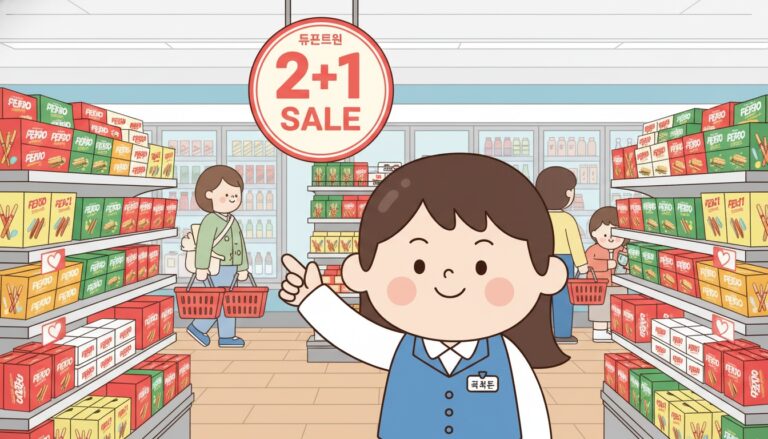
Phase 1: The November 11th Chaos
Hello! Your Daily Hangul editor here.
Imagine you walk into a GS25 or CU (convenience store) in early November. Suddenly, you can’t find the ramyeon aisle. Why? Because there is a literal wall of red and green boxes blocking your path. It’s Pepero Day (빼빼로데이).
In K-Dramas, this is usually where the shy high school girl hides a box of chocolate-dipped sticks in the boy’s locker. Or the cool office manager slides a box onto your desk without making eye contact, mumbling something incomprehensible.
If you’re in Korea on November 11th and you don’t participate? You might feel like the only person at a party who didn’t get the dress code memo. It’s not just about romance; it’s about ‘Jeong’ (affection/attachment).
Let’s learn how to hand over that box of chocolate sticks without making it awkward.
Phase 2: Core Expressions Deep Dive
Here are the three phrases you’ll actually need. Forget the poetry; let’s survive the office (or the date).
1. 이거 받으세요 (Please accept this)
- Pronunciation: [I-geo ba-deu-se-yo]
- Sounds like: “E-go” + “Bah” (like sheep) + “do” + “say-yo”
- Meaning: Here, take this (Polite).
- K-Culture Moment: Used when giving a gift to a coworker, a teacher, or someone slightly older. You hold the Pepero with two hands.
- Editor’s Insight: It’s the safest phrase. It’s not romantic, it’s not rude. It just means “I prepared this for you.”
- Situation Spectrum:
[🚫 Friends only] ———— [✅ Universal] ———— [✅ Boss/Elders]- 🤔 Think About It: Why does Korean require a verbal cue when giving a gift? In some cultures, you just hand it over. In Korea, the act of giving needs a verbal label to be polite.
2. 챙겨 왔어요 (I brought this for you)
- Pronunciation: [Chaeng-gyeo wa-sseo-yo]
- Sounds like: “Chang-gyo” + “wah-sso-yo”
- Meaning: I took care to bring this / I didn’t forget you.
- K-Culture Moment: This is the “I care about you” phrase. It implies effort. You didn’t just buy it; you remembered them.
- Editor’s Insight: Use this for team members or friends you want to get closer to. It has a warm nuance.
- Situation Spectrum:
[✅ Friends] ———— [✅ Colleagues] ———— [⚠️ Strict Boss]3. 오다 주웠다 (I picked it up on the way)
- Pronunciation: [O-da ju-wot-da]
- Sounds like: “Oh-da” + “joo-wot-da”
- Meaning: (Literal) I picked it up while coming here. / (Real) I bought this for you, but I’m too shy to admit I care, so pretend it’s trash I found.
- K-Culture Moment: The classic Tsundere (Cold outside, warm inside) line from K-Dramas. The male lead tosses the gift and walks away.
- Editor’s Insight: Warning! Only use this with close friends or a girlfriend/boyfriend as a joke. If you say this to your boss, you might get fired (okay, not fired, but judged).
- Situation Spectrum:
[✅ Close Friends/Lovers] ———— [🚫 Colleagues] ———— [🚫 Boss]
Phase 3: Textbook vs. Real Life
| Situation | 📖 Textbook Korean | 🗣️ Real Korean | 💡 Why? |
|---|---|---|---|
| Giving to a friend | 선물입니다. (It is a gift.) | 자, 옛다! (Here, take it!) | Friends don’t use formalities. “옛다” is playful, like tossing a treat to a pet (jokingly). |
| Giving to a crush | 좋아해서 샀습니다. (I bought it because I like you.) | 너 줄라고 샀어. (Bought it to give to you.) | Directness is rare. “Neol wihae” (for you) is too poetic. “Neo jullago” is casual and cool. |
| Refusing politely | 아니요, 괜찮습니다. (No, I am fine.) | 아, 됐어~ 너 먹어. (Ah, forget it~ You eat it.) | Close friends reject gifts to show they don’t need formalities (or they are dieting). |
Bottom Note: In real life, especially on Pepero Day, words are short. The gesture matters more.
Phase 4: Cultural Context — The “Nunchi” of Snacks
1. The “Giri” (Obligation) Pepero
In Korea, not all Pepero is about love. We have “Ui-ri Pepero” (의리 빼빼로 – Loyalty Pepero). This is what you give to your coworkers or platonic friends just to be nice.
* Tip: If you buy a huge expensive basket for a coworker you barely know, that’s bad Nunchi (social sense). It creates pressure. Stick to the standard small box.
2. The 11:11 Symbolism
Why November 11th? Because the date 11/11 looks like four Pepero sticks.
* K-Pop Context: Fans often build giant towers or “cakes” made of Pepero boxes to send to their idols’ agencies. It’s a flex of dedication.
Phase 5: Interactive Roleplay
Setting: It’s 9:00 AM on Nov 11th. You are at your desk in a Seoul office. Everyone has a small stack of Pepero boxes. Minji, your friendly coworker, approaches you.
Minji: (Smiling) OO씨, 이거 받아요! 해피 빼빼로데이~
(OO-ssi, igeo badayo! Happy Pepero Day~)
🔀 YOUR TURN! How do you respond?
- Option A: “감사합니다! 저도 준비했어요.”
- (Thank you! I prepared some too.)
- Option B: “왜 저한테 주세요?”
- (Why are you giving this to me?)
- Option C: “오다 주웠어.”
- (I picked it up on the way.)
✅ Best Choice: Option A. This is the perfect social exchange. Even if you didn’t prepare any, you can say “Thank you! I’ll buy you coffee later.” (This is the Korean art of reciprocation).
⚠️ Why not B: Too direct! It makes Minji feel embarrassed for being nice.
🚫 Why not C: You are not the cool main character in a drama right now. You are a coworker.
Phase 6: 10-Second Shadowing Drill
Let’s practice the most useful phrase. Say it with a smile, slightly bowing your head.
Emotion: 😊 Warm & Friendly
Happy / Pepero Day! / Please / take this.
“해피 / 빼빼로데이! / 이거 / 받으세요.”
(Hae-pi / Ppae-ppae-ro-de-i! / i-geo / ba-deu-se-yo.)
Phase 7: K-Culture Mini Dictionary
| Korean | Rom | Meaning | Context |
|---|---|---|---|
| 의리 | Uiri | Loyalty/Obligation | Doing something because of social duty or friendship, not romance. |
| 썸 | Ssome | “Something” | The ambiguous stage before dating. Pepero Day is a prime time to end the ‘Ssome’ and start dating. |
| 1+1 | Won-ppeul-won | Buy 1 Get 1 Free | The holy grail of convenience store shopping. Essential for buying bulk Pepero. |
Phase 8: Traveler’s Survival Kit
If you are in Korea around Nov 11th, you will go to a convenience store (CVS). Here is how to survive the sale section.
🆘 Survival Phrase #1
– 🇰🇷 “이거 투 플러스 원이에요?” (Igeo tu-ppeul-won-i-e-yo?)
– Meaning: Is this 2+1? (Buy 2, Get 1 Free)
– Why: Korean CVSs love “2+1” deals on Pepero. If you bring 2 boxes to the counter, the clerk will stare at you until you go get the free 3rd one.📌 Editor’s Travel Note
– Don’t buy just one box if you see a yellow tag. Check the tag!
– Best Flavor? The classic is red (chocolate), but the Nude Pepero (chocolate inside) is cleaner to eat (no melted chocolate on fingers!).
Phase 9: Think Deeper — “Jeong” and Snacks
Food & Identity:
In Korea, food is rarely just fuel; it’s a medium for affection. Pepero Day is criticized by some as a commercial holiday invented by snack companies (which is true). But why does it persist? Because Koreans look for excuses to express Jeong (connection). Saying “I care about you” is awkward for many Koreans. Handing over a box of sugary sticks is a low-stakes, socially accepted way to bridge that gap. It allows people to be kind without being “cringe.”
💬 Your Turn: Does your country have a day dedicated to a specific snack? Or a day where you are obligated to give gifts to coworkers? Tell me in the comments!
Phase 10: FAQ & Troubleshooting
- Q: Can I give Pepero to my boss?
- A: YES. But keep it simple. No heart-shaped boxes. Just a regular box on their desk says, “I respect you as part of our team.”
- Q: What if I receive one but didn’t get them anything?
- A: Don’t panic. Just say, “와, 감동이에요! 잘 먹을게요.” (Wow, I’m touched! I’ll enjoy it.) You can buy them a coffee later or just accept the love.
❌ Common Mistake: Giving Pocky instead of Pepero.
* Why: Pocky is the original Japanese version. Pepero is the Korean version. On Korean Pepero Day, stick to the Lotte Pepero brand to be safe and culturally in-tune!
Phase 11: Wrap-up & Mission
Summary: Pepero Day is about sharing “Jeong” (affection). Use “Igeo badeuseyo” to be polite and safe.
🚀 Action Mission:
* 🥉 Bronze: Look in the mirror and practice saying “Igeo badeuseyo” while handing an imaginary box with two hands.
* 🥈 Silver: Go to a Korean market (or Asian grocery) and find the Pepero section. Is there a 2+1 sale?
* 🥇 Gold: Buy a box and give it to a friend (even if it’s not Nov 11) saying, “Oda juwosseo!” (Just kidding, say “Igeo badeuseyo”!)
See you in the next lesson! Happy snacking! 🍫
Frequently Asked Questions (FAQ)
Q: What does "이거 받으세요 (Please accept this)" mean in Korean and how do you pronounce it?
A: In Korean, "이거 받으세요 (Please accept this)" is pronounced [I-geo ba-deu-se-yo] and means: a key conversational Korean expression covered in this lesson.
Q: What does "챙겨 왔어요 (I brought this for you)" mean in Korean and how do you pronounce it?
A: In Korean, "챙겨 왔어요 (I brought this for you)" is pronounced [Chaeng-gyeo wa-sseo-yo] and means: a key conversational Korean expression covered in this lesson.
Q: What does "오다 주웠다 (I picked it up on the way)" mean in Korean and how do you pronounce it?
A: In Korean, "오다 주웠다 (I picked it up on the way)" is pronounced [O-da ju-wot-da] and means: a key conversational Korean expression covered in this lesson.







