

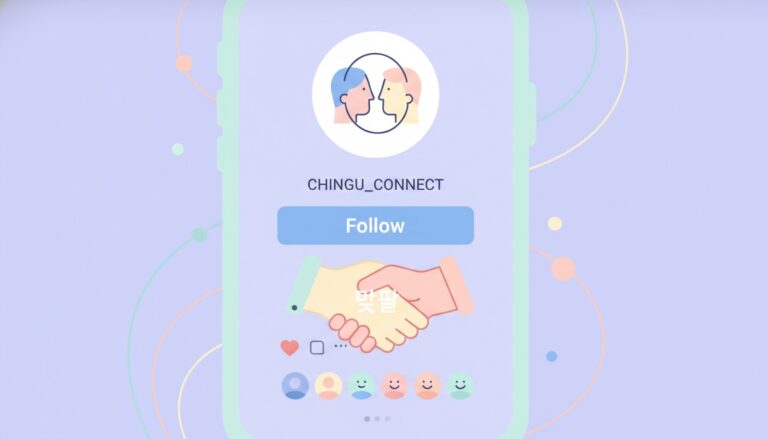
Get Korean Friends on Instagram: The Magic of “Mat-pal” (Mutual Follow) ✨
Phase 1: Welcome to the “K-World” 🌏
Hello! This is your Daily Hangul Editor.
Imagine this: You are scrolling through Instagram and find a Korean cafe owner who posts the most aesthetic photos of lattes in Seoul. Or maybe you found a K-Pop fan account that loves the same obscure B-side track as you. You want to connect. You want to say, “Hey, let’s be friends!”
You look at the button. It says 팔로우 (Pal-lo-u). That’s easy. But simply following isn’t enough in Korea. If you want them to follow you back and become “In-chin” (Insta-friends), you need the magic password.
I’ve seen so many students just silently follow people and wonder why no one talks to them. In Korea, social media is all about reciprocity—give and take. Today, I’ll teach you the words that turn a “follower” into a “friend.”
Phase 2: Deep Dive into SNS Lingo 📱
Here are the top 3 expressions you need to survive in the Korean digital world.
1. 맞팔 (Mat-pal)
- Pronunciation: [mat-pal] (Sounds like “Mat” as in doormat + “Pal” as in pal/friend)
- Meaning: Mutual Follow (Follow back)
- Editor’s Insight: This is the MVP (Most Valuable Phrase). It comes from 맞 (face-to-face/together) + 팔로우 (follow). It means “I followed you, so please follow me back!”
- Situation Spectrum:
[🚫 To Elders] ———— [⚠️ Strangers] ———— [✅ Social Media]
- Note: This is slang. Use it in comments or DMs, not in a business email!
- 🤔 Think About It: Why do Koreans love abbreviating everything (like Mat-pal)? Is it just for speed, or does it create a sense of “insider” belonging?
2. 소통해요 (So-tong-hae-yo)
- Pronunciation: [so-tong-hae-yo]
- Meaning: Let’s communicate / Let’s interact
- K-Culture Moment: You will see this everywhere in hashtags: #소통해요. It means “I don’t just want followers; I want people who will like my posts and comment.”
- Editor’s Insight: It sounds formal in English (“Communicate”), but on Korean SNS, it’s very casual. It’s an invitation to be active friends.
- Situation Spectrum:
[🚫 Boss] ———— [⚠️ Teachers] ———— [✅ New Online Friends]3. 인친 (In-chin)
- Pronunciation: [in-chin]
- Meaning: Instagram Friend
- Editor’s Insight: A combination of 인스타그램 (Instagram) + 친구 (Friend). Even if you’ve never met in real life, you can be In-chin.
Phase 3: Textbook vs. Real Life 🗣️
| Situation | 📖 Textbook Korean | 🗣️ Real Korean (SNS) | 💡 Why is it different? |
|---|---|---|---|
| Asking to follow | 저를 팔로우해주세요 (Please follow me) | 맞팔해요! (Let’s mutual follow!) | SNS culture prefers short, reciprocal slang over polite requests. |
| Greeting on a post | 사진이 참 예쁘네요 (The photo is very pretty) | 사진 대박! 소통해요~ (Pic is daebak! Let’s connect~) | Emotional exclamation (“Daebak”) shows more genuine interest. |
💡 Editor’s Note: “Textbook Korean” sounds like a robot or a customer service agent on Instagram. Use the “Real Korean” to sound like a local!
Phase 4: Cultural Context — The “Nunchi” of Liking ❤️
In Korea, “Jeong” (Deep connection) exists even online. You can’t just follow someone and disappear. That is considered “Ghosting” (유령 계정).
The Rule of the “Heart”:
If someone writes “Let’s be Mat-pal” on your post, you are socially expected to:
1. Go to their profile.
2. Click Follow.
3. Like (좋아요) at least 2-3 of their recent photos.
This is the digital version of bowing or shaking hands. It shows you are sincere.
Phase 5: Roleplay Scenario 🎭
Setting: You are a fan of a K-Pop group. You find a Korean fan account (@ArmyMinji) who posted a picture of a concert ticket. You want to connect.
Characters:
– YOU: K-Pop fan from overseas.
– MINJI: Korean fan.
(Dialogue Start)
YOU: (Leaving a comment) 와! 사진 멋져요! 😍
(Wa! Sajin meot-jeo-yo!)
(English: Wow! Cool photo!)
MINJI: 감사해요! 외국인 분이세요?
(Gamsa-haeyo! Oegugin bun-i-se-yo?)
(English: Thanks! Are you a foreigner?)
🔀 YOUR TURN! How do you reply to get a follow back?
A) 네. 안녕히 계세요. (Yes. Goodbye.)
B) 네! 저도 아미(Army)예요. 우리 맞팔해요! (Yes! I’m Army too. Let’s mutual follow!)
C) 팔로우 하세요. (Follow me.)
✅ Best Choice: B
– Reason: You established a common ground (Army) and used the magic word 맞팔 (Mat-pal). It’s friendly and inviting.
⚠️ Choice C Analysis: This sounds like a command. Very rude!
(Dialogue Continue)
MINJI: 반가워요! 좋아요, 맞팔 갔어요! 💜
(Ban-ga-wo-yo! Jo-a-yo, mat-pal ga-sseo-yo!)
(English: Nice to meet you! Okay, I just followed you [mutual followed]!)
Phase 6: 10-Second Shadowing Drill 🎧
Practice these to build your “SNS muscles.” Focus on the emotion!
- 😊 Brightly: 우리 / 맞팔 / 해요! (U-ri / mat-pal / hae-yo!) -> Let’s follow each other!
- 🥺 Cute/Hopeful: 소통 / 하고 / 싶어요! (So-tong / ha-go / si-peo-yo!) -> I want to communicate with you!
- 😎 Cool: 사진 / 좋아요~ (Sa-jin / jo-a-yo~) -> Nice photo~
Phase 7: K-Culture Mini Dictionary 📖
| Korean | Romanization | English | Context |
|---|---|---|---|
| 좋아요 | Jo-a-yo | Like | The heart button ❤️ |
| 댓글 | Daet-geul | Comment | “Write a daet-geul” |
| 디엠 | Di-em | DM | Direct Message |
| 프사 | Peu-sa | Profile Pic | Short for Profile Sajin |
Phase 8: Traveler’s Survival Kit ✈️
Even offline, you might meet cool people at a guesthouse or a bar in Hongdae. How do you stay in touch?
🆘 Survival Phrase #1
– 🇰🇷 “인스타 하세요?” (In-seu-ta ha-se-yo?)
– 🗣️ Meaning: Do you do Instagram?
– 📍 Where to use: After chatting with a new friend for 5 minutes.
– 💡 Pro Tip: If they say yes, simply hand them your phone to type their ID. It’s easier than spelling it out!
Phase 9: Think Deeper — Language & Connection 🧠
The Speed of “Friendship” in Korea
In many Western cultures, “friend” is a heavy word earned over time. In Korean SNS culture, words like In-chin (Insta-friend) suggest a quick desire for bonding. Koreans often use terms like “family” (fam) or “sister/brother” (eonni/oppa) very quickly online.
🧠 Think Deeper: Does using family/friend titles quickly make you feel closer, or does it feel artificial to you? How does this compare to how you make friends online in your country?
Phase 10: FAQ & Troubleshooting 🛠️
Q: Can I DM a K-Pop idol saying “Mat-pal hae-yo”?
A: You can try… but they won’t reply. 😅 Idols rarely follow fans back. It’s better to use specific fan apps (like Weverse) for that.
Q: Can I say “Mat-pal” to my Korean boss?
A: NO. Never. Keep your work life and SNS life separate unless they ask first. Even then, use polite language.
❌ Common Mistake: Using “Please follow me” (팔로우 해주세요).
✅ Fix: Use “맞팔해요” (Let’s mutual follow). It emphasizes doing it together, not just you asking for a favor.
Phase 11: Wrap-up & Mission 🎁
Today’s Summary: To make friends on Korean SNS, don’t just follow—ask for 맞팔 (Mat-pal)!
🚀 Your Action Missions:
– 🥉 Bronze: Say “Mat-pal hae-yo” out loud 3 times.
– 🥈 Silver: Find a Korean hashtag like #카페 (Cafe) or #여행 (Travel) and like 3 photos.
– 🥇 Gold: Leave a comment on a Korean post: “사진 멋져요! 맞팔해요!” (Cool photo! Let’s mutual follow!)
Phase 12: Quiz — Are you an Insider? 📝
1. Which is the BEST comment to leave to make a new friend?
a) 내 사진 봐줘. (Look at my photo.)
b) 반가워요! 소통해요! (Nice to meet you! Let’s connect!)
c) 팔로우 취소. (Unfollow.)
2. True or False?
“In-chin” refers to a friend you only meet inside your house.
Answers:
1. b) This is polite and friendly.
2. False. It means Instagram Chingu (Friend).
Frequently Asked Questions (FAQ)
Q: What does "맞팔 (Mat-pal)" mean in Korean and how do you pronounce it?
A: In Korean, "맞팔 (Mat-pal)" is pronounced [mat-pal] and means: Mutual Follow (Follow back)
Q: What does "소통해요 (So-tong-hae-yo)" mean in Korean and how do you pronounce it?
A: In Korean, "소통해요 (So-tong-hae-yo)" is pronounced [so-tong-hae-yo] and means: Let's communicate / Let's interact
Q: What does "인친 (In-chin)" mean in Korean and how do you pronounce it?
A: In Korean, "인친 (In-chin)" is pronounced [in-chin] and means: Instagram Friend







