

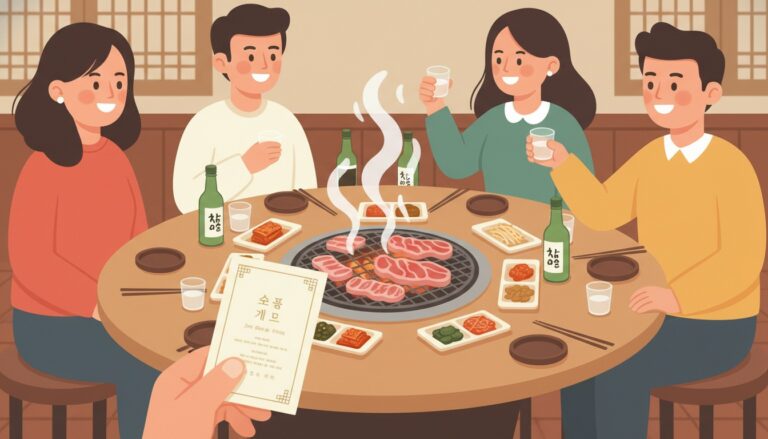
Phase 1: The “Cheong-mo” Panic — An Immersive Hook
Hello! Daily Hangul Editor here.
Picture this: You’re getting married in three months. In many Western cultures, you might just mail a save-the-date card. Easy, right? But in Korea, if you just send a mobile invitation or a card without a face-to-face meeting, you might find your guest list shrinking fast.
Enter the ‘Cheong-mo’ (Cheong-cheop-jang Moim) — the ‘Wedding Invitation Gathering.’
It’s Friday night in Gangnam. You have 5 former colleagues meeting you. You need to hand them the invitation, but the unwritten rule is: If you hand over the card, you pay for the meal.
Now, the sweat starts. If you take them to a cheap gimbap place, you’re cheap. If you take them to a ‘Hanwoo’ (premium beef) restaurant, they might feel burdened (or think you’re showing off). You need a place that says, “I respect you enough to feed you well, but we can still talk loudly.”
This isn’t just dinner; it’s high-stakes diplomacy. Today, we dissect the advanced vocabulary of ‘Daejeop’ (Serving/Treating).
Phase 2: Deep Dive — The Vocabulary of Hospitality
1. 대접하다 (Daejeop-hada)
- Pronunciation: [Dae-jeop-ha-da] (Think of ‘Dad’ + ‘Job’, but softer ‘j’)
- Meaning: To treat/serve (Literal) vs. To show formal hospitality/respect through a meal (Nuance)
- K-Culture Moment: In K-Dramas, when a future mother-in-law cooks a massive meal for the protagonist, she’ll say, “차린 건 없지만 많이 들어요.” (I haven’t prepared much, but eat up). That act is daejeop.
- Editor’s Insight: This isn’t just “buying lunch.” Using this word implies you are putting effort into the guest’s comfort. It elevates the meal to a ‘serving’ event.
- Situation Spectrum:
[🚫 Friends] ———— [✅ Elders/Formal] ———— [✅ Important Guests]- 🤔 Think About It: Why does Korean differentiate between “buying a meal” (사다) and “serving a meal” (대접하다)? It suggests that food is a medium of respect, not just nutrition.
2. 호불호가 갈리다 (Hobulho-ga gallida)
- Pronunciation: [Ho-bul-ho-ga gal-li-da]
- Meaning: Likes and dislikes are split (Literal) vs. It’s polarizing / Hit or miss (Nuance)
- K-Culture Moment: Selecting a menu like Gopchang (intestines) or spicy chicken feet. You’ll hear the organizer ask, “이거 호불호 갈리는데 괜찮아?” (This is polarizing, is it okay?)
- Editor’s Insight: At a C2 level, you don’t ask “Do you like this?” You assess the risk of the menu. A good host minimizes hobulho.
- Situation Spectrum:
[✅ Casual] ———— [✅ Business] ———— [✅ Formal]3. 무난하다 (Munan-hada)
- Pronunciation: [Mu-nan-ha-da]
- Meaning: Easy/Smooth (Literal) vs. Safe choice / Acceptable to everyone / Foolproof (Nuance)
- Editor’s Insight: This is the holy grail of Cheong-mo menus. Pasta, clean BBQ places, or modern Chinese fusion. It’s not necessarily “amazing,” but it prevents complaints. It’s the strategy of “minimizing errors.”
- Situation Spectrum:
[✅ All Situations]
Phase 3: Textbook vs. Real Life
| Situation | 📖 Textbook Korean | 🗣️ Real Korean (Insider Vibe) | 💡 Why the difference? |
|---|---|---|---|
| Checking Preferences | 어떤 음식을 좋아하세요? (What food do you like?) | 혹시 못 먹는 거 있어? (Is there anything you can’t eat?) | “What do you like?” is too broad. Asking specifically for exclusions (allergies, dislikes) is more efficient for group bookings. |
| Paying the Bill | 제가 계산하겠습니다. (I will calculate/pay.) | 이건 내가 대접하고 싶어서 그래. (I’m doing this because I want to treat/serve you.) | Just saying “I’ll pay” can trigger a fight for the bill. Adding “daejeop” shuts down the argument politely. |
| Menu Selection | 메뉴판을 주세요. (Menu, please.) | 여기서 제일 무난한 게 뭐예요? (What is the most ‘safe/standard’ dish here?) | You want to avoid ‘risky’ foods when hosting a large group. |
Phase 4: Cultural Deep Dive — The “Meal” Debt
4-1. The Psychology of “Buju” (부조)
Why are Koreans so obsessed with buying expensive dinners when handing out wedding invitations? It ties back to Reciprocity. Guests will bring Bujogeum (congratulatory money) to the wedding — usually ranging from 50,000 to 200,000 KRW depending on closeness. The Cheong-mo dinner is essentially a “pre-payment” of gratitude. If you feed them a $5 noodle soup but they bring $100, the “emotional balance sheet” is off, and you lose face.
4-2. K-Food Connection: The “Set Menu” Savior
In K-Dramas, you often see characters ordering “Set A” or “Set B.” For a Cheong-mo, Set Menus are a lifesaver. They remove the burden of choice from the guests (who might pick the cheapest thing to be polite) and ensure everyone gets a “full course” experience without the host looking cheap. Italian restaurants and Chinese courses are popular for this reason — individual plates vs. shared dishes is a strategic choice based on intimacy.
Phase 5: Immersive Roleplay — The Menu Negotiation
Setting: A trendy Italian bistro in Seongsu-dong. Friday, 7 PM. You (Foreigner, Groom-to-be) are meeting 3 close Korean friends (mix of male/female).
Characters:
* YOU: Nervous about the budget but wants to look generous.
* Minji: Practical friend, tells it like it is.
Dialog:
YOU: 애들아, 와줘서 고마워. 오늘 식사는 내가 대접할게.
(Guys, thanks for coming. I will treat [serve] you for today’s meal.)
Minji: 야, 무슨 대접이야~ 우리가 사줘야지! 결혼 준비하느라 돈도 많이 들 텐데.
(Hey, what do you mean ‘serve’? We should buy YOU dinner! You must be spending a lot on prep.)
YOU: 아냐, 청첩장 주는 날이잖아. 내가 사고 싶어서 그래.
(No, it’s the invitation day. I’m doing this because I want to buy.)
Minji: 알았어. 그럼 우리 너무 비싼 거 말고 무난하게 파스타 세트로 갈까?
(Okay. Then instead of something too expensive, shall we go with a safe/standard pasta set?)
🔀 Decision Point: How do you respond to her trying to save you money?
– A) “그래, 그게 좋겠다. 가성비로 가자.” (Sure, let’s go for cost-effectiveness.)
– B) “에이, 오늘은 스테이크 먹자! 내가 신경 좀 썼어.” (Ey~ Let’s eat steak today! I put some effort into this.)
– C) “너 먹고 싶은 거 아무거나 다 시켜.” (Order whatever you want.)
✅ Best Choice: B
* Why? Option A makes you look cheap on a special day. Option C is risky because Koreans often hesitate to order expensive items on someone else’s tab. Option B politely overrides their concern and elevates the “daejeop” vibe. “I put some effort into this” (신경 좀 썼어) is a magic phrase.
Phase 6: 10-Second Shadowing Drill
Let’s practice the “Closing Comment” after the meal. This shows grace.
“음식이 / 입에 맞으셨는지 / 모르겠네요. / 와주셔서 감사합니다!”
- Romanization: Eumsigi / ibe majeuseyunji / moreugenneyo. / Wajuseyoseo gamsahamnida!
- Meaning: I don’t know if the food suited your taste. Thank you for coming!
- Emotion: 😊 Humble but Warm (Slight bow of the head)
Phase 7: K-Culture Mini Dictionary
| Korean | Romanization | Meaning | Context |
|---|---|---|---|
| 청모 | Cheong-mo | Wedding Invitation Gathering | Short for 청첩장 모임. The official term for these stress-inducing dinners. |
| 엔빵 | N-bbang | Dutch Pay | splitting the bill 1/N. NEVER do this at a Cheong-mo if you are the host. |
| 2차 | I-cha | Round 2 | Usually a bar or cafe after dinner. Often, the friends will pay for this round to thank the host for dinner. |
| 가심비 | Ga-sim-bi | Price-to-Satisfaction Ratio | Unlike ‘cost-effectiveness’ (Ga-seong-bi), this focuses on psychological satisfaction. Essential for wedding meals. |
Phase 8: Traveler’s Survival Kit — The “Treating” Logic
Even if you aren’t getting married, you might want to treat a Korean friend who helped you during your travels. Here is how to do it without making it awkward.
🆘 Survival Expression: Paying the Bill
– 🇰🇷 “오늘은 제가 쏠게요!” (Oneul-eun jega ssol-ge-yo!)
– Meaning: I’ll shoot (pay) today!
– 📍 Where to use: Anywhere casual (BBQ, Cafe, Pub).
– 💡 Pro Tip: If they resist, say “한국에선 연장자가 내는 거라면서요?” (I heard the older person pays in Korea?) if you are older. It’s a funny cultural flex that works 100% of the time.
Phase 9: Think Deeper — The Burden of “Relationship Maintenance”
Food & Identity: In many Western cultures, an invitation is just information. In Korea, an invitation is a transaction of affection. The quality of the meal you serve at a Cheong-mo is often interpreted as a direct metric of how much you value that relationship. This creates immense social pressure.
🧠 Think Deeper: Is this “pre-payment” culture purely transactional, or is it a beautiful way to ensure people gather and break bread? Does your culture have a similar “mandatory treating” ritual?
Phase 10: FAQ & Troubleshooting
Q: Can I just invite people over Kakaotalk?
A: For close friends? Maybe. For elders or colleagues? Absolute No. It’s considered ‘rude’ because it looks like you just want their money without putting in the effort to meet them. The ‘Cheong-mo’ is the effort verification process.
Q: If I’m the guest at a Cheong-mo, do I bring a gift?
A: Usually, no. You bring the gift (money) on the wedding day. However, buying the “2nd round” (coffee or drinks) is the polite way to say thanks for the dinner.
❌ Common Mistake: Asking “How much was it?” at the end of the meal.
✅ Fix: Just say, “잘 먹었습니다” (I ate well/Thanks for the meal). Mentioning the price makes the ‘daejeop” feel cheap.
Phase 11: Wrap-up & Mission
One-Liner: A Cheong-mo isn’t about food; it’s about showing your guests, “You are worth this $50 steak.”
🚀 Action Mission:
* 🥉 Bronze: Practice saying “제가 대접하고 싶어요” in front of a mirror.
* 🥈 Silver: Go to a Korean restaurant and ask the server, “호불호 없는 메뉴가 뭐예요?” (What menu has no likes/dislikes?)
* 🥇 Gold: Treat a friend to a meal and refuse their money by saying, “오늘은 내가 대접하는 거야.”
💬 Your Turn: Have you ever felt pressured to buy dinner for a large group? How did you handle the menu? Tell me below!
Frequently Asked Questions (FAQ)
Q: What does "대접하다 (Daejeop-hada)" mean in Korean and how do you pronounce it?
A: In Korean, "대접하다 (Daejeop-hada)" is pronounced [Dae-jeop-ha-da] and means: To treat/serve (Literal) vs. To show formal hospitality/respect through a meal (Nuance)
Q: What does "호불호가 갈리다 (Hobulho-ga gallida)" mean in Korean and how do you pronounce it?
A: In Korean, "호불호가 갈리다 (Hobulho-ga gallida)" is pronounced [Ho-bul-ho-ga gal-li-da] and means: Likes and dislikes are split (Literal) vs. It’s polarizing / Hit or miss (Nuance)
Q: What does "무난하다 (Munan-hada)" mean in Korean and how do you pronounce it?
A: In Korean, "무난하다 (Munan-hada)" is pronounced [Mu-nan-ha-da] and means: Easy/Smooth (Literal) vs. Safe choice / Acceptable to everyone / Foolproof (Nuance)







