

Phase 1: The “Human Popsicle” Experience
Annyeonghaseyo! It’s your editor at Daily Hangul.
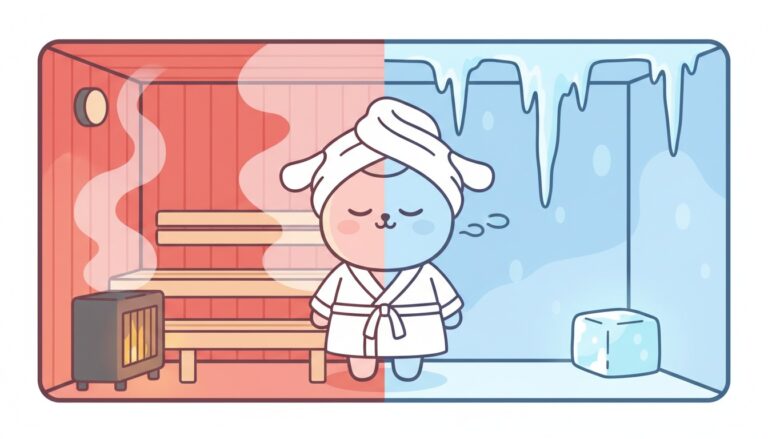
Picture this: You’ve just spent 15 minutes in a 80°C (176°F) charcoal sauna. You are sweating from places you didn’t know could sweat. Your face is red, your breath is heavy. You stumble out of the heat and see a door covered in frost.
The Ice Room (아이스방 – Aiseubang).
In K-Dramas, this is often where the cute couple hides to cool down, or where characters in variety shows like Running Man have to endure freezing penalties. But in real life? It’s the sweetest relief you will ever feel… for exactly 30 seconds. Then, it becomes a survival mission.
Today, we’re going to learn what to say when you go from “melting lava” to “frozen statue” in seconds. Knowing these phrases isn’t just about temperature; it’s about expressing that specific Korean emotion of extreme relief mixed with mild suffering.
Phase 2: Deep Dive into “Freezing” Korean
Here are the three phrases you’ll hear (and say) the most inside that freezer.
1. 살 것 같아요 (Sal geot gatayo)
- Pronunciation: [Sal-got-ga-ta-yo] (Sounds like: “Sal” as in Salmon + “got” + “ga-ta-yo”)
- Meaning:
- Literal: It seems like I will live.
- Real Nuance: “I feel alive again!” or “What a relief!”
- K-Culture Moment: You step out of the burning hot Bulgama (fire sauna) and enter the cool air. This is the involuntary sigh that escapes your mouth. It’s the ultimate expression of relief.
- Editor’s Insight: We use this for any relief—drinking water when thirsty, sitting down after a long hike, or entering the Ice Room. It’s dramatic, but that’s the Korean way.
- Situation Spectrum:
[🚫 Boss] ———— [⚠️ Co-worker] ———— [✅ Friends/Family]
(This is safe to say to yourself or friends. With a boss, maybe add a polite nod!) - 🤔 Think About It: Why do Koreans equate relief with “survival”? It shows how intense the stressful situation was!
2. 너무 시원해요! (Neomu siwonhaeyo!)
- Pronunciation: [No-moo she-won-hae-yo]
- Meaning:
- Literal: It is very cool.
- Real Nuance: “It’s so refreshing!”
- K-Culture Moment: Be careful! Inside a hot tub, an old man might say “Siwonhada” (It’s refreshing/relieving). But in the Ice Room, it literally means cool/cold. Context is king!
- Situation Spectrum:
[🚫 Formal Speech] ———— [⚠️ Semi-formal] ———— [✅ Casual]
(Perfectly fine to say to anyone in the room as a general comment.)
3. 추워 죽겠어요 (Chuwo juk-gess-eo-yo)
- Pronunciation: [Chu-wo juk-gess-uh-yo]
- Meaning:
- Literal: I will die from cold.
- Real Nuance: “I’m freezing to death!”
- Editor’s Insight: Koreans love adding “~jukgesseo” (die of…) to adjectives. Hungry to death, tired to death, cold to death. It’s not morbid; it’s just emphatic!
- Situation Spectrum:
[🚫 Strict Business] ———— [⚠️ Standard] ———— [✅ Casual]
(Very common in daily conversation.)
Phase 3: Textbook vs. Real Life
Let’s see how a textbook robot speaks versus a real person in a Jjimjilbang.
| Situation | 📖 Textbook Korean | 🗣️ Real Korean | 💡 Why the difference? |
|---|---|---|---|
| Entering the Ice Room | 이곳은 시원합니다. (This place is cool.) | 와, 천국이다! (Wow, this is heaven!) | Emotions come first! We express feeling, not just facts. |
| Feeling too cold | 저는 춥습니다. (I am cold.) | 으~ 얼어 죽겠다! (Ugh, gonna freeze to death!) | Koreans use exaggeration (dying) to emphasize the intensity. |
| Wanting to leave | 나가고 싶어요. (I want to go out.) | 나가자, 못 참겠다. (Let’s go, I can’t take it.) | “I can’t endure it” sounds more natural in a challenge situation. |
Bottom Note: As an A2 learner, stick to “너무 추워요” (It’s too cold) if you forget the slang. Everyone will understand!
Phase 4: Cultural Context — The Art of “Gore”
Wait, not blood and guts! I mean Go-saeng (Suffering).
4-1. The “Hot-Cold” Cycle
In Korean sauna culture, the magic happens in the contrast. You don’t just sit in the heat; you cycle between extreme heat and extreme cold. This is believed to tighten pores and boost circulation.
4-2. The “Couple” Dynamic
In K-Dramas, the Ice Room is often a romantic plot device. The guy gives his jacket to the shivering girl (even though they are both wearing sauna uniforms, somehow he has a towel/blanket?).
* Non-verbal Tip: If you are with friends, huddling together for warmth is totally acceptable and funny. It’s called “skinship” and it bonds people.
Phase 5: Roleplay — The 30-Second Limit
Setting: It’s 10 PM on a Saturday. You and your Korean friend, Min-su, have just escaped the 90-degree Bulgama. You run into the Ice Room.
(🚪 Sound of heavy door opening: Whoosh)
YOU: (Exhaling deeply) 와… 살 것 같아요!
(Wa… sal geot gatayo!)
(Wow… I feel alive again!)
Min-su: 대박 시원하지? 근데 땀 식으니까 좀 춥다.
(Daebak siwonhaji? Geunde ttam sigeunikka jom chupda.)
(It’s crazy cool, right? But now that the sweat is drying, it’s a bit cold.)
YOU: 맞아요. 여기가 냉동실 같아요.
(Majayo. Yeogiga naengdongsil gatayo.)
(Right. It’s like a freezer here.)
Min-su: (Rubbing his arms) 야, 나가자. 입 돌아가겠다.
(Ya, nagaja. Ip doragagetta.)
(Hey, let’s go out. My mouth is going to freeze crooked.)
🔀 Your Turn! How do you respond?
- A) “네, 빨리 나가요!” (Yes, let’s go out quickly!) — Safe & Agreeable
- B) “아니요, 1분만 더 있어요!” (No, let’s stay 1 more minute!) — The Challenger
- C) “추워 죽겠어요!” (I’m freezing to death!) — The Complainer (Funny)
✅ Best Choice: A or C. Usually, the Ice Room is a quick stop. Staying too long when your friend is cold might be annoying unless you are playing a game!
Phase 6: 10-Second Shadowing Drill
Practice this sentence. It captures the essence of the Jjimjilbang experience.
“땀 뺀 다음에 / 아이스방은 / 천국이에요!”
(Ttam ppaen da-eume / aiseubang-eun / cheon-guk-ieyo!)
- Translation: After sweating / the ice room / is heaven!
- Emotion: 😊 Pure Bliss (Close your eyes when you say “Cheon-guk”)
- Rhythm: Ttam ppaen da-eume (pause) / aiseubang-eun (pause) / cheon-guk-ieyo!
Phase 7: K-Culture Mini Glossary
| Korean | Romanization | Meaning | Context |
|---|---|---|---|
| 양머리 | Yangmeori | Sheep Head | The towel folded to look like sheep horns. Essential for cute selfies. |
| 식혜 | Sikhye | Rice Punch | The sweet, icy drink you MUST drink after the sauna. |
| 맥반석 계란 | Maekbanseok Gyeran | Sauna Eggs | Brown, roasted eggs. Crack them on your friend’s head (gently) for fun. |
| 불가마 | Bulgama | Fire Kiln | The super-hot sauna room. The arch-nemesis of the Ice Room. |
Phase 8: Traveler’s Survival Kit
Going to a Jjimjilbang for the first time? Keep these in mind inside the Ice Room.
🆘 Survival Phrases
1. “너무 추워요!” (Neomu chuwoyo!) – It’s too cold!
2. “문 닫아 주세요.” (Mun dada juseyo.) – Please close the door. (If someone leaves it open and lets the cold out/heat in).
3. “여기 자리 있어요?” (Yeogi jari isseoyo?) – Is this seat taken? (Use this if the bench is crowded).📌 Editor’s Pro Tip
* Don’t Sleep Here: It is dangerous to fall asleep in the Ice Room due to hypothermia risk. Use the main hall (Sleeping Room) for naps.
* Phone Warning: Extreme temperatures (hot or cold) drain your battery fast. Leave your phone in your locker or the main hall.
Phase 9: Think Deeper — Why the Extremes?
Mental Refreshment:
Have you noticed Korean food is often very spicy, and saunas are very hot or very cold? There is a cultural concept called “Yi-yeol-chi-yeol” (fighting heat with heat), but also a love for intense sensory stimulation to relieve stress.
Instead of a lukewarm, gentle relaxation, many Koreans prefer a “hard reset” for their body. The shock of the Ice Room forces you to forget your worries instantly because your brain is screaming “COLD!”
💬 Your Turn: Does your country have a culture of extreme temperatures (like polar plunges or extreme saunas)? Tell us in the comments!
Phase 10: FAQ & Troubleshooting
Q: Can I take my Sikhye (Rice Punch) into the Ice Room?
A: Yes! Sipping icy Sikhye in the Ice Room is the ultimate luxury. Just don’t spill it, or the sticky floor will be a nightmare.
Q: Is it rude to make loud noises when it’s cold?
A: Not really. Making sounds like “Uh-uh-uh!” (shivering sounds) is considered natural. Just don’t scream.
❌ Common Mistake: Bringing a blanket from the sleeping area into the Ice Room.
✅ Fix: The Ice Room is meant to be experienced with just your sauna clothes. If you need a blanket, you shouldn’t be in there!
Phase 11: Wrap-up & Mission
Summary: Today we learned how to express relief (“Sal geot gatayo”) and complain about the cold (“Chuwo jukgess-eo”) in the Jjimjilbang Ice Room.
🏆 Action Mission:
* 🥉 Bronze: Practice saying “Sal geot gatayo” next time you drink a cold glass of water.
* 🥈 Silver: Google “How to make Korean Sheep Head Towel” and make one with a hand towel at home.
* 🥇 Gold: Visit a Korean spa in your city (or Seoul!), enter the Ice Room, and say “Wa, cheon-guk-ida!”
See you in the next lesson (maybe in the hot tub)!
Frequently Asked Questions (FAQ)
Q: What does "살 것 같아요 (Sal geot gatayo)" mean in Korean and how do you pronounce it?
A: In Korean, "살 것 같아요 (Sal geot gatayo)" is pronounced [Sal-got-ga-ta-yo] and means: Literal: It seems like I will live.
Q: What does "너무 시원해요! (Neomu siwonhaeyo!)" mean in Korean and how do you pronounce it?
A: In Korean, "너무 시원해요! (Neomu siwonhaeyo!)" is pronounced [No-moo she-won-hae-yo] and means: Literal: It is very cool.
Q: What does "추워 죽겠어요 (Chuwo juk-gess-eo-yo)" mean in Korean and how do you pronounce it?
A: In Korean, "추워 죽겠어요 (Chuwo juk-gess-eo-yo)" is pronounced [Chu-wo juk-gess-uh-yo] and means: Literal: I will die from cold.







