

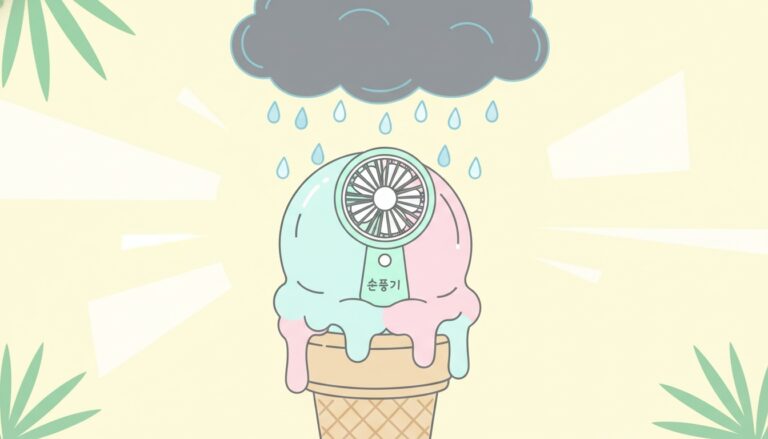
Why You Feel Like a Melted Gummy Bear in Korea: Surviving the Humidity
Phase 1: The ‘Sauna’ Welcome
Hello! Your Daily Hangul editor here. Let me set the scene.
You’ve just landed at Incheon Airport in mid-July. You watched 10 hours of K-Dramas on the flight where the characters wore crisp linen shirts and looked refreshingly cool. You grab your bags, walk through the automatic sliding doors to the curbside pickup, and then—WHAM.
It hits you. It’s not just heat. It feels like you’ve walked into a steamy bathroom after someone took a hot shower. Your shirt sticks to your back instantly. Your hair? It’s doing things you didn’t approve of.
Welcome to Korean summer. Welcome to Jangma (장마 – Rainy Season).
In K-Dramas, they skip this part (or fix it with a team of stylists). But in real life, if you don’t know how to complain about the humidity, you can’t bond with Koreans. Complaining about the weather here isn’t just small talk; it’s a national sport.
Let’s learn how to express that sticky, gross feeling so you can suffer together with the locals.
Phase 2: Deep Dive — The ‘Sticky’ Situation
Here are the three expressions that will make Koreans nod in sympathy.
1. 끈적거려요 (Kkeun-jeok-geo-ryeoyo)
- Pronunciation: [kkeun-jeok-geo-ryeoyo]
Tip: The ‘Kkeun’ sounds tight and sticky, like stepping on chewing gum.- Meaning: It’s sticky / I feel sticky.
- Real Nuance: This isn’t just about the air. It’s about your skin. It’s that gross feeling when your arm touches the table and peels off with a sound.
- K-Culture Moment: You’ll hear this in variety shows when celebs are doing outdoor missions in July. They aren’t trying to be funny; they are genuinely miserable.
- Situation Spectrum:
[🚫 Formal Speech] ———— [⚠️ Colleagues] ———— [✅ Friends/Casual]
(Safe to use with almost anyone if you are talking about the weather, not a person!)- 🤔 Think About It: Why does Korean have a specific onomatopoeia (sound word) just for stickiness? It shows how tactile the language is.
2. 습해요 (Seu-paeyo)
- Pronunciation: [seu-paeyo] (Sounds a bit like ‘Soup-ae-yo’)
- Meaning: It is humid.
- Real Nuance: This is the factual statement. You check your weather app, it says 90% humidity, you say “Ah, seu-paeyo.”
- Editor’s Insight: While correct, it lacks the emotional punch of ‘Kkeun-jeok-geo-ryeoyo’. Use this when talking to a taxi driver or a shop owner for polite small talk.
3. 불쾌지수 (Bul-kwae-ji-su)
- Pronunciation: [bul-kwae-ji-su]
- Meaning: Discomfort Index (literally: Unpleasantness Index).
- Real Nuance: This is a semi-scientific term used on the news, but everyone uses it. It measures stress levels based on heat + humidity.
- K-Drama Context: When the boss is yelling for no reason in a summer episode, an employee might whisper, “Today’s discomfort index must be 100.”
- 🤔 Think About It: Korea quantifies “annoyance” into a number. Does your country measure how irritable people are based on the weather?
Phase 3: Textbook vs. Real Life
| Situation | 📖 Textbook Korean | 🗣️ Real Korean | 💡 Why the difference? |
|---|---|---|---|
| Walking outside | 습도가 매우 높습니다. (Humidity is very high.) |
아, 완전 찜통이네. (Ah, it’s totally a steamer.) |
‘Jjim-tong’ means a steamer pot. We love food metaphors for misery. |
| Touching your arm | 땀이 나서 끈적거립니다. (It is sticky because of sweat.) |
으, 끈적거려. (Ugh, sticky.) |
Dropping the subject/particles makes it feel more immediate and emotional. |
| Checking the app | 날씨가 안 좋습니다. (The weather is bad.) |
숨이 턱턱 막혀요. (My breath is blocked.) |
Koreans emphasize the physical sensation of heavy air. |
Phase 4: Cultural Deep Dive — The Survival Tools
4-1. The Magic Wand: Son-pung-gi (Handheld Fan)
If you see someone walking down the street holding a small plastic stick buzzing near their face, they aren’t playing with a toy. That is a Son-pung-gi (손풍기). In July and August, this is not an accessory; it is life support. Not having one marks you as a tourist immediately.
4-2. The Food Cure: Yi-yeol-chi-yeol (Fight Heat with Heat)?
There is a traditional saying: Yi-yeol-chi-yeol (이열치열), meaning “control heat with heat.” Some older Koreans eat boiling hot Ginseng Chicken Soup (Samgyetang) on the hottest days.
But let’s be real. Most young Koreans just run to a cafe for Bingsu (shaved ice) or eat Naengmyeon (cold noodles with ice broth). If you invite a friend to eat hot soup when the humidity is 95%, you might lose that friend.
Phase 5: Roleplay — The Street Corner Meltdown
Setting: It’s 2 PM in Hongdae. The asphalt is radiating heat. The air is thick enough to chew. You are meeting your Korean friend, Min-ji.
Min-ji: (Fanning herself frantically with a flyer) 와, 날씨 실화야? 녹아내릴 것 같아.
(Wa, nalssi silhwaya? Noga-naeril geot gata.)
[Translation] Wow, is this weather for real? I feel like I’m melting.
🔀 YOUR TURN! How do you respond?
Option A: “네, 기온이 높네요.” (Yes, the temperature is high.)
Option B: “진짜 끈적거려요. 빨리 카페로 피신해요!” (It’s seriously sticky. Let’s escape to a cafe quickly!)
Option C: “우리 한강 공원에 산책 갈까요?” (Shall we go for a walk at Han River Park?)
Analysis:
– Option A: Too robotic. You sound like a weather bot.
– Option B (✅ Best Choice): Perfect! You acknowledged the specific feeling (sticky) and proposed a solution (AC).
– Option C (🚫 Death Wish): Do not suggest outdoor activities in high humidity unless you want Min-ji to hate you. The Han River is for after sunset.
Continue with Option B:
YOU: 진짜 끈적거려요. 빨리 카페로 피신해요!
(Jinjja kkeun-jeok-geo-ryeoyo. Ppal-li ka-pe-ro pi-sin-haeyo!)
Min-ji: (Laughs) 맞아! 에어컨이 필요해. 저기 스타벅스 가자.
(Maja! E-eo-keon-i pir-yo-hae. Jeogi Starbucks gaja.)
[Translation] Right! We need air conditioning. Let’s go to that Starbucks.
Phase 6: 10-Second Shadowing Drill
Don’t just read it, feel the stickiness and say it!
Emotion: 😖 Disgusted / Uncomfortable
“오늘 / 습도가 / 장난 아니에요.”
(Oneul / seup-do-ga / jangnan anieyo.)
“The humidity / today / is no joke.”
Note: ‘Jangnan anida’ (is no joke) is the most versatile phrase to emphasize anything extreme in Korea.
Phase 7: K-Culture Glossary
| Word | Romanization | Meaning | Context |
|---|---|---|---|
| 장마 | Jangma | Rainy Season | Usually late June to late July. Endless rain and humidity. |
| 찝찝하다 | Jjim-jjim-hada | Feeling gross/sticky | Used when you feel sweaty or unclean due to humidity. |
| 제습기 | Je-seup-gi | Dehumidifier | The most essential appliance in a Korean home during summer. |
| 열대야 | Yeol-dae-ya | Tropical Night | When the temp doesn’t drop below 25°C (77°F) at night. Sleep killer. |
Phase 8: Traveler’s Survival Kit
Top 3 Expressions for the Humid Hellscape
🆘 Survival Phrase #1: “에어컨 좀 세게 틀어주세요.”
(E-eo-keon jom se-ge teul-eo-ju-se-yo)
Meaning: Please turn up the air conditioner (make it stronger).
Where: Taxi, Hotel front desk.🆘 Survival Phrase #2: “아이스 아메리카노 주세요.”
(Ice Americano ju-se-yo)
Meaning: Iced Americano, please.
Why: This is the national fuel of Korea. It’s not just coffee; it’s hydration.📌 Editor’s Travel Note
– Hair Danger: If you have curly or frizzy hair, bring your strongest anti-frizz product. Korean humidity takes no prisoners.
– Malls are Safe Zones: If you can’t handle the heat outside, duck into a COEX or Lotte World Mall. They keep the AC at arctic levels.
Phase 9: Think Deeper — Why so obsessed with the weather?
The Collective Stress of ‘Bul-kwae-ji-su’
In many Western cultures, asking “How are you?” is a greeting. In Korea, commenting on the weather serves a similar function but with a twist: it’s about shared suffering.
When two Koreans say, “The discomfort index is terrible today,” they are validating each other’s irritation. It’s a way of saying, “If I seem cranky, it’s not you, it’s the air.” This collective acknowledgment helps maintain social harmony (Kibun) by blaming an external factor—the weather—for bad moods. So, when you complain about the humidity, you aren’t being negative; you’re being socially calibrated.
💬 Your Turn: Does your language have a way to blame the weather for your bad mood?
Phase 10: Troubleshooting & FAQ
Q: Can I wear flip-flops (slides) everywhere since it rains so much?
A: In casual settings, yes. But looking at people’s feet is sometimes considered unrefined in older generations. In “hip” places like Seongsu or Hongdae, anything goes. But if you are visiting a temple or a somewhat nice restaurant, sandals with a back strap are safer than rubber slides.
❌ Common Mistake: Saying “It is hot” (더워요) when it’s actually just humid.
✅ Fix: If it’s 25°C but sticky, use “습해요” (It’s humid). Koreans distinguish clearly between dry heat and wet heat.
Phase 11: Wrap-up & Mission
One-Liner: Korean summer is sticky (끈적거려요), so grab a handheld fan and an Iced Americano to survive the Discomfort Index.
Action Missions:
– 🥉 Bronze: Look in the mirror after a shower and say “Ah, 끈적거려!” (Ah, sticky!)
– 🥈 Silver: Check the weather app for Seoul right now. If humidity is over 60%, post a screenshot on social media with the caption “Seu-paeyo!”
– 🥇 Gold: Go to a Korean cafe (or any cafe) and order an Iced Americano while fanning yourself, channeling your inner K-Drama lead.
K-Culture Mission: Watch a K-Pop music show performance from July or August. Look at the idols’ hair. If it looks wet, it’s not gel—it’s the humidity. Respect their hard work!
Stay cool, everyone!
Frequently Asked Questions (FAQ)
Q: What does "끈적거려요 (Kkeun-jeok-geo-ryeoyo)" mean in Korean and how do you pronounce it?
A: In Korean, "끈적거려요 (Kkeun-jeok-geo-ryeoyo)" is pronounced [kkeun-jeok-geo-ryeoyo] and means: It's sticky / I feel sticky.
Q: What does "습해요 (Seu-paeyo)" mean in Korean and how do you pronounce it?
A: In Korean, "습해요 (Seu-paeyo)" is pronounced [seu-paeyo] and means: It is humid.
Q: What does "불쾌지수 (Bul-kwae-ji-su)" mean in Korean and how do you pronounce it?
A: In Korean, "불쾌지수 (Bul-kwae-ji-su)" is pronounced [bul-kwae-ji-su] and means: Discomfort Index (literally: Unpleasantness Index).







