

Lazy or Just “Gwichana”? How to Say You Don’t Want to Move in Korean
Phase 1: The “Floor is Lava” Mood 🛋️
안녕하세요! Hello, Daily Hangul family. Your editor is writing this while seriously debating if I should get up to grab another coffee or just stay in my chair forever.
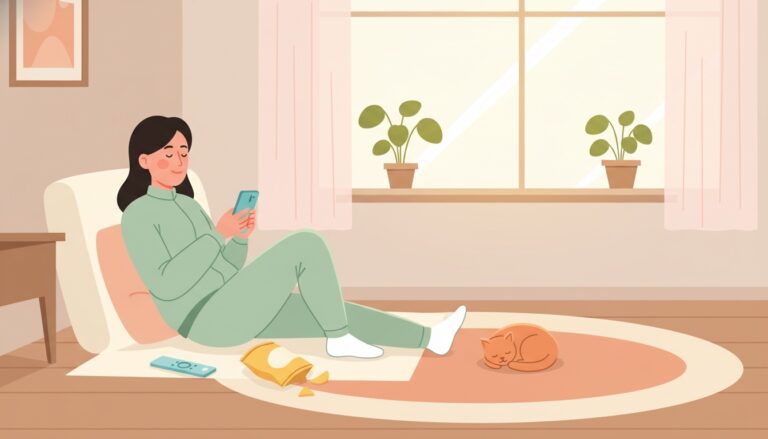
We’ve all seen that classic K-Drama scene: It’s the weekend. The main character isn’t wearing a fancy suit or a trendy dress. They are wearing a matching tracksuit (probably green or pink), lying on the floor—not the sofa, the floor—staring at the ceiling.
Their friend calls and asks, “Want to go hiking?”
The response isn’t just “No.”
It’s a long, agonizing groan followed by: “Ah… Gwichana…”
Today, we aren’t just learning the word for “lazy.” We are learning the Korean art of doing absolutely nothing. If you use these words correctly, your Korean friends won’t think you are rude; they’ll just say, “Me too, let’s order chicken.”
Phase 2: Deep Dive into Laziness
Here are the three expressions that define the Korean “chill” mode.
1. 게을러요 (Ge-eul-leo-yo)
- Pronunciation: [Ge-eul-leo-yo] Sounds like “Get-ul-low-yo” without the ‘t’.
- Meaning: I am lazy. (Adjective)
- K-Culture Moment: You might hear a parent in a drama scolding their child: “Why are you so ge-eul-leo? Wake up!”
- Editor’s Insight: This describes a personality trait. If you say “Jeo-neun ge-eul-leo-yo” (I am lazy), you are saying laziness is part of who you are. It’s a bit self-critical.
- Situation Spectrum:
[🚫 Boss] ———— [⚠️ Colleague] ———— [✅ Friends]- 🤔 Think About It: In many cultures, admitting you are lazy is bad. But in Korea, admitting it humorously among friends can be a way to bond over the stress of a busy life.
2. 귀찮아요 (Gwi-chan-a-yo) ⭐ MUST KNOW
- Pronunciation: [Gwi-chan-a-yo] Sounds like “Gwee-chan-ah-yo”
- Meaning: It’s a hassle / I can’t be bothered.
- K-Culture Moment: Every variety show ever. When a K-Pop idol is asked to do a complex dance challenge immediately after waking up, their face says Gwi-chan-a-yo.
- Editor’s Insight: This is the Real MVP of Korean daily life. It doesn’t mean you are a lazy person. It means the task is annoying. You can be a hardworking person but feel gwichana about washing dishes.
- Situation Spectrum:
[🚫 Boss] ———— [⚠️ Colleague] ———— [✅ Friends]3. 뒹굴뒹굴 (Dwing-gul-dwing-gul)
- Pronunciation: [Dwing-gul-dwing-gul]
- Meaning: Rolling around doing nothing.
- K-Culture Moment: A text message caption on a photo of someone lying in bed with snacks.
- Editor’s Insight: This is a mimetic word (sound effect word). It mimics the sound/motion of a round object rolling. It’s a cute way to say you’re having a lazy day.
- Situation Spectrum:
[🚫 Boss] ———— [⚠️ Colleague] ———— [✅ Friends/Social Media]
Phase 3: Textbook vs. Real Life
| Situation | 📖 Textbook Korean | 🗣️ Real Korean | 💡 Why different? |
|---|---|---|---|
| Rejecting a plan | 저는 게을러서 안 갈래요. (I won’t go because I’m lazy.) |
아, 귀찮아. 안 갈래. (Ah, it’s a hassle. Not going.) |
“Lazy” sounds like a confession. “Hassle” puts the blame on the situation! |
| Weekend plans | 집에서 쉴 거예요. (I will rest at home.) |
집에서 뒹굴뒹굴할 거야. (I’m gonna roll around at home.) |
Visual words like dwing-gul make you sound like a native speaker with vibes. |
Bottom Note: If you are beginner (A1), stick to “Oneul-eun jom pigon-haeyo” (I’m a bit tired today) if you want to be polite. Use Gwichana only with close friends!
Phase 4: Cultural Deep Dive — The “Halli Halli” Paradox
4-1. Why do Koreans love “Doing Nothing”?
Korea is famous for its “Halli Halli” (Quick Quick) culture. Everything is fast—delivery, internet, walking speed. Because daily life is so intense, being “lazy” on the weekend isn’t just laziness; it’s survival.
4-2. The Rise of the “Homebody” (Jipsuni/Jipdoli)
Have you heard the terms Jipsuni (Home-girl) or Jipdoli (Home-boy)? In K-Dramas, this used to be portrayed as “loser” behavior. Now? It’s a proud identity. Being a Jipsuni means you know how to enjoy your space—ordering delivery food, binge-watching Netflix, and wearing pajamas all day. It’s the ultimate “lazy” flex.
Phase 5: Roleplay — The Weekend Temptation 🎬
Setting: Saturday morning, 11 AM. You are lying on your bed. Your energetic friend, Minji, calls you.
Characters:
* YOU: A tired student/worker who wants to do nothing.
* Minji: Has way too much energy.
Dialogue:
Minji: 날씨 진짜 좋다! 한강 공원 갈래? ☀️
(Nalssi jinjja joda! Hangang gongwon gallae?)
[The weather is so good! Wanna go to Han River Park?]
YOU: (Choose your response!)
🔀 Your Turn! How do you answer?
- A) 미안해, 나 너무 게을러. (Mianhae, na neomu ge-eul-leo.)
- B) 아… 나가기 귀찮아. (Ah… nagagi gwi-chan-a.)
- C) 좋아! 가자! (Joa! Gaja!)
Analysis:
* Choice A: Grammatically correct, but sounds weird. You are calling yourself a lazy person just to say no to a park trip. Too dramatic.
* Choice B (Best Choice): “Ah… going out is a hassle.” This is the most natural Korean way to say you don’t want to move. It’s relatable.
* Choice C: You are clearly not lazy. Why are you reading this unit? (Just kidding!)
Minji: (If you picked B) 에이~ 맛있는 거 사 줄게!
(Ei~ Masinneun geo sa julge!)
[Ey~ I’ll buy you something delicious!]
YOU: 진짜? 그럼 갈게.
(Jinjja? Geureom galge.)
[Really? Then I’ll go.]
(Even a lazy person moves for free food. This is universal truth.)
Phase 6: 10-Second Shadowing Drill 🗣️
Read this aloud. Focus on the sigh at the beginning!
Emotion: Tired, whining, cute 🥺
아… / 아무것도 / 안 하고 / 싶어요!
(Ah… / amugeotdo / an hago / sipeoyo!)
Ah… I don’t want to do anything!
Phase 7: K-Culture Mini Glossary
| Korean | Romanization | Meaning | Context |
|---|---|---|---|
| 집순이 | Jipsuni | Homebody (female) | A girl who loves staying home. |
| 방콕 | Bang-kok | Staying in room | Pun on “Bangkok” (city). “Bang” (room) + “Kok” (stuck). |
| 멍 때리다 | Meong ttaerida | Space out | Staring blankly. There are even “Space Out” competitions in Korea! |
Phase 8: Traveler’s Survival Kit — Lazy Edition
Are you too lazy (or tired) to go out to a restaurant in Seoul? You don’t have to starve.
🆘 Survival Tool: Baedal (Delivery)
You don’t need to speak to anyone. Just use apps like Baemin or Yogiyo (or Shuttle for English service).
- Tip: If you are staying at a hotel, you usually have to go down to the lobby to pick up the food. The delivery driver won’t come to your room door.
- Expression: “문 앞에 놔 주세요.” (Mun ape nwa juseyo) = Please leave it in front of the door. (Great for introverts!)
Phase 9: Think Deeper — Laziness as Rebellion?
🧠 Think About It:
In a hyper-competitive society like Korea, where students study until midnight and office workers work overtime, saying “I’m lazy” or “Gwichana” is almost a small act of rebellion. It’s a way of reclaiming your time. In your country, is being “lazy” seen as resting, or is it judged negatively?
Phase 10: FAQ & Troubleshooting
Q: Can I say “Gwichana-yo” to my teacher if I didn’t do homework?
A: 🚫 ABSOLUTELY NOT. Saying “Doing homework was a hassle” to a teacher is a shortcut to getting in trouble. Use “I forgot” (Kkam-ppak haesseoyo) or “I was busy” (Bappasseoyo) instead.
Q: Is “Ge-eul-leo-yo” an insult?
A: Yes, if you say it to someone else. “You are lazy” is rude. Only use it to describe yourself humorously.
❌ Common Mistake:
Don’t confuse 피곤해요 (Pigon-haeyo / Tired) with 게을러요 (Ge-eul-leo-yo / Lazy).
* Pigon-haeyo = My body has no energy.
* Ge-eul-leo-yo = I have energy, but I refuse to use it.
Phase 11: Wrap-up & Mission
One-Liner: “Ge-eul-leo-yo” is for personality, “Gwichana-yo” is for the situation.
🔥 Action Mission:
* 🥉 Bronze: Say “Ah, Gwichana-yo” next time you drop your remote control.
* 🥈 Silver: Post a photo of your relaxing weekend on social media with the hashtag #뒹굴뒹굴.
* 🥇 Gold: Find the song “Lazy” by EXO-CBX or “Gwichanist” by Min Kyunghoon and listen to the lyrics!
💬 Your Turn: What is the one thing that makes you say “Gwichana” the most? Washing dishes? Going to the gym? Tell me in the comments!
Phase 12: Quick Quiz
1. Your Korean friend asks you to go jogging at 6 AM. You don’t want to. What is the most natural response?
a) I am a bad person.
b) Ah, Gwichana… (It’s a hassle…)
c) I love jogging!
2. True or False?
You should tell your boss “Reporting is Gwichana-yo” when you don’t want to work.
⬇️ Click to see answers
- b) This is the perfect time for “Gwichana.”
- False! Never say that to a boss unless you want to be fired!
Frequently Asked Questions (FAQ)
Q: What does "게을러요 (Ge-eul-leo-yo)" mean in Korean and how do you pronounce it?
A: In Korean, "게을러요 (Ge-eul-leo-yo)" is pronounced [Ge-eul-leo-yo] and means: I am lazy. (Adjective)
Q: What does "귀찮아요 (Gwi-chan-a-yo) ⭐ MUST KNOW" mean in Korean and how do you pronounce it?
A: In Korean, "귀찮아요 (Gwi-chan-a-yo) ⭐ MUST KNOW" is pronounced [Gwi-chan-a-yo] and means: It's a hassle / I can't be bothered.
Q: What does "뒹굴뒹굴 (Dwing-gul-dwing-gul)" mean in Korean and how do you pronounce it?
A: In Korean, "뒹굴뒹굴 (Dwing-gul-dwing-gul)" is pronounced [Dwing-gul-dwing-gul] and means: Rolling around doing nothing.







