

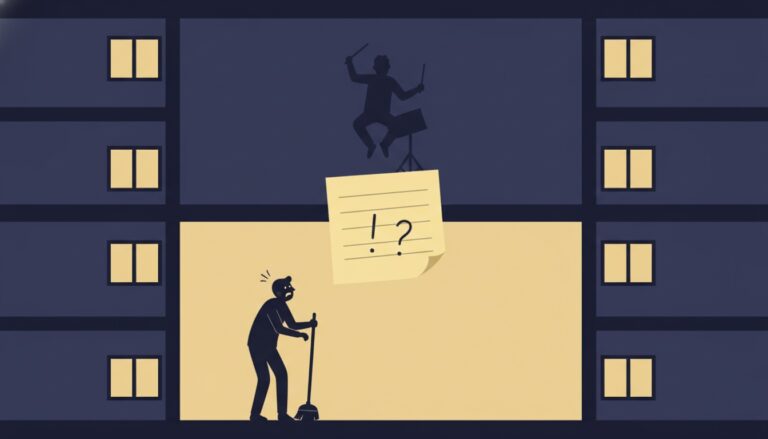
Phase 1: The Midnight Thump
Hello! Your Daily Hangul editor here. 👋
Picture this: It’s 11:30 PM. You’ve just finished a long day, poured yourself a glass of water, and settled into your sofa to watch the latest episode of your favorite K-Drama. Suddenly—THUMP. THUMP. DRRRRG.
It sounds like the person upstairs is practicing for a bowling tournament in their living room. In K-Dramas like Sweet Home or Strangers from Hell, apartment tension leads to horror. In real life Seoul, it leads to the “Intercom War.”
Floor noise, or 층간소음 (cheonggan soeum), is the arch-nemesis of Korean apartment living. As a C2 learner, you know how to order food. But do you know how to complain without starting a feud? Do you press the intercom button, or do you leave a passive-aggressive Post-it note on their door?
Today, we navigate the minefield of Korean neighbor etiquette. This isn’t just about language; it’s about survival in the concrete jungle.
Phase 2: The Art of the Polite Complaint
Direct confrontation is rare and risky in Korea. We prefer “polite friction.” Here are three C2-level expressions to handle this delicately.
1. 혹시 댁에서 나는 소리인가요?
Pronunciation: [Hoksi daek-eseo naneun sori-in-gayo?] + Imagine a detective asking a suspect, but the suspect is your mother-in-law.
Meaning: “By any chance, is this sound coming from your household?”
Nuance: You know it is. They know it is. But asking it as a question removes the accusation. Using 댁 (daek) instead of ‘집’ elevates the respect level, making it harder for them to get angry.
Situation Spectrum:[🚫 Friends] ———— [⚠️ Colleagues] ———— [✅ Neighbors/Strangers]
🤔 Think About It: Why does Korean use high honorifics (daek) even when you are annoyed? It’s a shield. Politeness creates emotional distance, preventing the conflict from becoming personal.
2. 조금만 배려해 주시면 감사하겠습니다.
Pronunciation: [Jogeum-man baeryeo-hae jusimyeon gamsa-hage-sseumnida]
Meaning: “I would appreciate it if you could show a little consideration.”
Editor’s Insight: The keyword here is 배려 (baeryeo – consideration). In a collectivist society, lacking ‘baeryeo’ is a significant character flaw. You aren’t saying “Shut up”; you are appealing to their sense of community virtue.
K-Culture Moment: You’ll see this phrase on signs in library reading rooms or subway cars. It’s the standard “civilized society” request.
3. 아이가 뛰는 것 같은데, 매트 좀 깔아주실 수 있나요?
Pronunciation: [Ai-ga ttwineun geot gateunde, maeteu jom kkara-jusil su innayo?]
Meaning: “It seems like a child is running; could you perhaps install some mats?”
Nuance: This is a constructive suggestion. Instead of just complaining, you offer a solution (noise-canceling puzzle mats). It implies, “I understand you have kids (empathy), but fix it (demand).”
Phase 3: Textbook vs. Real Life
| Situation | 📖 Textbook Korean | 🗣️ Real Street Korean | 💡 Why the difference? |
|---|---|---|---|
| Asking for quiet | 조용히 해 주세요. (Please be quiet.) | 너무 쿵쿵거려서요… (It’s thumping too much…) | Koreans often end sentences with ~서요 (trailing off). It softens the demand by stating the cause rather than the order. |
| Reporting to Guard | 위층이 시끄러워요. (Upstairs is noisy.) | 인터폰 좀 넣어주시겠어요? (Could you ‘put in’ an intercom call?) | We use the guard as a buffer. Asking them to “put in” a call implies a formal procedure, not a personal fight. |
| Writing a Note | 밤에는 조용히 합시다. (Let’s be quiet at night.) | 서로 조심 좀 합시다. (Let’s both be careful.) | Using 서로 (each other) implies mutual effort, even if they are the only ones making noise. It saves face. |
Bottom Note: Avoid specific slang in these confrontations. Using slang like “개시끄러워” (It’s damn loud) instantly escalates the situation from a civil dispute to a street fight.
Phase 4: Cultural Deep Dive — The Hierarchy of Complaints
In high-density Seoul apartments (Apatu), there is an unwritten protocol for escalation. Jumping straight to step 3 makes you the villain.
- Level 1: The Security Guard (경비실 – Gyeongbisil). You call the guard via your wall pad. “Room 402 is noisy.” The guard buzzes them. This is the safest route.
- Level 2: The Post-it Note. You leave a polite note on their door. Sometimes with a small drink (bribery). This is passive-aggressive but accepted.
- Level 3: The Intercom (Direct). You call their unit directly. This is aggressive. Tension spikes.
- Level 4: The Visit. You go upstairs and ring the bell. Warning: In modern Korea, this is often considered trespassing or harassment. Many people will not open the door.
K-Culture Connection:
Think of the movie Parasite. The semi-basement family tolerates the noise (and fumigation) from outside because they have no power. In high-rise apartments, sound travels down. The person above holds the physical power; the person below holds the moral high ground. It is a vertical power struggle.
Phase 5: Immersive Roleplay
Setting: It’s 2 AM. A Gangnam studio apartment. The footsteps upstairs sound like a giant marching band. You have a presentation tomorrow. You decide to call the Security Office (Management Office).
Characters:
* YOU: An exhausted expat office worker.
* Guard (Mr. Kim): Tired, 60s, dealing with complaints all night.
Dialogue:
YOU: (Pressing the ‘Call’ button on the wall pad) 여보세요? 경비실이죠?
(Yeoboseyo? Gyeongbisil-ijyo?)
(Hello? This is the security office, right?)
Guard: 네, 무슨 일입니까? 🥱
(Ne, museun irimnikka?)
(Yes, what is the matter?)
YOU: 늦은 시간에 죄송한데요, 위층 소음이 너무 심해서요.
(Neujeun sigane joesonghandeyo, wicheung soeumi neomu simhaeseoyo.)
(I’m sorry for the late hour, but the noise from upstairs is too severe.)
Guard: 아, 502호요? 거기가 원래 좀… 제가 연락해 볼게요.
(Ah, 502-ho-yo? Geogi-ga wollae jom… jega yeollak-hae bolgeyo.)
(Ah, unit 502? They are usually a bit… I will try contacting them.)
🔀 Decision Point: The noise doesn’t stop after 20 minutes. What do you do?
- A) Call the guard again and scream. “아저씨! 해결 안 되잖아요!” (Mister! It’s not fixed!)
- B) Write a note and stick it on 502’s door. “Please respect sleeping hours.”
- C) Hit your ceiling with a broom handle (The ‘Revenge’ method).
✅ Best Choice: B (The Note). Calling the guard again (A) puts him in a tough spot and he might ignore you. Banging the ceiling (C) is technically “retaliatory noise” and can get you in legal trouble.
⚠️ Choice B Analysis: When writing the note, use the “Sandwich Method”: Apology (Sorry to write this) -> Complaint (Noise is hard) -> Request (Please help).
Phase 6: 10-Second Shadowing Drill
Let’s practice the “Trailing Off” technique. This is crucial for sounding like a native who doesn’t want to fight but needs peace.
😟 Emotion: Tired, slightly apologetic, but firm.
Sentence: 죄송한데 / 발소리가 / 너무 크게 들려서요… /
Romanization: Joesonghande / balsori-ga / neomu keuge deullyeoseoyo… /
Translation: I’m sorry but / the footsteps / sound too loud (so… please stop).
Phase 7: K-Culture Glossary
| Korean | Romanization | English | Context |
|---|---|---|---|
| 층간소음 | Cheonggan soeum | Floor Noise | The specific term for noise between apartment floors. A major social issue. |
| 경비실 | Gyeongbisil | Security Office | The first line of defense for apartment complaints. |
| 쪽지 | Jjokji | Note/Slip | A small written note. Leaving a ‘jjokji’ is the standard passive method of complaining. |
| 눈치 | Nunchi | Social Sense | If your neighbor has no nunchi, they vacuum at midnight. |
Phase 8: Traveler’s Survival Kit
Wait, what if YOU are the noisy one in an Airbnb?
Travelers often unknowingly become the villains. Korean apartments have thin walls and hard floors (no carpet). Walking with heels on inside is a disaster.
🆘 Survival Expressions (If the neighbor complains to you)
* 🇰🇷 “죄송합니다. 저희가 여행 중이라 잘 몰랐어요.”
* (Joesonghamnida. Jeohi-ga yeohaeng jung-ira jal mollasseoyo.)
* “I’m sorry. We are traveling so we didn’t know well.”
* 🇰🇷 “바로 조용히 하겠습니다.”
* (Baro joyonghi hagesseumnida.)
* “We will be quiet immediately.”
* 📍 Use this: When the intercom rings or a neighbor knocks.
* 💡 Pro Tip: Koreans walk on their heels (“heavy walkers”). Try to walk softly on the balls of your feet indoors (called “ninja walking” by some expats).
Phase 9: Think Deeper — “The Paradox of Privacy”
Why is noise such a trigger in Korea?
Korea is a collective society, yet modern Seoul is hyper-individualistic. The apartment is the only private sanctuary in a densely populated city. When noise invades that space, it feels like a physical violation.
Interestingly, while direct confrontation is avoided to save face (Chemyon), anonymous online shaming of noisy neighbors is common. It reflects a society where public politeness clashes with private frustration. In your culture, do neighbors confront each other directly, or is there a mediator?
Phase 10: Troubleshooting & FAQ
Q: Can I call the police for noise?
A: You can, but it’s considered the “Nuclear Option.” Unless it sounds like domestic violence or a chaotic party at 3 AM, the police will likely just tell them to keep it down and leave. It creates permanent bad blood.
Q: Is it rude to offer earplugs to a neighbor?
A: Giving earplugs to the complainer? Yes, very rude. Giving slippers to the noisy neighbor? Passive-aggressive, but effective. It says, “I bought these for you, so wear them.”
❌ Common Mistake: Shouting “Ya!” (Hey!) at the ceiling or floor.
✅ Fix: Keep your dignity. Use the intercom or the guard.
Phase 11: Wrap-up & Mission
Summary: In Korea, silence is golden, and the Security Guard is your best friend. Use indirect speech (~서요) to complain without starting a war.
🏆 Action Mission:
* Bronze: Practice the shadowing sentence while sighing tiredly.
* Silver: Write a mock “Polite Note” (Jjokji) in Korean on a Post-it and stick it on your fridge.
* Gold: If you are in Korea, locate the “Call” button for the Security Office on your wall pad (usually labeled 경비 or 통화). Don’t press it unless necessary!
💬 Your Turn: What is the most annoying noise a neighbor has ever made in your country? How did you handle it? Let me know in the comments!
Frequently Asked Questions (FAQ)
Q: What does "층간소음" mean in Korean and how do you pronounce it?
A: In Korean, "층간소음" is pronounced [cheonggan soeum] and means: , is the arch-nemesis of Korean apartment living. As a C2 learner, you know how to order food. But do you know how to complain without starting a feud? Do you press the intercom button, or do you leave a passive-aggressive Post-it note on their door?
Q: What does "댁" mean in Korean and how do you pronounce it?
A: In Korean, "댁" is pronounced [daek] and means: instead of '집' elevates the respect level, making it harder for them to get angry.
Q: What does "배려" mean in Korean and how do you pronounce it?
A: In Korean, "배려" is pronounced [baeryeo - consideration] and means: . In a collectivist society, lacking 'baeryeo' is a significant character flaw. You aren't saying "Shut up"; you are appealing to their sense of community virtue.
Q: What does "서로" mean in Korean and how do you pronounce it?
A: In Korean, "서로" is pronounced [each other] and means: implies mutual effort, even if







