

Phase 1: The Immersive Hook
Greeting: 안녕하세요! This is your Daily Hangul Editor, reporting not from a cozy cafe in Hongdae, but mentally from the rocky, wind-swept docks of the East Sea.
The K-Culture Cold Open:
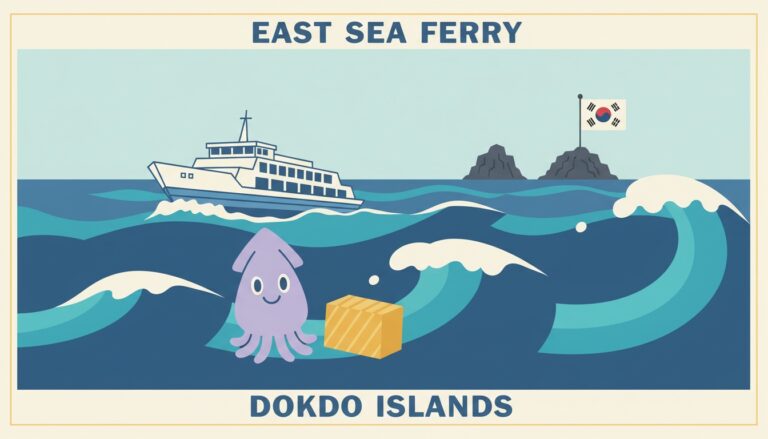
If you’ve watched iconic Korean variety shows like 1 Night 2 Days (1박 2일) or Infinite Challenge (무한도전), you know the drill. The cast gathers at the ferry terminal at dawn. The mood is tense. They aren’t worried about the script; they’re worried about the waves.
Suddenly, the PD announces, “Today’s boat to Dokdo is cancelled due to high waves.” The cast collapses in despair (or relief, if they were prone to seasickness).
Visiting Ulleungdo (울릉도) and Dokdo (독도) isn’t just a trip; in Korea, it’s considered a pilgrimage that requires the universe’s permission. It’s where nature commands respect and history weighs heavy on the heart. Today, we’re learning the language of awe, struggle, and deep national sentiment—C1 level expressions for when “It’s beautiful” just doesn’t cut it.
Phase 2: Deep Dive into Core Expressions
1. 가슴이 벅차오르다 (Gaseum-i beokcha-oreuda)
- Pronunciation: [ga-seum-i beok-cha-o-reu-da] Sounds like “gah-seum-ee buck-cha-oh-reu-da”
- Meaning: To be overwhelmed with emotion; for one’s heart to swell (Literal: The chest fills up/overflows).
- K-Culture Moment: Think of that scene in a K-Drama where long-lost siblings reunite, or when a K-Pop group finally wins the ‘Daesang’ (Grand Prize) and they can’t speak through the tears. That feeling? That’s beokcha-oreuda.
- Editor’s Insight: You use this when you step onto Dokdo. It’s not just “happy.” It’s a mix of pride, sadness, and overwhelming grandeur. It implies an emotion so big it physically expands your chest.
- Situation Spectrum:
[🚫 Casual Chat about Lunch] ———— [⚠️ Complimenting a Movie] ———— [✅ Life Milestones/Nature] - 🤔 Think About It: In English, we might say “it’s breathtaking” or “I’m choked up.” Why does Korean focus on the chest (heart space) filling up physically?
2. 하늘이 허락해야 가는 곳 (Haneul-i heorak-haeya ganeun got)
- Pronunciation: [ha-neu-ri heo-rak-hae-ya ga-neun got]
- Meaning: A place you can only visit if the heavens permit.
- K-Culture Moment: Every travel documentary about Ulleungdo starts with this phrase. The weather changes so rapidly that ferries are cancelled frequently. It adds a layer of mystical destiny to the trip.
- Editor’s Insight: This isn’t a superstition; it’s a statistic. But Koreans love to attribute it to Un (destiny/luck). If you make it to Dokdo on your first try, people will say you have “3 generations of good karma.”
- Situation Spectrum:
[🚫 Going to Starbucks] ———— [⚠️ Hiking Mt. Halla] ———— [✅ Ulleungdo/Dokdo]
3. 멀미가 장난 아니다 (Meolmi-ga jangnan anida)
- Pronunciation: [meol-mi-ga jang-nan a-ni-da]
- Meaning: The seasickness is no joke / is intense.
- Editor’s Insight: “장난 아니다” (It’s not a joke/prank) is the Swiss Army Knife of Korean emphasis. At a C1 level, you should know exactly when to drop this. The ferry ride to Ulleungdo is notorious. Saying “I felt a little sick” doesn’t cover it. You need to express the intensity.
- Situation Spectrum:
[🚫 Formal Presentation] ———— [⚠️ Office Small Talk] ———— [✅ Friends/Travel]
Phase 3: Textbook vs. Real Life
| Situation | 📖 Textbook Korean | 🗣️ Real Korean | 💡 Why the difference? |
|---|---|---|---|
| Arriving at Dokdo | 경치가 정말 아름답네요. (The scenery is truly beautiful.) | 와… 말문이 막히네요. (Wow… I’m speechless / My speech is blocked.) | “Beautiful” is too generic for the historical/emotional weight of this place. |
| Rough Waves | 파도가 높습니다. (The waves are high.) | 파도가 춤을 추네요. (The waves are dancing.) | A poetic, slightly sarcastic way to describe terrifyingly high waves. |
| Eating Squid | 오징어가 맛있어요. (The squid is delicious.) | 역시 울릉도 오징어는 급이 다르네. (As expected, Ulleungdo squid is on a different level.) | Shows you understand the brand value of the local specialty. |
Bottom Note: Using “급이 다르다” (the level is different) is a great way to sound like a connoisseur, whether it’s for food, K-Pop vocals, or scenery.
Phase 4: Cultural Deep Dive
4-1. Nunchi (눈치) on the Islands
When visiting Dokdo, the vibe shifts. It’s not just a tourist spot; it’s a symbol of sovereignty.
* Do: Take photos, look solemn or happy, wave the Korean flag (Taegukgi).
* Don’t: Make jokes about the size of the island or complain loudly about the lack of facilities. The “guardians” (police) living there are respected figures. Read the room—people are likely crying or feeling patriotic.
4-2. K-Food Connection: The Squid & Pumpkin
Ulleungdo is famous for two things: Squid (오징어) and Pumpkin Taffy (호박엿).
In Korean culture, giving someone Yeot (taffy) traditionally meant wishing them luck (to “stick” to a university entrance exam), but be careful—”Eat Yeot” (엿 먹어라) is also a profanity equivalent to “Screw you.”
* Safe Usage: “이거 울릉도 호박엿이에요. 드셔보세요.” (This is Ulleungdo pumpkin taffy. Please try some.)
Phase 5: Immersive Roleplay Scenario
Setting: It’s 7:00 AM at the Gangneung Ferry Terminal. The wind is howling outside. You are waiting with your Korean friend, Ji-ho (34, avid traveler), staring at the electronic board displaying departure times.
Ji-ho: (Sighs deeply) 아, 안내방송 들었어? 오늘 파도가 3미터래.
(Ah, annae-bangsong deureosseo? Oneul pado-ga 3-mita-rae.)
(Ah, did you hear the announcement? They say the waves are 3 meters high today.)
YOU: (Looking at the shaking windows)
🔀 Your Turn! How do you respond?
- Choice A: “배가 취소될까요?” (Will the boat be cancelled?) — Functional, standard.
- Choice B: “와, 오늘 멀미 장난 아니겠는데요?” (Wow, the seasickness is going to be no joke today.) — Empathetic & Natural.
- Choice C: “하늘이 우리를 시험하나 봐요.” (I guess the heavens are testing us.) — Poetic & Culturally deep.
✅ Best Choice: C (or B).
If you choose C, Ji-ho will likely nod and say, “그러니까. 독도 가기가 참 쉽지 않다.” (Exactly. Going to Dokdo is really not easy.) It aligns with the cultural sentiment that the journey is a challenge.
Ji-ho: 일단 멀미약이라도 미리 먹자. 내가 강력한 걸로 사 왔어.
(Ildan meolmi-yag-irado miri meokja. Naega gangnyeokan geollo sa wasseo.)
(Let’s take motion sickness medicine for now. I bought the strong stuff.)
Phase 6: 10-Second Shadowing Drill
Emotion: A mix of relief and awe as you finally see the island after a rough boat ride.
“와, 드디어 도착했어! / 가슴이 / 정말 벅차오른다.”
- Romanization: Wa, deudi-eo dochak-haesseo! / Gaseum-i / jeongmal beokcha-oreunda.
- Meaning: Wow, we finally arrived! My heart is truly overwhelmed.
Phase 7: K-Culture Mini Glossary
| Korean | Romanization | English | Context |
|---|---|---|---|
| 입도 | Ip-do | Entering the island | Specifically used for landing on an island. “입도에 성공했다” (Succeeded in landing). |
| 독도 이사부길 | Dokdo Isabu-gil | Dokdo Isabu Road | A road name on Dokdo, named after the General who conquered the island in 512 AD. |
| 동해 | Donghae | East Sea | Never call it the Sea of Japan while in Korea. This is crucial Nunchi. |
| 울릉도 트위스트 | Ulleungdo Twist | Ulleungdo Twist | A classic old Korean song everyone knows. Mentioning this gets a laugh from older Koreans. |
Phase 8: Traveler’s Survival Kit (Remote Island Edition)
🆘 Survival Expression #1
* 🇰🇷 “배가 많이 흔들리나요?” (Bae-ga mani heundeul-linayo?)
* 🗣️ Meaning: Does the boat rock a lot?
* 📍 Where: Ticket counter or asking crew.
* 💡 Pro Tip: If they say “네 (Yes),” buy liquid motion sickness medicine (마시는 멀미약) at the pharmacy. It works faster than pills.📌 Editor’s Travel Note
* Cash is King: While cards work in most places, small stalls selling seafood or taffy might prefer cash or bank transfer (Gyejwa-iche).
* Booking: Ferries to Ulleungdo sell out fast. Book weeks in advance. For Dokdo, you usually book after arriving on Ulleungdo.
Phase 9: Think Deeper — Territory & Identity
Subject: Why is a rocky island the emotional center of a nation?
Foreigners often ask, “Why is Korea so obsessed with those small rocks?” It’s rarely about economic value or resources. It is about historical trauma and recovery. For Koreans, Dokdo is the first territory that was annexed by Japan in the early 20th century, and the first to be returned.
Therefore, visiting isn’t just “sightseeing”; it’s a validation of independence. When you say “가슴이 벅차오르다” (heart swelling) there, you are tapping into a collective memory of resilience.
💬 Your Turn: Does your country have a specific landmark that symbolizes national survival or identity? How do people describe the feeling of visiting it?
Phase 10: FAQ & Troubleshooting
- Q: Can I use “가슴이 벅차오르다” when I eat good food?
- A: No. That would be too dramatic. For food, use “감동적이다” (touching/moving) or just “환상적이다” (fantastic). Beokcha-oreuda is for graduations, weddings, or majestic nature.
- Q: Is it safe to talk about Dokdo with Koreans?
- A: Yes, but as a listener. Most Koreans are passionate about it. If you ask, “Can you tell me why it’s important?”, you will make a friend for life. Just avoid debating sovereignty unless you want a very heated 2-hour lecture.
- ❌ Common Mistake: Calling the ferry a “boat” (보트).
- ✅ Correction: Use “배” (Bae) or “여객선” (Yeogaek-seon – Passenger ship). “Boat” implies a small pleasure craft.
Phase 11: Wrap-up & Mission
One-Liner: Visiting Korea’s easternmost islands is a test of luck and stomach, but describing it requires the language of the heart.
Action Missions:
* 🥉 Bronze: Say “가슴이 벅차오르다” out loud while imagining you just won the lottery.
* 🥈 Silver: Watch a YouTube clip of 2 Days & 1 Night visiting Dokdo. Listen for the word “파도” (Wave) or “날씨” (Weather).
* 🥇 Gold: Next time you face a difficult travel situation (traffic, flight delay), tell yourself: “이건 하늘이 허락해야 가는 곳인가 봐.” (I guess the heavens have to permit me to go here.)
Phase 12: Interactive Quiz
- Situational Judgment: You are on the ferry, and the person next to you looks green in the face. What do you say?
- A) 경치가 아름답네요. (The view is beautiful.)
- B) 멀미가 심하세요? (Is your seasickness bad?)
- C) 오징어 드실래요? (Do you want some squid?)
- >!Answer: B. Offering squid to a seasick person is cruel!!<
- True or False: “가슴이 벅차오르다” is commonly used when you find $5 on the street.
- >!Answer: False. That’s just lucky. This phrase is for overwhelming emotional magnitude.!<
Frequently Asked Questions (FAQ)
Q: What does "가슴이 벅차오르다 (Gaseum-i beokcha-oreuda)" mean in Korean and how do you pronounce it?
A: In Korean, "가슴이 벅차오르다 (Gaseum-i beokcha-oreuda)" is pronounced [ga-seum-i beok-cha-o-reu-da] and means: To be overwhelmed with emotion; for one's heart to swell (Literal: The chest fills up/overflows).
Q: What does "하늘이 허락해야 가는 곳 (Haneul-i heorak-haeya ganeun got)" mean in Korean and how do you pronounce it?
A: In Korean, "하늘이 허락해야 가는 곳 (Haneul-i heorak-haeya ganeun got)" is pronounced [ha-neu-ri heo-rak-hae-ya ga-neun got] and means: A place you can only visit if the heavens permit.
Q: What does "멀미가 장난 아니다 (Meolmi-ga jangnan anida)" mean in Korean and how do you pronounce it?
A: In Korean, "멀미가 장난 아니다 (Meolmi-ga jangnan anida)" is pronounced [meol-mi-ga jang-nan a-ni-da] and means: The seasickness is no joke / is intense.






