

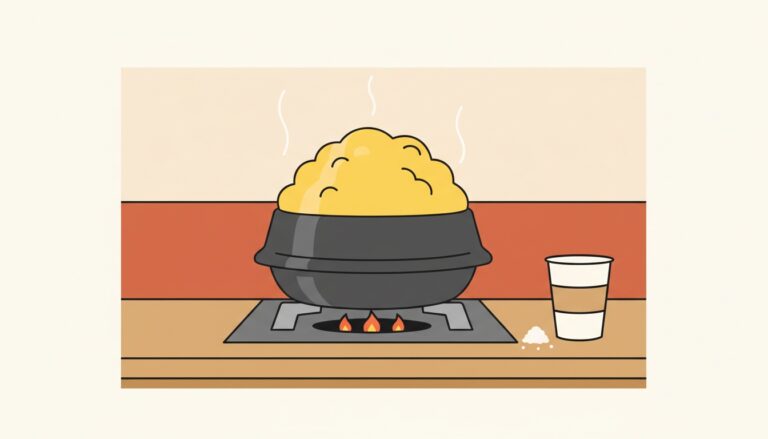
Phase 1: The “Hand Taste” Mystery
Hello! Daily Hangul Editor here.
Picture this: You’re watching a K-Drama. The protagonist visits a famous matjib (tasty restaurant) run by a grumpy but lovable grandmother. She’s making Galbijjim (braised short ribs). The protagonist asks for the recipe. The grandma scoffs, throws a handful of garlic into the pot, and says:
“Just put in enough.”
Frustrating, right? If you’ve ever tried to follow a Korean recipe online or asked a Korean friend how to cook Gyeran-jjim (steamed eggs), you’ve probably heard vague instructions like “cook it until it looks right” or “add a little bit of salt.”
Today, we are cracking the code of Korean Steamed Dishes (Jjim) and how to talk about recipes without needing a chemistry degree. We’re going beyond the textbook measurements to learn the language of feeling and intuition—what Koreans call Son-mat (hand taste).
Let’s get cooking.
Phase 2: Deep Dive into “Jjim” Talk
Here are the three expressions that will help you survive a Korean kitchen conversation.
1. 적당히 넣으세요 (Jeokdanghi neouseyo)
- Pronunciation: [Jeok-dang-hi neo-eu-se-yo]
- Tip: ‘Jeok’ sounds like ‘Jug’, and ‘dang’ sounds like a bell ringing ‘dang!’.
- Meaning:
- Literal: Put in a moderate amount.
- Real Nuance: “You should know how much based on the vibe.”
- K-Culture Moment: In variety shows like I Live Alone, when a clumsy celebrity tries to cook, they panic because the recipe says “jeokdanghi.” They usually end up dumping the whole bag of salt in.
- Editor’s Insight: This is the most dangerous word in the Korean language. “Jeokdanghi” relies on nunchi. If you ask a Korean, “How much soy sauce?” and they say this, start with one spoon and look at their face. If they look anxious, stop.
- Situation Spectrum:
[🚫 Formal Reports] ———— [⚠️ Boss] ———— [✅ Cooking/Casual] - 🤔 Think About It: Why does Korean culture value “feeling” over precise measurement in cooking? Does this reflect a culture that values shared experience over strict rules?
2. 푹 찌세요 (Puk jjiseyo)
- Pronunciation: [Puk jji-se-yo]
- Tip: ‘Puk’ is a short, explosive sound, like a puff of steam escaping.
- Meaning: Steam it thoroughly/deeply.
- K-Culture Moment: You know those scenes where the meat falls off the bone in Galbijjim? That texture is the result of “Puk.” If it’s chewy, you didn’t do it “Puk.”
- Editor’s Insight: “Puk” isn’t just a time duration; it’s a state of being. It implies soft, tender, and fully cooked. We use it for sleeping too: “푹 주무세요” (Sleep deeply/well).
- Situation Spectrum:
[🚫 None] ———— [⚠️ None] ———— [✅ Universal]
(Safe to use with everyone)
3. 간을 보세요 (Ganeul boseyo)
- Pronunciation: [Ga-neul bo-se-yo]
- Meaning: Taste it (to check the seasoning).
- K-Culture Moment: Every cooking show ever. The chef makes the sauce, takes a tiny spoon, tastes it with a serious face, and nods. That’s “Ganeul boneun” moment.
- Editor’s Insight: In Western cooking, you might follow a recipe exactly. In Korea, because ingredients (like Kimchi or Gochujang) vary in saltiness, you must taste as you go. It’s not optional; it’s part of the process.
Phase 3: Textbook vs. Real Life
How to sound less like a robot and more like a local foodie.
| Situation | 📖 Textbook Korean | 🗣️ Real Korean | 💡 Why the difference? |
|---|---|---|---|
| Asking for recipe | 레시피 좀 알려주시겠어요? (Could you tell me the recipe?) | 이거 어떻게 했어요? 비법 좀! (How did you do this? Secret please!) | “Recipe” sounds like a document. “Bibeop” (secret method) flatters the cook. |
| Measuring | 소금 5그램 넣으세요. (Add 5 grams of salt.) | 소금 한 꼬집 넣어. (Put in a pinch of salt.) | Nobody uses scales at home. We use “pinches” and “fistfuls.” |
| Timing | 20분 동안 끓이세요. (Boil for 20 minutes.) | 국물 졸아들 때까지 둬. (Leave it until the broth reduces.) | Visual cues are more reliable than clocks in Korean cooking. |
Phase 4: Cultural Deep Dive — The Myth of “Son-mat”
K-Food Connection: Why Recipes Are Vague
If you ask a Korean mom for a recipe, she might say, “Just use your hands.” This concept is Son-mat (Hand taste). It’s the belief that the flavor comes from the cook’s touch, care, and experience, not just the ingredients.
In dramas, when a character eats something and cries, “It tastes like Mom’s cooking,” they aren’t talking about the specific brand of soy sauce. They are missing the Son-mat.
Think Deeper: Is Son-mat scientifically real? Maybe not. But culturally? It’s the most important ingredient. It explains why measuring cups are rare in traditional Korean kitchens. We measure with our eyes and hearts (and sometimes a generic paper cup).
Phase 5: Immersive Roleplay
Setting: A cooking class in Seoul. You are learning to make Andong Jjimdak (Braised Chicken). The instructor is a charismatic middle-aged lady who moves very fast.
Characters:
* YOU: An eager learner holding a measuring spoon.
* Teacher (Ssem): An instinctive cook who hates measuring spoons.
The Dialogue:
Teacher: 자, 이제 간장을 넣을 거예요. 적당히 둘러주세요! 🧂
(Ja, ije ganjangeul neoeul geoyeyo. Jeokdanghi dulleojuseyo!)
(Okay, now we add soy sauce. Just pour it around moderately!)
YOU:
(Looking confused at the bottle)
잠깐만요 선생님! 정확히 몇 스푼이에요?
(Jamkkanmanyo seonsaengnim! Jeonghwakhi myeot seupunieyo?)
(Wait, teacher! Exactly how many spoons?)
Teacher: 아이고, 그냥 색깔 보면서 넣으면 돼요! 이렇게~
(Aigo, geunyang saekkal bomyeonseo neoeumyeon dwaeyo! Ireoke~)
(Oh my, just look at the color and pour! Like this~)
(She pours a generous amount without measuring)
🔀 Decision Point: The sauce looks dark. What do you say?
- A) “너무 짜지 않을까요?” (Won’t it be too salty?)
- B) “와, 선생님 손맛이 기대되네요!” (Wow, I look forward to your hand taste!)
- C) “50ml 맞나요?” (Is that 50ml?)
✅ Best Choice: B. Flattery works best. She knows what she’s doing. Trust the Son-mat.
⚠️ Choice A Analysis: It’s a valid question, but might sound like you doubt her skill. Better to taste it later.
Phase 6: 10-Second Shadowing Drill
Don’t just read it. Feel the frustration of vague measurements!
Emotion: A mix of confusion and determination. 😤
“레시피에는 / ‘적당히’라고 써 있는데… / 도대체 / 얼마나 넣어야 해요?”
(Recipe-eneun / ‘jeokdanghi’-rago sseo inneunde… / dodaeche / eolmana neoeoya haeyo?)
Translation: The recipe says “moderately”… but exactly how much should I put in?
Phase 7: K-Culture Mini Glossary
| Korean | Romanization | Meaning | Context |
|---|---|---|---|
| 손맛 | Son-mat | Hand taste | The unique flavor imparted by a specific cook’s touch. |
| 비법 | Bibeop | Secret method | Used when asking for a special recipe or trick. |
| 찜 | Jjim | Steamed/Braised | A category of cooking (Galbijjim, Agwijjim). |
| 한 꼬집 | Han kkojip | A pinch | Common unit of measurement for salt/sugar. |
Phase 8: Traveler’s Survival Kit (Restaurant Edition)
Since you might not be cooking Galbijjim in your hotel room, here is how to order it like a pro.
🆘 Survival Expression #1: Spiciness Level
* 🇰🇷 “덜 맵게 해주세요.” (Deol mapge haejuseyo.)
* 🗣️ Sound-alike: “Doll map-ge hae-ju-se-yo”
* Meaning: Please make it less spicy.
* Context: Most “Jjim” dishes (especially Agwijjim or Galbijjim) are naturally spicy. If you are not good with spice, say this before ordering.📌 Editor’s Travel Note
* Ordering Size: Jjim dishes usually come in “Small (So)”, “Medium (Jung)”, “Large (Dae)”. A “Small” is usually enough for 2 people. Don’t order one per person!
* Fried Rice: Always, ALWAYS leave some sauce behind to order “Bokkeumbap” (fried rice) at the end. It’s the dessert of the meal.
Phase 9: Think Deeper — High Context Culture
Why does Korean have so many words like “Jeokdanghi” (moderately) or “Nunchi”?
Korea is what linguists call a High Context Culture. This means communication relies heavily on shared knowledge and non-verbal cues. When a recipe says “moderately,” it assumes you share the same cultural background about what “tasty” implies. In contrast, Low Context cultures (like the US or Germany) prefer explicit, precise instructions to avoid ambiguity.
💬 Your Turn: Does your language have vague cooking terms? In English, we might say “season to taste,” but is it as common as in Korea?
Phase 10: FAQ & Troubleshooting
Q: I saw a recipe that said “1 Cup.” Is that a US measuring cup (240ml)?
A: No! Stop! In Korea, “1 Cup” almost always refers to a paper cup (jo-ngi-cup), which is about 180ml. If you use a US cup, your food will be watery or salty. This is a classic mistake.
Q: Can I ask a restaurant owner for their recipe?
A: You can try, but usually, they will laugh and say it’s a “myeoneuri” (daughter-in-law) secret—meaning they wouldn’t even tell their own family. It’s better to compliment the food by asking, “What is the secret ingredient?” rather than the whole recipe.
Phase 11: Wrap-up & Action Mission
Today we learned that Korean cooking is less about chemistry and more about art (and guessing).
Your Mission, should you choose to accept it:
- 🥉 Bronze: Look at a Korean recipe on YouTube. Count how many times they say “Jeokdanghi” or “Jogeum” (a little).
- 🥈 Silver: Go to a Korean restaurant, order a Jjim dish, and tell the server, “The spice level is perfect (Jeokdanghi maewo-yo)!”
- 🥇 Gold: Try cooking Gyeran-jjim (Steamed Egg) at home. Use a paper cup to measure water. Post the result and tag us!
Have you ever ruined a dish because of vague instructions? Tell me in the comments!
Phase 12: Interactive Quiz
Situation: You are making soup. Your Korean friend tastes it and makes a face. She says: “음… 간을 좀 더 봐야겠는데?” (Hmm… I think we need to check the seasoning more.)
What does she actually mean?
- “It is perfect, don’t touch it.”
- “It tastes terrible/bland. Fix it.”
- “She wants to eat the liver (gan) of an animal.”
Answer: 2. “Gan” means seasoning/saltiness here. If she says “look at the gan” (ganeul boda), it usually implies something is missing.
Frequently Asked Questions (FAQ)
Q: What does "적당히 넣으세요 (Jeokdanghi neouseyo)" mean in Korean and how do you pronounce it?
A: In Korean, "적당히 넣으세요 (Jeokdanghi neouseyo)" is pronounced [Jeok-dang-hi neo-eu-se-yo] and means: a key conversational Korean expression covered in this lesson.
Q: What does "푹 찌세요 (Puk jjiseyo)" mean in Korean and how do you pronounce it?
A: In Korean, "푹 찌세요 (Puk jjiseyo)" is pronounced [Puk jji-se-yo] and means: a key conversational Korean expression covered in this lesson.
Q: What does "간을 보세요 (Ganeul boseyo)" mean in Korean and how do you pronounce it?
A: In Korean, "간을 보세요 (Ganeul boseyo)" is pronounced [Ga-neul bo-se-yo] and means: Taste it (to check the seasoning).







