

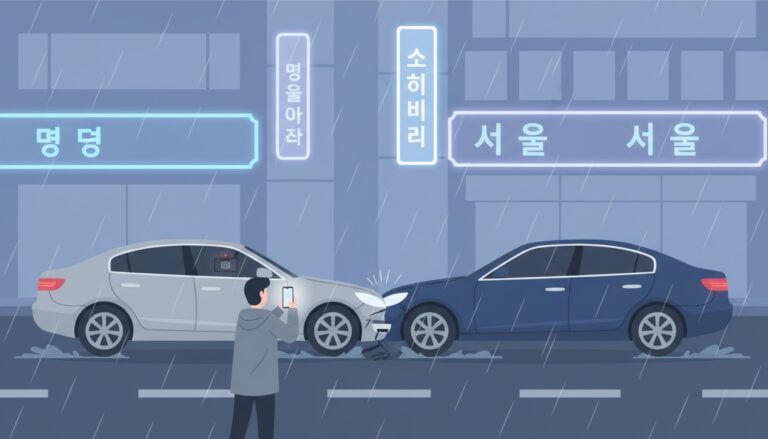
Phase 1: The Crash (Landing on Reality)
Hello, Daily Hangul family.
Let’s be real for a second. In K-Dramas, a car accident is almost romantic. The protagonist steps out of a luxury sedan, looking flawless. Maybe they grab the back of their neck (the legendary dwitmok move), glare at the other driver, and suddenly—destiny begins.
In reality? It’s a logistical nightmare.
I’ve driven in Seoul for over a decade, and my first fender bender wasn’t romantic. It was messy, loud, and incredibly awkward. The taxi driver I bumped into didn’t look like a chaebol heir; he looked ready to lecture me for three hours.
If you are at a C2 level, you don’t just need to say “I’m sorry.” You need to negotiate liability, manage evidence, and navigate the highly efficient (yet aggressive) world of Korean insurance dispatchers. Today, we aren’t just learning words; we are learning how to protect your legal rights on the chaotic roads of Seoul.
Phase 2: Deep Dive into Crisis Management
1. 현장 보존 (Hyeonjang Bojon)
- Pronunciation: [Hyeon-jang Bo-jon] (Sounds like: Hyeon as in Hyundai + Jang + Bo as in Boat + Jon as in Jones)
- Meaning: Preservation of the scene (Literal: Site Preservation)
- The Real Nuance: This is legal terminology used in everyday life. You aren’t just “taking pictures”; you are freezing the evidence before moving the vehicles to avoid traffic congestion.
- Editor’s Insight: If you block traffic in Gangnam because you scratched a bumper, other drivers will hate you more than the person you hit. We use this phrase to signal: “I am taking the necessary legal photos, then I will move immediately.”
- Situation Spectrum:
[🚫 Friends] ———— [⚠️ Family] ———— [✅ Accidents/Police]
🤔 Think About It: Why is “preserving the scene” so critical in Korea? It links back to the high distrust in verbal accounts. Without photographic evidence or a Black Box (dashcam), your word means nothing against a veteran taxi driver.
2. 과실 비율 (Gwasil Biyul)
- Pronunciation: [Gwa-sil Bi-yul]
- Meaning: Fault ratio / Negligence percentage
- K-Culture Moment: If you watch the YouTube channel Hanmuncheol TV (a lawyer who analyzes dashcam footage), this is the most used word. It’s never just “my fault.” It’s “80:20” or “100:0.”
- Editor’s Insight: Do not admit 100% fault immediately. Even if you think you are wrong, say “Let’s check the fault ratio later” (과실 비율은 나중에 따지시죠). Admitting “It’s all my fault” on the spot can complicate the insurance claim.
3. 보험 접수번호 (Boheom Jeopsu-beonho)
- Pronunciation: [Bo-heom Jeop-su Beon-ho]
- Meaning: Insurance claim registration number
- Real Life Context: In the US or Europe, you might exchange insurance policy details. In Korea, you call your insurer immediately, they send a text with a “Registration Number,” and you give that number to the other party (or the hospital). That number is your golden ticket.
Phase 3: Textbook vs. Real Life
| Situation | 📖 Textbook Korean | 🗣️ Real Korean (Street Smart) | 💡 The “Why” |
|---|---|---|---|
| Moving the car | 차를 안전한 곳으로 이동합시다. (Let’s move the car to a safe place.) | 사진 다 찍으셨으면 차 좀 뺄까요? (If you’re done snapping photos, shall we pull the car out?) | Korean drivers have zero patience for traffic jams caused by minor accidents. |
| Asking for Insurance | 보험 회사를 부르셨습니까? (Did you call the insurance company?) | 대인, 대물 다 접수해 주세요. (Please register for both person and property coverage.) | You need to specify what the insurance covers explicitly (medical vs. car repair). |
| Admitting mistake | 제 잘못입니다. 죄송합니다. (It is my fault. I am sorry.) | 일단 보험사 불러서 처리하죠. (Let’s just call the insurance and handle it.) | Admitting fault is seen as a legal vulnerability. Shift responsibility to the system. |
Phase 4: Cultural Deep Dive — The “Black Box” Obsession
In many Western countries, dashcams are optional. In Korea, a car without a “Black Box” (블랙박스) is suspicious.
It’s not just about recording; it’s a cultural surveillance tool. When you walk down a narrow alley at night, you’ll see blinking lights inside parked cars. Those are Black Boxes, watching you.
The “Dwitmok” (Neck Grab) Trope:
Why do drama characters grab their necks? It stems from the idea of “sudden hypertension” (blood pressure spike) caused by shock. However, in insurance terms, complaining of neck pain (whiplash) is the standard procedure to get admitted to a hospital. If the other driver grabs their neck, prepare for a messy negotiation regarding medical bills.
Phase 5: Interactive Roleplay
Setting: Friday night, heavy rain. You are driving near Yeouido. You brake late and tap the bumper of a Sonata in front of you. The driver, a middle-aged man in a suit, looks annoyed.
You (Driver): (Stay calm. Don’t panic.)
NPC (Angry Driver): 아, 운전을 어떻게 하시는 거예요? 차 산 지 일주일도 안 됐는데! 😤
(Ah, unjeoneul eotteoke hasineun geoyeyo? Cha san ji ilju-ildo an dwaenneunde!)
(English translation: “How are you driving? I bought this car less than a week ago!”)
🔀 Your Turn! How do you respond?
Option A: “죄송합니다! 제가 다 물어낼게요!” (I’m sorry! I’ll pay for everything!)
Option B: “많이 놀라셨죠? 일단 다치신 데는 없으세요?” (You must be shocked. Are you hurt anywhere first?)
Option C: “제 블랙박스 확인해 보시죠?” (Check my black box first?)
✅ Best Choice: Option B. Empathy first, liability second. Ask if they are hurt (shows manners/nunchi). Then pivot to insurance.
⚠️ Analysis of A: Never say you’ll pay for everything. You don’t know the repair cost yet.
Dialogue Continues:
You: 많이 놀라셨죠? 다치신 데는 없으세요? 비 오니까 사진만 빨리 찍고 갓길로 차 빼시죠.
(Mani nollasyeotjyo? Dachisin deneun eopseuseyo? Bi onikka sajinman ppalli jjikgo gatgillo cha ppaesijyo.)
(You must be startled. Are you hurt? Since it’s raining, let’s take photos quick and move the car to the shoulder.)
NPC: (Sighs) 에휴… 알겠습니다. 보험사는 부르셨어요?
(Okay… Did you call insurance?)
Phase 6: 10-Second Shadowing Drill
Assertive, professional, and calm. Do not sound apologetic; sound competent.
😐 Emotion: Calm & Business-like
“과실 비율은 / 보험사 직원 오면 / 그때 이야기하시죠.”
(Gwasil biyul-eun / boheomsa jigwon omyeon / geuttae iyagi-hasijyo.)
Translation: Let’s talk about the fault ratio when the insurance agent gets here.
Phase 7: K-Culture Glossary (Survival Edition)
| Word | Romanization | Meaning & Context |
|---|---|---|
| 블랙박스 | Black Box | Dashcam. The ultimate judge in Korean accidents. |
| 렉카 | Rek-car | Tow truck. Warning: Private tow trucks (Sayseol Rekka) are predatory. They arrive before police and overcharge. Never let them hook your car without verifying. |
| 합의 | Hab-ui | Settlement. Reaching an agreement (usually money) to avoid police records. |
| 나이롱 환자 | Nylong Hwanja | Fake patient. Someone who isn’t hurt but stays in the hospital for insurance money. |
Phase 8: Traveler’s Survival Kit (Rental Car Edition)
Most tourists rent cars in Jeju Island. Here is your survival card.
🆘 Rental Car Crash Manual
1. Do NOT Move (unless blocking major traffic) until you take photos.
2. Photo Checklist: License plate, wheel direction (shows intent), collision point, and a “wide shot” showing the road lanes.
3. Call the Rental Company: Don’t call 112 (Police) first unless someone is dying. Call the number on the rental key chain.
4. Papago App: If you can’t speak, type: “사고가 났어요. 도와주세요.” (I had an accident. Please help.) and show the screen.
Phase 9: Think Deeper — The Speed of Trust?
“Palli-palli” (Hurry, hurry) in Accidents
In many countries, waiting for the police to file a report takes hours. In Korea, insurance dispatchers often arrive on motorbikes within 10-15 minutes. It is a stunning display of efficiency, but it also reflects a society where speed is valued over detailed deliberation.
We outsource the conflict. Instead of two drivers arguing and blocking the road, we summon “agents” to fight for us while we stand aside and smoke a cigarette. It’s a specialized form of conflict resolution that minimizes direct confrontation between individuals.
💬 Your Turn: In your country, do people move their cars immediately, or do they leave them exactly where the crash happened until police arrive? How does that affect traffic?
Phase 10: Troubleshooting & FAQ
Q: A tow truck arrived in 30 seconds. Should I let him take my car?
A: NO. This is a common trap. Private tow drivers listen to police radios or wait at intersections. They will hook your car and charge insane fees just to drop it 100 meters away. Wait for the tow truck sent by your insurance company (or the rental company).
Q: The other driver is yelling and using Banmal (informal language). Should I get angry?
A: No. If you get angry and swear back, it can be used against you (insult laws). Keep using Jeondaemal (Formal language). It makes you look rational and them look unhinged. The Black Box is recording everything.
Phase 11: Wrap-up & Mission
One-Liner: In a Korean car accident, the camera (Black Box) is mightier than the tongue.
🔥 Action Mission:
– Bronze: Practice saying “Gwasil biyul” (Fault ratio) five times. It’s a tongue twister.
– Silver: Look at cars on the street in your country. How many have dashcams? Compare it to a Korean street view on Google Maps.
– Gold: (If you live in Korea) Check your own insurance policy or rental agreement. Do you know the emergency number?
Frequently Asked Questions (FAQ)
Q: What does "현장 보존 (Hyeonjang Bojon)" mean in Korean and how do you pronounce it?
A: In Korean, "현장 보존 (Hyeonjang Bojon)" is pronounced [Hyeon-jang Bo-jon] and means: Preservation of the scene (Literal: Site Preservation)
Q: What does "과실 비율 (Gwasil Biyul)" mean in Korean and how do you pronounce it?
A: In Korean, "과실 비율 (Gwasil Biyul)" is pronounced [Gwa-sil Bi-yul] and means: Fault ratio / Negligence percentage
Q: What does "보험 접수번호 (Boheom Jeopsu-beonho)" mean in Korean and how do you pronounce it?
A: In Korean, "보험 접수번호 (Boheom Jeopsu-beonho)" is pronounced [Bo-heom Jeop-su Beon-ho] and means: Insurance claim registration number







