

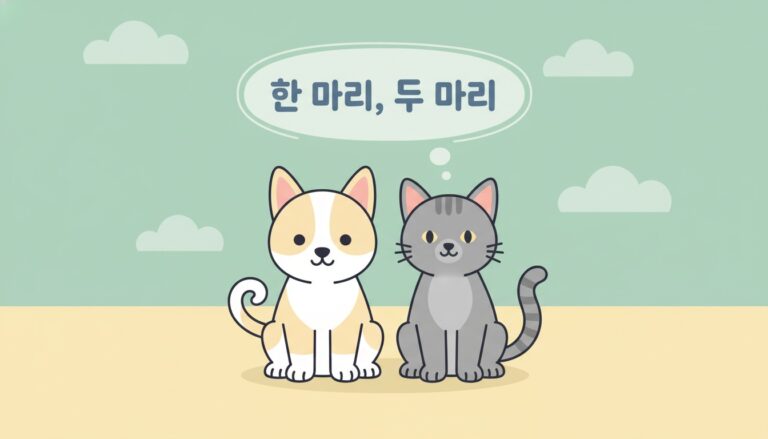
Phase 1: 👋 Hello! Daily Hangul Editor Here
Picture this: You are walking through a beautiful park in Seoul, maybe near the Han River. You see a cute dog, and the owner smiles at you. You want to ask, “Do you have two dogs?”
Your brain starts racing. You remember the numbers for money (Il, Ee, Sam…), so you confidently say: “Gangaji Ee (2) Gae?”
The owner looks confused, maybe even a little insulted.
Why? Because you just counted their beloved family member like a pencil or an apple! 😱
Don’t worry. This is the #1 mistake almost every beginner makes. In English, “one” is always “one.” But in Korean, we have a special “Heart” for counting living things. Today, I’ll teach you how to count animals so natural that Korean pet owners will want to be your best friend.
Phase 2: 🔍 Deep Dive: The Magic of “Mari”
To count animals, we must use the Native Number system (Hana, Dul, Set…) combined with the counter 마리 (Mari).
1. 한 마리 (One animal)
- Pronunciation:
Han-ma-ree[Han like ‘Han’ Solo + Ma-ree sounds like the name ‘Marie’] - Meaning: One head (of an animal).
- Editor’s Insight: Wait, isn’t “One” Hana? Yes! But when Hana meets a counter like Mari, it gets shy and drops the ‘a’. So it becomes Han-mari.
2. 두 마리 (Two animals)
- Pronunciation:
Du-ma-ree[Du sounds like ‘Do’ in Donut] - Meaning: Two animals.
- Editor’s Insight: Same rule here! Dul (2) loses the ‘L’ sound to become smooth. It’s not Dul-mari, it’s Du-mari. This makes it much faster to say.
3. 세 마리 (Three animals)
- Pronunciation:
Se-ma-ree[Se like Sa in Say] - Meaning: Three animals.
- Situation Check: Used for everything from tiny ants to giant elephants. Whether it’s a hamster or a tiger, they are all Mari.
Phase 3: 🆚 Textbook vs. Real Life
Okay, you learned the grammar. Now let’s learn the street style.
| Textbook Korean (Robot Mode 🤖) | Real Life Korean (Human Mode 😎) |
|---|---|
| 강아지가 한 마리 있습니다. (Gangaji-ga han-mari iss-seumnida.) “There is one dog.” (Too stiff!) |
강아지 한 마리 있어요. (Gangaji han-mari isseo-yo.) “I have a dog.” (Standard Polite) |
| 고양이 두 마리입니까? (Goyangi du-mari im-nikka?) “Is it two cats?” (Sounds like a military interrogation) |
(고양이) 두 마리예요? (Goyangi du-mari-yeyo?) “Are there two of them?” (Friendly) |
| 개 (Gae) “Dog” |
강아지 (Gangaji) / 댕댕이 (Daeng-daeng-i) “Puppy” / “Doggo” (Use these for extra cute points!) |
💡 Pro Tip: Even if the dog is huge, calling it 강아지 (Puppy) instead of 개 (Dog) sounds much softer and friendlier!
Phase 4: 🇰🇷 Cultural Context: The “Nunchi” of Pets
In Korea, pets are treated like children. We often call ourselves “Mom” or “Dad” to our pets.
- Don’t point with your finger: When counting someone’s pets, don’t point at them with your index finger. It can be seen as rude. Instead, use an open hand (palm up) to gesture toward the animals.
- The “Cute” Gasp: When you hear someone has a pet, the culturally correct reaction is a small gasp and saying “Jin-jja-yo?” (Really?) or “Gwi-yeo-wo-yo!” (Cute!). This reaction is part of the conversation etiquette!
Phase 5: 🎬 Roleplay: At the Han River Park
Setting: You (A) see a Korean person (B) walking two adorable dogs.
A (You): 강아지가 진짜 귀여워요!
(Gangaji-ga jin-jja gwi-yeo-wo-yo!)
(Your puppies are really cute!)
B (Korean): 아, 감사합니다!
(Ah, gam-sa-ham-ni-da!)
(Ah, thank you!)
A (You): 지금 두 마리예요?
(Ji-geum du-mari-yeyo?)
(Are there two of them right now?)
B (Korean): 네, 엄마랑 아기. 두 마리예요.
(Ne, eomma-rang agi. Du-mari-yeyo.)
(Yes, mom and baby. It’s two of them.)
Acting Tip: When you ask “Du-mari-yeyo?”, tilt your head slightly and smile. It makes you look friendly and harmless!
Phase 6: 🗣️ 10-Second Shadowing
Let’s practice the rhythm. Don’t read it flat. Read it with emotion!
Sentence: “I raise one cat.”
저 / 고양이 / 한 마리 / 키워요.
(Jeo / go-yangi / HAN-ma-ree / ki-wo-yo.)
- Focus: Put a little stress on HAN. It emphasizes the number.
- Pause: Slight pause after “Goyangi” (Cat).
Phase 7: 🛠️ FAQ & Troubleshooting
Q: Can I just use “One, Two, Three” (Il, Ee, Sam) if I forget?
A: Honestly? They will understand you, but it sounds very awkward. It’s like saying “I have dog number two” instead of “I have two dogs.” Stick to Native Numbers for counting things!
Q: What if there are 11 dogs?
A: Wow, that’s a lot of dogs! You would say Yeol-han-mari (10+1). But for A1 level, focusing on 1 (Han) to 4 (Ne) is enough for 90% of conversations.
Phase 8: 🎁 Wrap-up & Mission
Today’s Summary:
Animal counter is Marie (마리). Numbers change slightly: Hana → Han, Dul → Du.
🚀 Your Mission:
Next time you scroll through Instagram and see a pet photo, say out loud in Korean how many you see. “Ah! Goyangi Se-mari!” (Ah! 3 cats!).
Question for you: Do you have a pet? Tell me in the comments: “_______ 한 마리 있어요.” (Fill in the blank!)
Phase 9: 📝 Quick Quiz
- Which word is the correct counter for animals?
A) Gae (개)
B) Myeong (명)
C) Mari (마리) -
How do you say “Two animals”?
A) Dul-mari
B) Du-mari
C) Ee-mari -
True or False: You should point your finger directly at someone’s dog when counting it.
( ) True
( ) False
Click to see answers
1. C (Mari)
2. B (Du-mari – remember, Dul loses the ‘L’!)
3. False (Use an open hand!)
Frequently Asked Questions (FAQ)
Q: What does "한 마리 (One animal)" mean in Korean and how do you pronounce it?
A: In Korean, "한 마리 (One animal)" is pronounced [Han-ma-ree [Han like 'Han' Solo + Ma-ree sounds like the name 'Marie'] and means: One head (of an animal).
Q: What does "두 마리 (Two animals)" mean in Korean and how do you pronounce it?
A: In Korean, "두 마리 (Two animals)" is pronounced [Du-ma-ree [Du sounds like 'Do' in Donut] and means: Two animals.
Q: What does "세 마리 (Three animals)" mean in Korean and how do you pronounce it?
A: In Korean, "세 마리 (Three animals)" is pronounced [Se-ma-ree [Se like Sa in Say] and means: Three animals.






