

안녕하세요! This is your Daily Hangul Editor.
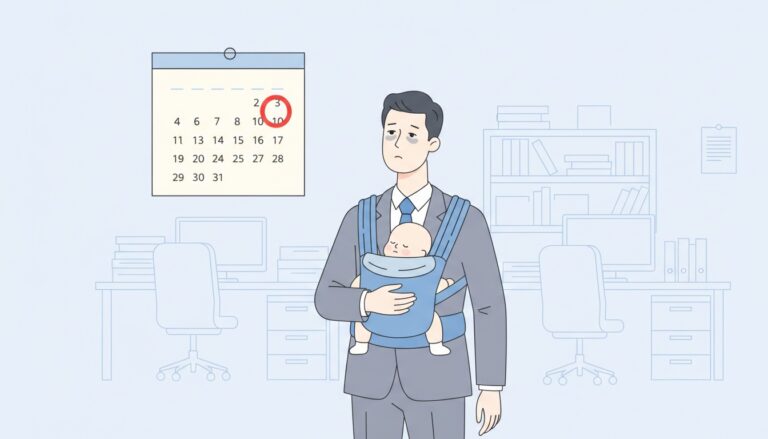
Today, we are stepping away from the standard “Hello, how are you?” and diving deep into a topic that dominates Korean news headlines and dinner table conversations: The low birth rate and the push for Mandatory Paternity Leave (육아 휴직 남성 의무화).
If you are a C2 learner or living in Korea, you know that understanding the language means understanding the society. You might read in a textbook that “paternity leave is a right,” but if you say that naively to a Korean male colleague in his 30s, he might give you a bitter smile.
Why? Because in Korea, there is a massive gap between Law (법) and Reality (현실).
Today, I will equip you with the sophisticated vocabulary and cultural insight needed to discuss this complex social issue like a true intellectual insider. Let’s bridge the gap between the news anchor and the stressed office worker.
1. Deep Dive: The Core Vocabulary of “Friction”
To discuss this topic at a C2 level, you need words that express the tension between policy and company culture.
1. 눈치(가) 보이다 [Nun-chi-ga bo-i-da]
- Pronunciation: Nun-chi-ga bo-i-da (The ‘chi’ sounds like the ‘chee’ in ‘cheese’, but shorter. ‘Eu’ in ‘nun’ is subtle.)
- Meaning: To feel uncomfortable/pressured by the atmosphere; to feel like one is walking on eggshells.
- Editor’s Insight: You know Nunchi. But at C2, we use the passive form 보이다. It’s not that you are actively looking at others; it’s that the situation itself forces you to feel the pressure. A father wants to take leave, but the boss’s silent glare makes it impossible.
- Situation Check: Used everywhere. From expressing hesitation to a friend to explaining your situation to a supervisor.
- Ex: “법적으로는 가능한데, 팀장님 눈치가 보여서 못 쓰겠어요.” (It’s legally possible, but I can’t use it because of the pressure from the team manager.)
2. 그림의 떡 [Geu-rim-ui tteok]
- Pronunciation: Geu-rim-e-tteok (Linking sound: ui often sounds like e in conversation. Tteok has a strong, tensed ‘Tt’ sound.)
- Meaning: A pie in the sky; something that looks good but is unattainable.
- Editor’s Insight: This is the perfect idiom for Korean paternity leave policies. The government offers it, but can you eat it (take it)? No, because it’s just a picture. Use this to sound cynical yet intelligent about social policies.
- Situation Check: Great for debates or serious conversations about social issues.
3. 경력 단절 [Gyeong-nyeok dan-jeol]
- Pronunciation: Gyeong-nyeok dan-jeol (Note the nasalization: Gyeong-nyeok flows together.)
- Meaning: Career break/gap (usually forced or negative context).
- Editor’s Insight: Traditionally used for women (warning: the term “경단녀” comes from this). However, in the context of male paternity leave, men fear this too. They fear being “left behind” while they are changing diapers.
- Situation Check: Formal/Professional. Used in news, interviews, or deep life talks.
2. Textbook vs. Real Life (The Nuance of C2)
At the Advanced level, we stop sounding like a brochure and start sounding like a real person living the reality.
| Context | Textbook / Formal | Real Life (Insider/Colleague) |
|---|---|---|
| Hesitation | 상사의 기분을 생각해야 합니다. (I must consider the boss’s mood.) |
눈치가 보여서 엄두도 못 내요. (The pressure is so bad, I can’t even dare to think about it.) |
| Effectiveness | 그 제도는 현실적이지 않습니다. (That system is not realistic.) |
그거 완전 빛 좋은 개살구예요. (That’s completely an apricot with a good color (useless/all talk).) |
| Workload | 동료들에게 폐를 끼칠까 봐 걱정입니다. (I worry about inconveniencing colleagues.) |
내가 빠지면 남은 사람들이 독박 쓰잖아요. (If I leave, the remaining people take the full hit/burden.) |
Note: ‘독박(을) 쓰다’ implies taking all the blame or burden unfairly. It is very common in spoken Korean to describe an unfair workload.
3. Cultural Context: The “Empty Desk” Fear
Why is mandatory paternity leave such a hot debate? It clashes with the traditional Korean corporate concept of “The Seat (자리)”.
In Korea, your physical presence in the office is historically tied to your loyalty. There is a deeply rooted fear called “책상이 없어진다” (My desk will disappear). It’s a metaphor for being marginalized or tacitly fired upon return.
Even if the law says “Mandatory,” the Corporate Culture (사내 문화) often whispers, “Sure, go ahead. But don’t expect a promotion when you return.” Understanding this irony is key to understanding the Korean male perspective on parenting.
4. Roleplay Script: The Lunch Break Venting
Setting: Two deputy managers (대리) talking at a cafe after lunch.
Characters: Alex (Foreigner, C2 level), Min-su (Korean colleague, new father).
Alex: (Coffee in hand) 이번에 정부에서 남성 육아 휴직 의무화 추진한다던데, 민수 씨는 어떻게 생각해요?
(I heard the government is pushing for mandatory paternity leave. What do you think, Min-su?)
Min-su: (Sighing deeply) 글쎄요… 취지는 좋은데, 솔직히 중소기업에서는 그림의 떡이죠.
(Well… the intention is good, but honestly, in small-to-medium businesses, it’s just a pie in the sky.)
Alex: 하긴, 팀장님 성격에 휴직 결재받으러 가면 표정이 안 좋을 것 같긴 해요.
(True, knowing the team manager’s personality, his face won’t look good if you go to get approval.)
Min-su: 표정만 안 좋으면 다행이죠. 복직했을 때 제 자리가 온전할지가 걱정이죠.
(I’d be lucky if it were just a bad look. I’m worried if my position will be intact when I return.)
Alex: 에이, 설마요. 그래도 시대가 변하고 있잖아요. 눈치 보지 말고 권리를 챙겨야죠!
(Hey, no way. But times are changing. You should claim your rights without feeling pressured!)
5. 10-Second Shadowing Drill
Read this sentence aloud to practice intonation and pausing. This is a sentence you can use to summarize the entire situation elegantly.
“제도는 계속 좋아지는데, / 사회적 분위기가 / 그걸 따라가지 못하는 것 같아요.”
“Je-do-neun gye-sok jo-a-ji-neun-de, / sa-hoe-jeok bu-nwi-gi-ga / geu-geol tta-ra-ga-ji mo-ta-neun geot ga-ta-yo.”
(Policies keep getting better, but / the social atmosphere / doesn’t seem to be catching up.)
- Tip: Pause slightly at the
/. Emphasize 제도 (Policy) and 분위기 (Atmosphere) to highlight the contrast.
6. FAQ & Troubleshooting
Q: Can I ask a Korean colleague, “Are you going to take paternity leave?”
A: Be careful. If you are close friends, yes. But in a formal business setting, it can be a sensitive topic because it highlights their dilemma. Instead of asking directly (“Are you taking it?”), try discussing the news generally: “요즘 뉴스 보니까 육아 휴직 얘기가 많던데, 회사 분위기는 어때요?” (I see a lot of news about paternity leave lately, how is the company atmosphere?) This is much safer and polite.
7. Wrap-up
- One-Liner: Learning Korean is not just about words; it’s about understanding the struggle between Policy (제도) and Reality (현실).
- Action Mission: Next time you see a news clip about the birth rate on YouTube or TV, look for the comments section. Try to spot the word “현실” (Reality) or “쇼” (Show/Performance). You will see exactly what we discussed today!
Is there a gap between policy and reality in your country regarding parenting? Let me know in the comments!
8. Pop Quiz
1. Which expression best describes a policy that looks good but is impossible to use?
A) 금강산도 식후경 (Even Geumgangsan is best seen after eating)
B) 그림의 떡 (Pie in the sky)
C) 누워서 떡 먹기 (Piece of cake)
2. What is the passive verb used to describe feeling pressure from the atmosphere?
A) 눈치를 보다
B) 눈치를 주다
C) 눈치가 보이다
3. Which word refers to a “career break”?
A) 경력 단절
B) 경력 개발
C) 경력직
(Answers: 1-B, 2-C, 3-A)
Frequently Asked Questions (FAQ)
Q: What does ""책상이 없어진다"" mean in Korean and how do you pronounce it?
A: In Korean, ""책상이 없어진다"" is pronounced [My desk will disappear] and means: . It’s a metaphor for being marginalized or tacitly fired upon return.
Q: What does ""쇼"" mean in Korean and how do you pronounce it?
A: In Korean, ""쇼"" is pronounced [Show/Performance] and means: . You will see exactly what we discussed today!







