

Phase 1: Introduction
안녕하세요! This is your Daily Hangul Editor.
So, you’ve mastered the standard “이거 주세요” (Please give me this) and you’re feeling confident. You decide to visit a Cheongnyeon Mall (Youth Mall) inside a traditional market or hit up the Bamdokkaebi Night Market at the Han River.
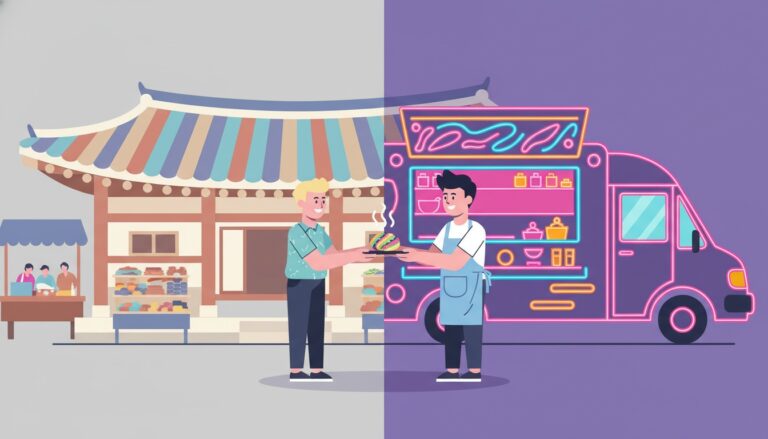
The vibe here is different. The owners aren’t the halmeonis (grandmas) you see in textbooks; they are young entrepreneurs, “hip” chefs, and trendsetters. If you walk up to a trendy fusion food truck and speak like a rigid 1990s textbook character, the vibe instantly dies.
“How much is this item?” (Standard)
vs.
“Is this the signature menu?” (Insider)
At the C1 level, we stop sounding like robots and start sounding like people with taste and preference. Today, we look at how to order at these hip spots with the perfect mix of politeness and casual cool.
Phase 2: Deep Dive (Core Expressions)
1. 혹시 여기 시그니처가 뭐예요?
- Pronunciation: [Hoksi yeogi signature-ga mwo-yeyo?]
- Sound Tip: ‘Hoksi’ should be said with a rising, hesitant tone to sound polite. ‘Signature’ is pronounced with a Korean accent: Shi-geu-ni-cheo.
- Meaning: “By any chance, what is the signature dish here?”
- Editor’s Insight: At Youth Malls and food trucks, the menus are often experimental fusion dishes. Asking for the “Best Menu” is okay, but asking for the “Signature” proves you understand modern Korean café/foodie culture. It appeals to the young owner’s pride as a creator.
- Situation Check: Casual (O) / Polite (O) – Perfect for talking to staff your age or younger.
2. 현금이 없어서 그런데, 계좌 이체 되나요?
- Pronunciation: [Hyeongeumi eop-seoseo geureonde, gyejwa-iche doenayo?]
- Sound Tip: ‘Gyejwa’ (Account) is tricky. Think of saying “G-y-eh” quickly.
- Meaning: “I don’t have cash right now [implication: that’s why I’m asking], is a bank transfer possible?”
- Editor’s Insight: This is pure C1 grammar. The “~어서 그런데” (since A… [so B]) structure softens the blow. While many trucks take cards now, smaller stalls in Youth Malls often prefer transfers. Asking this fluently makes you look like a local resident, not a tourist.
- Situation Check: Essential survival phrase in traditional markets.
3. 바로 먹을 건데, 소스는 많이 뿌려주세요.
- Pronunciation: [Baro meogeul geonde, soseu-neun mani ppuryeo-juseyo.]
- Meaning: “I’m going to eat it right away, so please sprinkle a lot of sauce.”
- Editor’s Insight: You aren’t just ordering; you are customizing.
- “바로 먹을 건데” alerts them not to pack it in a sealed bag.
- “~해 주세요” is standard, but adding specific requests like “sauce” or “spiciness level” shows you know exactly what you want.
Phase 3: Textbook vs. Real Life
| Textbook Korean (Awkward Robot) | Real “Youth Mall” Korean (Trendy Local) |
|---|---|
| 추천해 주시겠습니까? (Could you please recommend?) |
사장님 픽(Pick) 하나만 추천해주세요. (Boss, please recommend your personal ‘pick’.) |
| 이 음식은 아주 맵습니까? (Is this food very spicy?) |
이거 신라면보다 매워요? (Is this spicier than Shin Ramyun?) |
| 영수증 주세요. (Give me the receipt.) |
영수증은 버려주세요. (Please throw away the receipt.) |
Editor’s Note: Using “사장님 픽(Pick)” is very trendy. It implies you trust their taste. Also, referencing “Shin Ramyun” is the universal Korean metric for spiciness.
Phase 4: Cultural Context & Nunchi
1. The “Young Boss” (젊은 사장님) Dynamic
Unlike the older market sellers, the owners in Youth Malls are often in their 20s or 30s.
* Don’t Haggle: Haggling (kkak-ka-juseyo) is part of the fun with grandmas selling vintage clothes. But at a food truck selling 12,000 KRW Cube Steaks? It’s considered rude. They view their food as a fixed-price product, similar to a restaurant.
2. The “Waiting” Nunchi
Popular food trucks have long lines.
* Don’t block the path: If you order and stand right in front of the pickup window, you are blocking the flow.
* The Look: If the owner makes eye contact while cooking, a simple nod is enough. Don’t try to hold a long conversation while they are grilling 10 orders at once.
Phase 5: Roleplay Scenario
Setting: A popular fusion shrimp truck at the Han River Night Market. Saturday night, long queue.
Characters:
* Mark (You): C1 Korean learner, hungry.
* Owner: Busy young Korean man cooking furiously.
Mark: (Approaching the counter confidently)
안녕하세요! 혹시 여기서 제일 잘 나가는 메뉴가 뭐예요?
(Annyeonghaseyo! Hoksi yeogiseo jeil jal naganeun menyu-ga mwoyeyo?)
(Hello! By any chance, what’s the best-selling menu here?)
Owner: (Wiping sweat)
갈릭 버터 새우가 시그니처예요. 제일 많이 나가요.
(Garlic butter shrimp-ga signature-yeyo. Jeil mani nagayo.)
(The Garlic Butter Shrimp is our signature. It sells the most.)
Mark:
아, 그럼 그걸로 하나 주세요. 아! 저 오이 알러지 있어서 피클은 빼주실 수 있나요?
(Ah, geureom geugeollo hana juseyo. Ah! Jeo oi allergy isseoseo pickle-eun ppaejusil su innayo?)
(Ah, give me one of those then. Oh! I have a cucumber allergy, is it possible to leave out the pickles?)
Owner:
네, 가능합니다. 5분 정도 걸리는데 진동벨 드릴까요?
(Ne, ganeunghamnida. 5-bun jeongdo geollineunde jindong-bell deurilkkayo?)
(Yes, possible. It takes about 5 minutes, shall I give you a buzzer?)
Mark: (Handing over card)
네, 감사합니다. 결제 여기요.
(Ne, gamsahamnida. Gyeolje yeogiyo.)
(Yes, thank you. Here is the payment.)
Phase 6: 10-Second Shadowing
Practice this sentence to sound like a pro who values their time but stays polite.
“죄송한데, / 지금 주문하면 / 음식이 나오기까지 / 얼마나 걸릴까요?”
- Romanization: Jwesong-hande, / jigeum jumun-hamyeon / eumsigi na-ogi-kkaji / eolmana geollilkkayo?
- Focus Point:
- Don’t say “Wait” (gidaryeoyo). Use “eolmana geollilkkayo” (how long will it take).
- Pause after “hande” to soften the interruption.
Phase 7: FAQ & Troubleshooting
Q: Can I use informal language (Banmal) since the owner looks young?
A: Absolutely NOT. Even if the owner looks 20 years old, this is a business transaction. Always use polite language (Jon-daet-mal). You can drop the formal “-simnida” style and stick to the polite “-yo” style, but never use Banmal unless you are actually friends.
Q: Is it okay to eat standing in front of the truck?
A: Generally, yes, but look at the ground. If there are “Standing Tables,” use them. If not, move to the side so you don’t block new customers.
Phase 8: Wrap-up
- One-Liner: When at a Youth Mall, stop asking “Is it delicious?” and start asking “Is this your signature?”
- Action Mission: Next time you buy street food, ask “계좌 이체 되나요?” even if you have cash, just to see if you can understand their response!
- Engagement: What’s the weirdest fusion food you’ve seen in a Korean market? Tell us in the comments!
Phase 9: Quiz
1. Which phrase is the most natural way to ask for a recommendation at a trendy food truck?
A) 이것은 맛이 있습니까?
B) 사장님 픽이 뭐예요?
C) 깎아주세요.
2. How do you politely say “I don’t have cash, so…” before asking for a bank transfer?
A) 현금 싫어해요.
B) 현금이 없어서 그런데…
C) 돈이 없습니다.
3. True or False: You should haggle aggressively at Youth Mall food trucks because it’s a traditional market.
A) True
B) False
(Answers: 1-B, 2-B, 3-B)







