

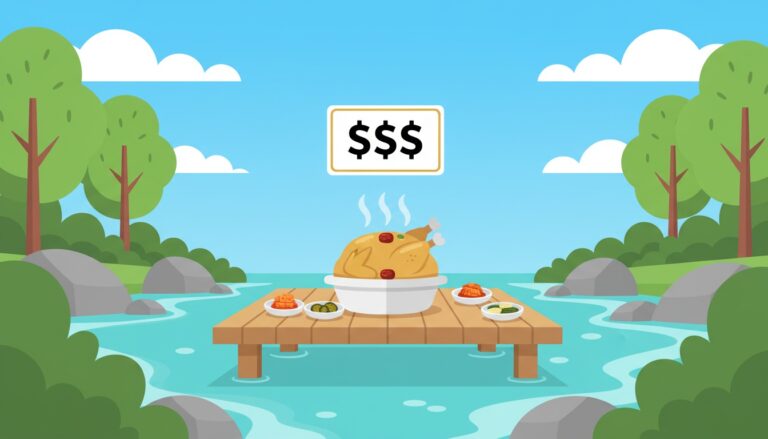
Phase 1: 🍉 Introduction: The $100 Chicken Shock
“Wait, did I just pay $100 for boiled chicken?!”
Hello! This is your Head Editor at Daily Hangul. 👋
Summer in Korea is amazing, but there is one specific situation that even locals dread: The Gyegok (Valley) Vacation. Picture this: You are cooling off by a beautiful mountain stream, you order the famous Baeksuk (Korean boiled chicken soup), and when the bill comes, your jaw drops. The price is three times higher than in the city!
This is a classic Korean summer debate known as the “Gyegok Baeksuk Controversy.”
Today, I will teach you the specific B2-level expressions to handle this situation. Knowing these phrases won’t just save your wallet; it will make Koreans look at you and think, “Wow, they really know Korean culture!”
Phase 2: 🔍 Deep Dive: Core Expressions
Here are the top 3 expressions you need when the price doesn’t make sense.
1. 바가지 쓰다 (Bagaji sseuda)
- Pronunciation: [Ba-ga-ji sseu-da] Think of ‘Bag’ + ‘Ah’ + ‘G’ (like Gee) + ‘ji’
- Meaning: To get ripped off (Lit: To wear a gourd/plastic bowl)
- Editor’s Insight: This is THE most important idioms for tourists. In the old days, people might have used gourds (bagaji) to play tricks or cover things up. If you say this, you sound like a local expert.
- Situation Check: Casual ⭕ | Formal ❌ (Use “가격이 비합리적이다” for formal complaints, but ‘Bagaji’ is perfect for complaining to friends).
2. 가격이 좀 세네요 (Gagyeogi jom seneyo)
- Pronunciation: [Ga-gyeo-gi jom seh-neh-yo] ‘Se’ sounds like the start of ‘Se-ven’
- Meaning: The price is a bit steep/strong.
- Editor’s Insight: Most beginners say “비싸요 (It’s expensive).” But B2 learners use 세다 (seda). It literally means “strong,” but for prices, it means “Whoa, that’s heavy.”
- Situation Check: Casual ⭕ | Polite/Formal ⭕ (Safe to say to the owner).
3. 자릿세 (Jarisse)
- Pronunciation: [Ja-rit-seh]
- Meaning: Seat tax / Table fee
- Editor’s Insight: This is the reason the chicken is expensive. You aren’t paying for the bird; you are paying for the Jari (seat) by the water.
- Situation Check: Essential vocabulary for understanding the receipt.
Phase 3: 📖 Textbook vs. Real Life
How to sound less like a book and more like a local complaining about prices.
| Textbook Korean (Standard) | Real Korean (Insiders/Locals) |
|---|---|
| 너무 비싸요. (It is too expensive.) | 완전 바가지네! (This is a total rip-off!) |
| 가격이 높습니다. (The price is high.) | 가격이 사악하네요. (The price is evil/wicked.) |
| 여기 앉는 비용이 있나요? (Is there a cost to sit here?) | 여기는 다 자릿세죠. (It’s all just the seat tax here, right?) |
💡 Editor’s Note: “가격이 사악하다” (The price is evil) is a very trendy B2+ expression Koreans use on Instagram when reviewing expensive cafes or restaurants!
Phase 4: 🇰🇷 Cultural Context: The “Seasonal Price” Logic
In Korea, there is a concept called 한철 장사 (Hancheol jangsa). This means “doing business for just one season.”
Valley owners argue that they only earn money during July and August, so they must charge high prices to survive the rest of the year. Recently, the government has cracked down on illegal “seat taxes,” so this is a very hot topic in the news!
👀 Nunchi Tip: If the menu price is clearly written, arguing usually won’t work. However, if they tell you a price different from the menu just because you are a foreigner, that is the moment to use the phrase: “메뉴판이랑 가격이 다르네요?” (The price is different from the menu?) while maintaining firm eye contact.
Phase 5: 🎬 Real Scenario Roleplay
Situation: Mark checks the bill after eating Baeksuk at a valley in Gapyeong.
Characters:
* 🧍♂️ Mark: Foreign resident (B2 level)
* 👩🍳 Owner: Valley restaurant owner
(Mark looks at the bill and his eyes widen.)
Mark: 이모님, 계산서가 좀 이상한데요? 닭백숙이 10만 원이에요?
(Imonim, the bill looks a bit strange. The chicken soup is 100,000 won?)
Owner: 아, 우리 계곡은 다 자릿세 포함이라 그래요. 시간 제한도 없잖아요.
(Ah, our valley includes the seat fee. And there’s no time limit, you know.)
Mark: 와… 그래도 가격이 너무 센데요. 이건 좀 바가지 아니에요?
(Wow… still, the price is too steep. Isn’t this a bit of a rip-off?)
Owner: (Laughing awkwardly) 아이고, 총각 한국말 잘하네! 그럼 음료수 하나 서비스로 줄게.
(Oh my, young man, your Korean is good! Fine, I’ll give you a free soda.)
Phase 6: 🗣️ 10-Second Shadowing
Practice this sentence to express shock naturally. Pay attention to the pause!
” 와, / 솔직히 / 가격이 / 너무 사악하네요! “
(Wow, / honestly / the price is / too wicked/evil!)
- Intonation: Raise your pitch on “와” and “사악” to emphasize disbelief.
Phase 7: 🛠️ FAQ & Troubleshooting
Q: Can I use “바가지” to my boss if we go on a company workshop?
A: NO! 🙅♂️ “바가지” is slangy. If your boss booked the place, you are insulting their choice. Instead, just say “가격이 생각보다 꽤 나가네요” (The price is higher than I thought).
Q: Is haggling (Kkakka-juseyo) rude here?
A: Maybe. In established restaurants, yes. But in these temporary valley stalls, if you pay cash (hyeongeum), you might get a small discount. Try: “현금으로 하면 좀 깎아주시나요?”
Phase 8: 🎁 Wrap-up
One-Liner Summary: Use “가격이 세다” for polite complaints and “바가지” when you are talking to friends about a rip-off.
🚀 Your Mission: Next time you see something expensive (even in a department store), whisper to yourself: “와, 가격 깡패네 (Wow, price gangster/bully).” It’s a fun variation of today’s lesson!
Question: Have you ever felt ripped off in Korea? Tell me in the comments!
Phase 9: 🧠 Pop Quiz
1. Which word means “Seat Tax”?
a) 세금 (Segeum)
b) 자릿세 (Jarisse)
c) 월세 (Wolse)
2. How do you politely say “The price is steep/strong”?
a) 가격이 뚱뚱해요 (Price is fat)
b) 가격이 힘나요 (Price has energy)
c) 가격이 세네요 (Price is strong)
3. What is the literal meaning of “Bagaji”?
a) A golden pot
b) A plastic gourd/bowl
c) A broken wallet
(Scroll down for answers)
.
.
.
Answers: 1. (b), 2. (c), 3. (b)
Frequently Asked Questions (FAQ)
Q: What does "바가지 쓰다 (Bagaji sseuda)" mean in Korean and how do you pronounce it?
A: In Korean, "바가지 쓰다 (Bagaji sseuda)" is pronounced [Ba-ga-ji sseu-da] and means: To get ripped off (Lit: To wear a gourd/plastic bowl)
Q: What does "가격이 좀 세네요 (Gagyeogi jom seneyo)" mean in Korean and how do you pronounce it?
A: In Korean, "가격이 좀 세네요 (Gagyeogi jom seneyo)" is pronounced [Ga-gyeo-gi jom seh-neh-yo] and means: The price is a bit steep/strong.
Q: What does "자릿세 (Jarisse)" mean in Korean and how do you pronounce it?
A: In Korean, "자릿세 (Jarisse)" is pronounced [Ja-rit-seh] and means: Seat tax / Table fee







