

Hello! This is your Daily Hangul Editor.
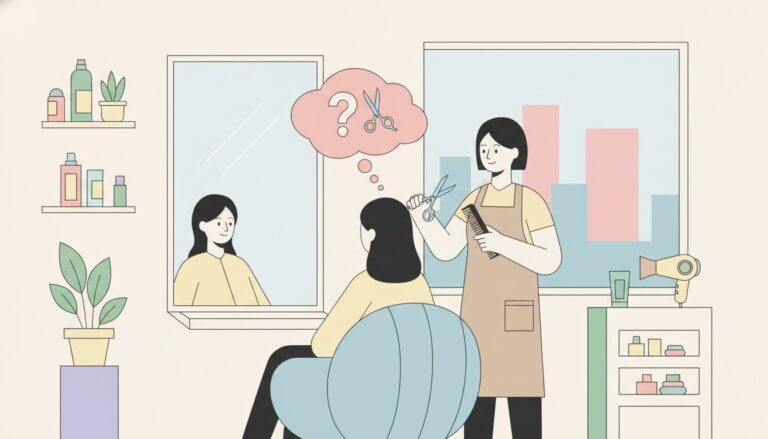
Today, we are tackling one of the biggest dilemmas known to humankind—or at least to anyone standing in front of a mirror in Seoul: “Should I get bangs or not?”
I’ve seen so many of my students walk into a Korean hair salon (미용실 – miyongsil) full of confidence, only to walk out wearing a hat because they couldn’t explain exactly how much they wanted to cut.
Getting bangs in Korea is a serious stylistic choice. It’s the difference between looking like a K-Drama lead or a middle school student who cut their own hair with safety scissors. Don’t worry! As a veteran tutor who has saved many hairstyles, I’m here to guide you through the B1 (Intermediate) level phrases you need to survive the “Bangs Dilemma.”
Phase 1: The Deep Dive (Core Expressions)
Here are the three phrases you will use the most during your consultation.
1. 앞머리 자를까요, 말까요?
(Ammeori jareulkkayo, malkkayo?)
- Meaning: Should I cut my bangs or not?
- Pronunciation Tip: ‘Ammeori’ (Bangs). The ‘eu’ in ‘reul’ sounds like the noise you make when you see something gross (ugh!).
- Editor’s Insight: The grammar
-(으)ㄹ까요?is perfect here. It shows you value the stylist’s professional opinion. You aren’t just asking for permission; you are asking, “What do you think looks better on me?”- Situation Check: polite/Formal. Use this with your stylist!
2. 다듬기만 해 주세요.
(Dadeumgiman hae juseyo.)
- Meaning: Please just trim it.
- Pronunciation Tip: ‘Dadeum’ sounds soft. Don’t stress the ‘D’ too hard.
- Editor’s Insight: This is the most important phrase. If you say “Jallaju-seyo” (Cut it), they might chop off 5cm. If you say “Dadeumeo-juseyo” (Trim it), they will only take off the split ends. It’s a safety net.
- Situation Check: Use this when you are scared of losing length.
3. 시스루 뱅으로 해 주세요.
(Siseuru-baeng-euro hae juseyo.)
- Meaning: Please give me see-through bangs.
- Pronunciation Tip: It’s Konglish! Pronounce ‘See-through’ with equal stress on every syllable: Si-Seu-Ru.
- Editor’s Insight: In Korea, thick, heavy bangs are rare. The “See-through bang” (forehead visible through wispy hair) is the standard K-beauty look. It makes your face look smaller!
Phase 2: Textbook vs. Real Life
Textbooks teach you to be robotic. Real Koreans talk about nuance.
| Textbook Korean | Real Korean (Native Vibe) | Why? |
|---|---|---|
| 앞머리를 자르고 싶어요. (I want to cut bangs.) |
앞머리 좀 내고 싶은데요. (I want to “let out” some bangs.) |
If you don’t have bangs yet, you are creating them from your existing hair. We use the verb 내다 (to make/put out) when creating a new style! |
| 이 사진처럼 해 주세요. (Please do it like this photo.) |
이 느낌으로 가능할까요? (Is this “vibe” possible?) |
Asking “Is it possible?” (가능할까요?) sounds much softer and respects the stylist’s ability to judge your hair texture. |
Phase 3: Cultural Context (Manners & Nunchi)
1. The “Photo” Rule
In Western salons, you might describe what you want. In Korea, showing a photo is mandatory. Don’t be shy! Whether it’s a photo of an idol like Jennie or an actor like Park Seo-joon, show them. Korean stylists prefer visual references over verbal descriptions because “short” means different things to different people.
2. The Shampoo Service
Unlike some countries where shampoo costs extra, it is almost always included in the cut price in Korea. Also, when they cover your eyes with a towel during the wash, do not open your eyes. It’s awkward for everyone. Just relax!
Phase 4: Real Roleplay
Setting: A trendy salon in Hongdae. You are sitting in the chair.
Designer: 어떻게 해 드릴까요? (How would you like your hair done today?)
You: (Showing a photo) 앞머리 좀 내고 싶은데… 저한테 어울릴까요?
(I want to get bangs… do you think it would suit me?)
Designer: 음, 고객님은 얼굴이 작으셔서 시스루 뱅이 잘 어울리실 것 같아요.
(Hmm, since you have a small face, I think see-through bangs would suit you well.)
You: 그래요? 그럼 너무 짧지 않게 잘라 주세요.
(Really? Then please cut them, but not too short.)
Designer: 네, 알겠습니다. 예쁘게 해 드릴게요!
(Okay, understood. I’ll make it look pretty!)
Phase 5: 10-Second Shadowing
Read this aloud to practice your hesitation and politeness!
“앞머리를 / 자를까 하는데… / 너무 짧지는 않게 / 다듬어 주세요.”
(Ammeorireul / jareulkka haneunde… / neomu jjaljineun anke / dadeumeo juseyo.)Meaning: I’m thinking of cutting my bangs… please trim them so they aren’t too short.
Phase 6: FAQ & Troubleshooting
- Q: Can I use informal language (Banmal) if the stylist looks younger than me?
- A: Absolute NO. Even if the stylist is 20 and you are 40, the salon is a business setting. Always use polite language (
-요or-습니다).
- A: Absolute NO. Even if the stylist is 20 and you are 40, the salon is a business setting. Always use polite language (
- Q: What if I hate it?
- A: If it’s too long, say “조금만 더 다듬어 주세요” (Please trim a little more). If it’s too short… well, ask for a hat recommendation! (Just kidding, Korean stylists are very skilled).
Phase 7: Wrap-up
Today’s One-Liner:
If you want to create bangs for the first time, say “앞머리 내고 싶어요” instead of “자르고 싶어요.”
Your Mission:
Next time you walk past a mirror, look at your hair and practice saying, “Siseuru-baeng-euro hae juseyo” three times. Your future stylist will thank you!
Comment below:
Have you ever had a haircut disaster in a foreign country? Tell me your story!
Pop Quiz
1. Which verb is most natural when you want to create bangs you didn’t have before?
A) 없애다 (eopsaeda)
B) 자르다 (jareuda)
C) 내다 (naeda)
2. You only want a small trim, not a big cut. What do you say?
A) 다듬어 주세요 (Dadeumeo juseyo)
B) 삭발해 주세요 (Sakbalhae juseyo)
C) 볶아 주세요 (Bokka juseyo)
3. What is the popular Korean bang style that is wispy and light?
A) Heavy Bang
B) See-through Bang
C) Curtain Bang
(Answers: 1. C, 2. A, 3. B)







