

Phase 1: Introduction
Hello! This is your Senior Editor at Daily Hangul.
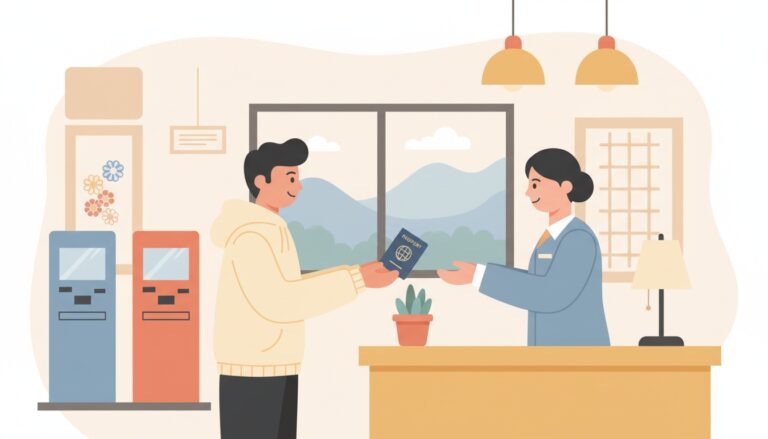
Imagine this: You’ve just survived a 10-hour flight to Seoul. You are exhausted, your suitcase feels like it weighs a ton, and you finally arrive at the shiny front desk of your hotel. The receptionist smiles and speaks to you in rapid-fire Korean.
Panic sets in. You freeze. You awkwardly shove your passport across the counter in silence. 😅
Does this sound familiar? At Daily Hangul, many of our students tell us that the “first contact” at a hotel is the most nerve-wracking moment of their trip. But guess what? You only need one magic phrase to turn that awkward silence into a confident arrival.
Today, we aren’t just learning words; we are learning how to start your trip with dignity and confidence. Let’s check in like a local.
Phase 2: Deep Dive (Core Expressions)
Here are the absolute essentials. If you remember nothing else, remember #1.
1. 예약했습니다 (I have a reservation)
- Pronunciation: [Ye-yak-haet-seum-ni-da]
- Sound Analogy: “Yeah” + “Yak” (like a yak animal) + “Hess” (like chess) + “Sum” (like sum total) + “Knee-da”.
- Meaning: “I have made a reservation.”
- Ye-yak (예약): Reservation
- Haet-seum-ni-da (했습니다): Did / Have done (Formal politeness)
- Editor’s Insight: This is the “Open Sesame” of Korean hotels. It is formal, polite, and perfect for speaking to staff. It immediately tells them, “I am prepared.”
- Situation Check: 🏢 Hotel Front Desk (Formal) | ✅ Yes | 👫 Friend’s House (Casual) | ❌ No
2. 체크인할게요 (I will check in)
- Pronunciation: [Check-in-hal-key-yo]
- Sound Analogy: “Check-in” (same as English) + “Hal” (like Hal in HAL 9000) + “Kay-yo”.
- Meaning: “I’d like to check in.”
- Editor’s Insight: Koreans use a lot of English words! “Check-in” is universally understood. If Ye-yak-haet-seum-ni-da feels too long, this is your safety net.
3. 성함이 어떻게 되세요? (What is your name?)
- Pronunciation: [Seong-ham-i eo-tteo-ke dwe-se-yo?]
- Meaning: “May I ask for your name?” (Very polite)
- Editor’s Insight: Don’t panic! You don’t need to say this. You need to hear this. When the clerk looks at you and ends a sentence with an upward intonation, they are likely asking for your name.
Phase 3: Textbook vs. Real Life
Textbooks make you sound like a robot. Let’s make you sound like a person.
| Textbook Korean 🤖 | Real Life Korean 😎 |
|---|---|
| 제 이름은 스미스입니다. (My name is Smith.) |
스미스요. (Smith.) |
| 여권 여기 있습니다. (Here is the passport.) |
여기요. (Here.) |
💡 Editor’s Note (A1 Level): Notice how in real life, we keep it short? Adding “-yo” (-요) at the end of a noun (like your name) makes it polite enough without needing a full sentence.
Phase 4: Cultural Context & Manners
Language is only 50% of communication. The other 50% is attitude.
1. The “Two-Hand” Rule (Two Hands, One Heart)
When you hand over your passport or credit card to the receptionist, never use one hand.
* Best: Use two hands to hold the card.
* Good: Use your right hand to hold the card, and support your right elbow/wrist with your left hand.
* Why? It shows respect. If you toss your passport on the counter with one hand, it can look rude or dismissive.
2. The “Ppalli-Ppalli” (Hurry-Hurry) Spirit
Koreans value efficiency. Have your passport and booking confirmation ready in your hand before you approach the desk. Fumbling through your bag for 2 minutes while the staff watches is a major “vibe killer” in Korea!
Phase 5: Real-Life Scenario (Roleplay)
Setting: The lobby of a boutique hotel in Gangnam. You approach the desk.
👩💼 Staff: 어서 오세요. (Welcome.)
🧑🦱 You: 안녕하세요. 예약했습니다. (Hello. I have a reservation.)
(Bow slightly with your head)
👩💼 Staff: 네, 성함이 어떻게 되세요? (Yes, may I have your name?)
🧑🦱 You: Alex 요. (Alex.)
👩💼 Staff: 여권 좀 보여주시겠어요? (Could you show me your passport?)
🧑🦱 You: 아, 네. 여기요. (Ah, yes. Here it is.)
(Hand over passport with two hands)
Phase 6: 10-Second Shadowing
Let’s train your muscle memory. Read this out loud three times. Focus on the pause.
“Hello… I have a reservation.”
안녕하세요 / 예약했습니다.
[An-nyeong-ha-se-yo] / [Ye-yak-haet-seum-ni-da]
- Tip: Don’t rush. Pause for a breath where the slash (/) is. A clear pause is better than mumbling fast.
Phase 7: FAQ & Troubleshooting
Q: Can I just show them my phone with the booking app?
A: Yes! But don’t just shove the phone in their face silently. Show the phone screen and say “예약했습니다”. It changes you from a “confused tourist” to a “polite guest.”
Q: Is it okay to use English?
A: Most hotel staff in major cities speak English. However, opening with “안녕하세요, 예약했습니다” breaks the ice and gets you warmer service. It shows you tried!
Phase 8: Wrap-up
📝 One-Liner Summary:
To check in, simply say “Ye-yak-haet-seum-ni-da” and hand over your passport with two hands.
🏃 Action Mission:
Practice the “Two-Hand Rule” today. When you hand a pen, a cup, or a phone to a friend or family member, use two hands. It feels awkward at first, but it will become natural by the time you land in Seoul!
Are you worried about other hotel situations? Let me know in the comments if you want to learn how to ask for “Extra Towels” next! 👇
Phase 9: Pop Quiz
1. What is the most natural way to say your name is “Kim” at the front desk?
A) My name is Mr. Kim.
B) Kim-iyo. (Kim + polite particle)
C) I am Kim.
2. Which body language is considered polite when handing over a credit card?
A) Sliding it across the table like a casino dealer.
B) Using one hand casually.
C) Using two hands.
3. What does “Ye-yak” (예약) mean?
A) Cancel
B) Passport
C) Reservation
(Answers: 1.B, 2.C, 3.C)
Frequently Asked Questions (FAQ)
Q: What does "예약했습니다 (I have a reservation)" mean in Korean and how do you pronounce it?
A: In Korean, "예약했습니다 (I have a reservation)" is pronounced [Ye-yak-haet-seum-ni-da] and means: a key conversational Korean expression covered in this lesson.
Q: What does "체크인할게요 (I will check in)" mean in Korean and how do you pronounce it?
A: In Korean, "체크인할게요 (I will check in)" is pronounced [Check-in-hal-key-yo] and means: a key conversational Korean expression covered in this lesson.
Q: What does "성함이 어떻게 되세요? (What is your name?)" mean in Korean and how do you pronounce it?
A: In Korean, "성함이 어떻게 되세요? (What is your name?)" is pronounced [Seong-ham-i eo-tteo-ke dwe-se-yo?] and means: "May I ask for your name?" (Very polite)







