

Phase 1: Hook & Introduction
Hello! It’s your Daily Hangul Editor. 👋
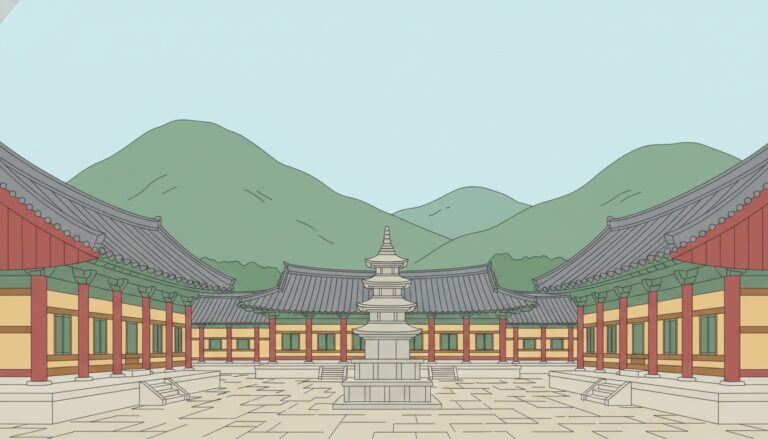
Imagine this: You are at a beautiful mountain temple (Sa-chal) in Korea for a Temple Stay. The air smells like incense, the wind chimes are ringing softly, and everyone looks so peaceful.
You want to participate, maybe offer a prayer or make a wish, but you suddenly freeze. “Do I just stand here? What are people muttering? Can I just say ‘Hi’ to Buddha?”
Don’t worry! Today, we are going to learn how to blend in perfectly at a Korean temple. Even if you aren’t religious, knowing these expressions allows you to experience the ‘Peaceful Vibes’ of Korean culture properly. This guide is based on real questions from students who visited Bulguksa and Jogyesa temples!
Phase 2: Deep Dive into Core Expressions
Here are the top 3 phrases you need when offering prayers (불공 드리기 – Bulgong deurigi).
1. 절을 해요 (I bow / I do a deep bow)
- Pronunciation: [Jeol-eul hae-yo]
- Tip: ‘Jeol’ sounds a bit like the first part of ‘Jelly’, but lower in pitch.
- Meaning: To perform a formal bow.
- Editor’s Insight: In Korea, a ‘bow’ isn’t just a nod. In a temple, this usually means the full prostration (knees and forehead on the ground).
- Situation Check: Use this to describe your action. “저는 절을 해요.” (I am bowing.)
2. 소원을 빌어요 (I make a wish)
- Pronunciation: [So-won-eul bi-reo-yo]
- Tip: ‘So’ like ‘So’ in English. ‘Won’ like the currency ‘Won’.
- Meaning: To pray for a wish.
- Editor’s Insight: This is the most important part! Whether it’s for health, love, or passing an exam (very popular in Korea!), this is the phrase you use.
- Situation Check: Can be used on birthdays too! 🎂
3. 마음이 편해요 (My mind is at peace / I feel comfortable)
- Pronunciation: [Ma-eum-i pyeon-hae-yo]
- Tip: ‘Pyeon’ sounds like ‘Pyon’ in Pyonchang Olympics.
- Meaning: Literal: My mind/heart is comfortable.
- Editor’s Insight: This is the #1 feedback people give after visiting a temple. If someone asks, “How was the temple?” just say this. You will sound very native.
Phase 3: Textbook vs. Real Life
How to sound less like a book and more like a local.
| Textbook (Correct but stiff) | Real Life (Natural & Common) |
|---|---|
| 불공을 드리러 왔습니다. (I came to offer a Buddhist prayer.) |
절하러 왔어요. (I came to bow/visit the temple.) |
| 법당이 어디입니까? (Where is the Dharma Hall?) |
대웅전이 어디예요? (Where is the Main Hall? – Daewungjeon is the specific name usually used.) |
| 소원을 성취했습니다. (I achieved my wish.) |
기도빨이 잘 받아요! (My prayers worked well! Slangy nuance: This temple has good vibes/results.) |
Editor’s Note: “기도빨” (Gi-do-bbal) is a funny slang meaning the “power/effect of prayer.” Maybe don’t use it with the Head Monk, but it’s great with friends! 😉
Phase 4: Cultural Context & Manners (Nunchi)
Language is 50% words and 50% manners. Don’t make these mistakes!
1. The Center Door is Forbidden! 🚫
When entering the main hall, never use the center door. That entrance is reserved for the Monk or the spirit of Buddha. Always enter through the side doors.
2. Hapjang (합장) 🙏
When you meet a monk or enter the temple yard, don’t wave “Hi!” instead, put your palms together near your chest and bow slightly. This is called Hapjang. It commands instant respect.
3. Step over the threshold
Don’t step on the wooden raised sill at the door. Step over it. Stepping on it is considered bad luck and disrespectful to the structure.
Phase 5: Real-Life Roleplay
Situation: Alex (Foreigner) is visiting a temple with his Korean friend, Min-su.
(Alex puts his hands together awkwardly)
Alex: 어떻게 해요?
(Eotteoke haeyo? / How do I do this?)
Min-su: 손을 모으고 절을 해.
(Soneul mo-eu-go jeoreul hae. / Put your hands together and bow.)
Alex: 이렇게요?
(Ireokeyo? / Like this?)
Min-su: 응, 그리고 소원을 빌어.
(Eung, geurigo sowoneul bireo. / Yes, and make a wish.)
Alex: 가족의 건강을 빌었어요.
(Gajogui geongangeul bireosseoyo. / I prayed for my family’s health.)
Phase 6: 10-Second Shadowing
Read this aloud to practice your rhythm. Focus on the pause!
“부처님 앞에서 / 소원을 빌었어요.”
- Romanization: Bu-cheo-nim a-pe-seo / so-won-eul bi-reo-sseo-yo.
- Meaning: I made a wish in front of Buddha.
- Guide: Pause slightly after “a-pe-seo” (in front of). Keep your voice soft and calm—you are in a temple!
Phase 7: FAQ & Troubleshooting
Q: I am Christian/Atheist. Can I still say “절을 해요”?
A: Yes! In Korea, visiting a temple is often seen as a cultural activity rather than a purely religious one. Saying you did a bow doesn’t convert you; it just shows you participated in the custom.
Q: Is it okay to take photos inside?
A: Usually, No. Taking photos of the Buddha statue inside the prayer hall is often prohibited or frowned upon because people are praying. Take photos outside! 📸
Phase 8: Wrap-up & Action Item
- Summary: Say “절을 해요” (I bow) and “소원을 빌어요” (Make a wish) while entering through the side door!
- Mission: Next time you visit a temple (or even a quiet park), put your hands together (Hapjang) and try saying, “마음이 편해요” (My mind is at peace).
- Question: What is one wish you would make at a Korean temple? Tell me in the comments! 👇
Phase 9: Quick Quiz
- Which door should you use to enter the main temple hall?
- a) The Center Door
- b) The Side Door
- c) The Window
- What does “소원을 빌어요” mean?
- a) I am hungry.
- b) I make a wish.
- c) I take off my shoes.
- What is the respectful hand gesture called?
- a) Kimchi
- b) Hapjang
- c) Bulgogi
(Answers: 1-b, 2-b, 3-b)
Frequently Asked Questions (FAQ)
Q: What does "절을 해요 (I bow / I do a deep bow)" mean in Korean and how do you pronounce it?
A: In Korean, "절을 해요 (I bow / I do a deep bow)" is pronounced [Jeol-eul hae-yo] and means: a key conversational Korean expression covered in this lesson.
Q: What does "소원을 빌어요 (I make a wish)" mean in Korean and how do you pronounce it?
A: In Korean, "소원을 빌어요 (I make a wish)" is pronounced [So-won-eul bi-reo-yo] and means: a key conversational Korean expression covered in this lesson.
Q: What does "마음이 편해요 (My mind is at peace / I feel comfortable)" mean in Korean and how do you pronounce it?
A: In Korean, "마음이 편해요 (My mind is at peace / I feel comfortable)" is pronounced [Ma-eum-i pyeon-hae-yo] and means: a key conversational Korean expression covered in this lesson.







