

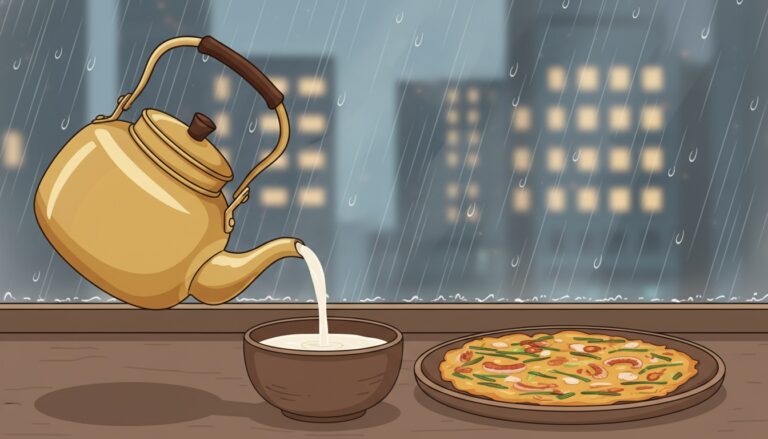
Phase 1: Hook & Empathy
☔ Why Does Every Korean Want This When It Rains?
Hello! This is your Senior Editor at Daily Hangul.
Imagine this: You are in Seoul. Suddenly, the sky turns gray, and a heavy summer rain starts pouring down. You run for cover under a convenience store awning, feeling a bit annoyed by the wet shoes. But then you notice something strange.
Your Korean friends aren’t annoyed. They are checking their phones, smiling, and texting the same message to their groups: “Hey, it’s raining. Makgeolli time?”
If you’ve ever wondered why Korean restaurants serving Makgeolli (rice wine) and Pajeon (green onion pancakes) are packed on rainy days, you are in the right place. To the untrained eye, it’s just dinner. To an insider, it’s a deep cultural vibe called “Unchi” (운치 – atmospheric mood).
Today, I’ll teach you not just the words, but the feeling behind them. By the end of this post, you won’t just be watching the rain; you’ll be inviting your Korean friends out for a drink like a true local.
Phase 2: Deep Dive into Key Expressions
Here are the top 3 expressions you need to survive—and thrive—on a rainy evening in Korea.
1. 비도 오는데, 막걸리 한잔할까요?
- Pronunciation: [Bi-do o-neun-de, Mak-geol-li han-jan-hal-kka-yo?]
- Sound Tip: “Mak” sounds like Mockingbird. “Geol” sounds like Girl without the strong ‘r’.
- Meaning: Since it’s raining (and that sets the mood), shall we have a glass of Makgeolli?
- Editor’s Insight: The grammar point
-는데here is magic. It sets the background. You aren’t just asking to drink; you are saying, “The rain is the excuse/reason, so…” - Situation Check: ✅ Friends ✅ Close Colleagues ⚠️ Formal Boss (Use casually)
2. 파전에 막걸리는 국룰이죠.
- Pronunciation: [Pa-jeon-e Mak-geol-li-neun Gung-nul-i-jyo]
- Sound Tip: “Gung-nul” is tricky. It sounds like Kung-fu + Rule.
- Meaning: Pajeon and Makgeolli are an unwritten rule (standard combination).
- Editor’s Insight: 국룰 (Gungnul) literally means “National Rule.” Koreans use this slang when a combination is undeniable (like burgers and fries). Using this makes you sound incredibly fluent and culturally aware.
- Situation Check: ✅ Casual ✅ Internet Slang ✅ Friendly Conversation
3. 기분이 좀 꿀꿀해요.
- Pronunciation: [Gi-bun-i jom Kkul-kkul-hae-yo]
- Sound Tip: “Kkul” sounds like the Cool in Coolant, but with a tighter throat.
- Meaning: I feel a bit gloomy/down.
- Editor’s Insight: Rain can make people sentimental. 꿀꿀하다 is a B1-level word that perfectly describes that low-energy, gray-sky feeling. It’s also the sound a pig makes, implying you feel grumpy or heavy.
- Situation Check: ✅ Friends ✅ Family (Expressing feelings)
Phase 3: Textbook vs. Real Life
Let’s upgrade your Korean from “Classroom Robot” to “Hongdae Hipster.”
| Textbook Korean (Safe, but boring) | Real Life Korean (Natural & Witty) |
|---|---|
| 비가 와서 술을 마시고 싶어요. (I want to drink alcohol because it rains.) |
비도 오는데 한잔 적실까? (Rain’s falling… shall we wet our throats?) |
| 파전을 먹읍시다. (Let’s eat Pajeon.) |
오늘 안주는 파전 콜? (For snacks today, Pajeon, cool?) |
| 정말 맛있어요. (It is very delicious.) |
빗소리 들으면서 먹으니까 꿀맛이네요. (Tastes like honey [amazing] while listening to the rain.) |
Editor’s Note: “Jeok-sil-kka?” (wet our throats) is a bit old-school cool, like something a fun uncle would say. Use it for a laugh!
Phase 4: Cultural Context & Manners
Why Rain and Pajeon?
There is a pseudo-scientific theory Koreans love: ** The Sound Analogy.**
The sound of rain hitting the ground (Tuduk, tuduk) is very similar to the sound of Pajeon batter frying in hot oil (Chiji-jik). So, when Koreans hear rain, their brains unconsciously trigger a craving for fried food.
The “Two-Hand” Pouring Rule
Even in a casual Makgeolli place, hierarchy exists.
* Pouring: Hold the distinctive yellow kettle with your right hand, and lightly support your right wrist or elbow with your left hand.
* Receiving: Hold your bowl with two hands if the person pouring is older or higher in rank.
* The Clink: Makgeolli bowls are sturdy. Don’t be afraid to clink them enthusiastically while shouting “Jjan!” (Cheers!).
Phase 5: Real-Life Roleplay
Setting: 6 PM on a rainy Friday. Alex wants to invite his Korean co-worker, Minji, for a drink.
(Alex looks out the office window as thunder rumbles)
- Alex: 와, 비가 진짜 많이 오네요.
- (Wa, bi-ga jin-jja ma-ni o-ne-yo.)
- Wow, it’s really pouring.
- Minji: 그러게요. 이런 날은 집에 가기 싫은데…
- (Geu-reo-ge-yo. I-reon na-reun jib-e ga-gi si-reun-de…)
- I know. On days like this, I don’t really want to go home…
- Alex: (Smiles) 그럼 우리 전집 가서 막걸리 어때요? 파전에 막걸리는 국룰이잖아요.
- (Geu-reom u-ri jeon-jip ga-seo mak-geol-li eo-ttae-yo? Pa-jeon-e mak-geol-li-neun gung-nul-i-ja-na-yo.)
- Then how about we go to a Jeon place for Makgeolli? Pajeon and Makgeolli is the rule, you know.
- Minji: (Laughing) 오, 알렉스 씨 한국 사람 다 됐네요! 좋아요, 가요!
- (Oh, Alex-ssi Han-guk sa-ram da dwaet-ne-yo! Jo-a-yo, ga-yo!)
- Oh, Alex, you’ve become a total Korean! Sounds good, let’s go!
Phase 6: 10-Second Shadowing Drill
Read this aloud to practice your rhythm. Pause where you see the / mark.
“비 오는 날엔 / 따뜻한 방바닥에 앉아서 / 막걸리 마시는 게 / 최고예요.”
- Meaning: On a rainy day / sitting on a warm floor / and drinking Makgeolli / is the best.
- Focus: Emphasize “최고 (Choe-go)” at the end to show enthusiasm!
Phase 7: FAQ (Troubleshooting)
- Q: I don’t like alcohol. Can I still join?
- A: Absolutely. You can drink “Saida” (Sprite/7-Up). Just ask for a Makgeolli bowl for your soda so you can still do the “Cheers” (Jjan) with everyone. It’s about the atmosphere, not the alcohol.
- Q: Can I dip the Pajeon in the sauce twice?
- A: Usually, the sauce is shared. Unlike some strict rules, Koreans are generally okay with it, but to be polite/hygienic, try to tear off a piece and dip it just once before eating.
Phase 8: Wrap-up & Mission
One-Liner Summary: When it rains, suggest “Makgeolli & Pajeon” to instantly bond with Koreans using the word “Gungnul” (National Rule).
✅ Today’s Mission:
Check the weather forecast. The next time it rains (or even drizzles), send this text to a Korean friend or your tutor:
“비도 오는데 오늘 막걸리 각?” (It’s raining, is today the angle/time for Makgeolli?)
Phase 9: Pop Quiz
1. What is the “National Rule” (Gungnul) food pairing for rainy days?
a) Fried Chicken & Beer
b) Makgeolli & Pajeon
c) Soju & Pork Belly
2. Which word describes a “gloomy” feeling often associated with rain?
a) Haengbok-hada (Happy)
b) Kkul-kkul-hada (Gloomy)
c) Siwon-hada (Refreshing)
3. Why do Koreans associate rain with Pajeon?
a) Because Pajeon is waterproof.
b) Because the sound of frying resembles rain.
c) Because green onions grow fast in rain.
(Answers: 1-b, 2-b, 3-b)
Frequently Asked Questions (FAQ)
Q: What does "비도 오는데, 막걸리 한잔할까요?" mean in Korean and how do you pronounce it?
A: In Korean, "비도 오는데, 막걸리 한잔할까요?" is pronounced [Bi-do o-neun-de, Mak-geol-li han-jan-hal-kka-yo?] and means: a key conversational Korean expression covered in this lesson.
Q: What does "파전에 막걸리는 국룰이죠." mean in Korean and how do you pronounce it?
A: In Korean, "파전에 막걸리는 국룰이죠." is pronounced [Pa-jeon-e Mak-geol-li-neun Gung-nul-i-jyo] and means: a key conversational Korean expression covered in this lesson.
Q: What does "기분이 좀 꿀꿀해요." mean in Korean and how do you pronounce it?
A: In Korean, "기분이 좀 꿀꿀해요." is pronounced [Gi-bun-i jom Kkul-kkul-hae-yo] and means: a key conversational Korean expression covered in this lesson.







