

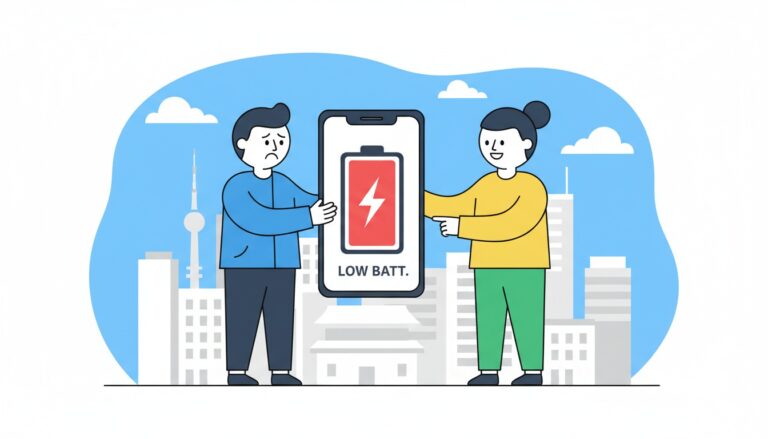
Phone Dying? Ask for Battery-Saving Tips in Korean!
Hello! It’s your friendly Korean language guide, [Maeil Hangeul], here to upgrade your skills!
Ever been in the middle of watching a K-drama on the subway or catching your favorite idol’s live stream, only to see that dreaded red battery icon? A dead phone in hyper-connected Korea can feel like a disaster! Today, we’re going to learn how to ask for and give simple advice, focusing on the very real-world problem of saving your smartphone’s battery. Let’s get started!
Core Expressions You Need to Know
Here are three essential phrases for asking for and giving advice.
1. 어떻게 해야 돼요? (Eotteoke haeya dwaeyo?)
- Meaning: What should I do?
- Detailed Explanation: This is your go-to phrase whenever you need advice or are unsure about what to do next. It’s polite and can be used in almost any situation, from asking for directions to, well, asking for tech tips! It literally means “How must I do?”
- 💡 Pronunciation Tip: The Korean word ‘어떻게’ is spelled ‘eo-tteoh-ge’ but it’s not pronounced that way. The ‘ㅎ’ (h) sound is very weak and almost silent when followed by ‘ㄱ’ (g), making the pronunciation closer to [eotteoke]. Focus on making a strong ‘tt’ sound at the beginning.
2. -(으)는 게 좋아요 (-(eu)neun ge joayo)
- Meaning: It’s a good idea to… / You should…
- Detailed Explanation: This is a fantastic way to give a soft, friendly suggestion. You attach it to a verb stem. Use ‘-는 게 좋아요’ for verbs ending in a vowel (e.g., 끄다 → 끄는 게 좋아요) and ‘-은 게 좋아요’ for verbs ending in a consonant (e.g., 낮추다 → 낮추는 게 좋아요). It’s much less forceful than telling someone “You must do this!”
- 💡 Pronunciation Tip: The word ‘좋아요’ is pronounced [joayo]. The ‘ㅎ’ (h) in the ‘좋’ syllable is silent when followed by a vowel. So, instead of ‘joh-a-yo’, the sounds link together smoothly to become ‘jo-a-yo’.
3. 한번 해 보세요 (Hanbeon hae boseyo)
- Meaning: Try doing it.
- Detailed Explanation: This is a gentle and encouraging phrase. ‘한번 (hanbeon)’ literally means “once,” but in this context, it means “give it a try.” The grammar pattern ‘-아/어 보세요’ means “to try doing (verb).” It’s a perfect way to respond after giving a piece of advice.
- 💡 Pronunciation Tip: The pronunciation of ‘한번’ is [hanbeon]. Notice how the ‘ㄴ’ (n) sound flows smoothly into the ‘ㅂ’ (b) sound. It’s a very common and useful phrase, so practice saying it smoothly!
Example Conversation
Let’s see how these expressions work in a real conversation. Imagine two friends talking about their phones.
- A: 요즘 핸드폰 배터리가 너무 빨리 닳아요. 어떻게 해야 돼요?
- Yojeum haendeupon baeteoriga neomu ppalli darayo. Eotteoke haeya dwaeyo?
- My phone battery drains so fast these days. What should I do?
- B: 아, 정말요? 화면 밝기를 낮추는 게 좋아요. 그리고 안 쓰는 앱은 꺼 보세요.
- A, jeongmallyo? Hwamyeon balgireul natchuneun ge joayo. Geurigo an sseuneun aebrun kkeo boseyo.
- Oh, really? It’s a good idea to lower the screen brightness. And try turning off apps you’re not using.
- A: 알겠어요. 한번 해 볼게요. 고마워요!
- Agesseoyo. Hanbeon hae bolgeyo. Gomawoyo!
- I see. I’ll give it a try. Thanks!
Culture Tip & Trend Deep Dive
In Korea’s famous ‘빨리빨리’ (ppalli-ppalli, or hurry-hurry) culture, staying connected is everything. People use their phones for payment (like Samsung Pay), navigation (Naver Maps), and constant communication (KakaoTalk). A dead battery means you’re cut off!
This is why you’ll see portable battery rental stations called ‘보조배터리 대여 서비스’ in almost every subway station and café. It’s also why talking about battery-saving tips is such a common conversation topic. Knowing today’s phrases will not only help you with your phone but also let you participate in a very everyday Korean conversation!
Let’s Practice!
Time to check what you’ve learned. Choose the correct phrase to complete the sentence.
Quiz: My phone is too slow. What should I do? (핸드폰이 너무 느려요. ___________?)
- 한번 해 보세요
- 어떻게 해야 돼요
- 는 게 좋아요
(The answer is 2!)
Great job today! Now it’s your turn. What’s your best battery-saving tip? Leave a comment below using the ‘-(으)는 게 좋아요’ grammar pattern. We can’t wait to see your sentences!
Frequently Asked Questions (FAQ)
Q: What does "어떻게 해야 돼요? (Eotteoke haeya dwaeyo?)" mean in Korean and how do you pronounce it?
A: In Korean, "어떻게 해야 돼요? (Eotteoke haeya dwaeyo?)" is pronounced [Tip: The Korean word '어떻게' is spelled 'eo-tteoh-ge' but it's not pronounced that way. The 'ㅎ' (h] and means: What should I do?
Q: What does "-(으)는 게 좋아요 (-(eu)neun ge joayo)" mean in Korean and how do you pronounce it?
A: In Korean, "-(으)는 게 좋아요 (-(eu)neun ge joayo)" is pronounced [Tip: The word '좋아요' is pronounced [joayo] and means: It's a good idea to... / You should...
Q: What does "한번 해 보세요 (Hanbeon hae boseyo)" mean in Korean and how do you pronounce it?
A: In Korean, "한번 해 보세요 (Hanbeon hae boseyo)" is pronounced [Tip: The pronunciation of '한번' is [hanbeon] and means: Try doing it.







