

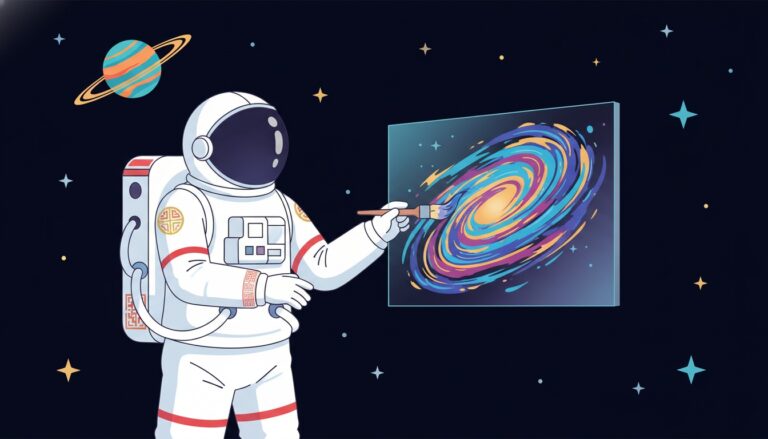
Hello! Welcome to Maeil Hangul, here to upgrade your Korean skills!
Have you ever looked up at the stars and imagined what life would be like in space? What kind of art would we create? What music would we listen to? Today, we’re going on a creative journey to learn how to talk about art and culture in a future space civilization, all in Korean!
Lately in Korea, the new sci-fi K-drama ‘Starlight Canvas’ (별빛 캔버스), about artists living on a space colony, is a huge hit! It’s got everyone talking about the future. So, let’s learn some key phrases that will make you sound like a futuristic art critic!
Core Expressions for the Cosmos
Here are some essential words to discuss futuristic and imaginative art.
1. 상상력 (sangsangnyeok)
* Pronunciation [Romanization]: sang-sang-nyeok
* English Meaning: Imagination
* Detailed Description: This is a fundamental word for any creative discussion. It’s a noun formed from the verb ‘상상하다’ (sangsanghada), which means ‘to imagine’. You can use it to praise someone’s creativity or to describe a work that is highly original and inventive. It’s a neutral term used in both casual and formal settings.
* 💡 Pronunciation Tip: The final syllable ‘력’ ends with a ‘ㄱ’ (k) sound. In Korean, when a ‘ㄱ’ is the final consonant of a syllable (a ‘받침’), it’s often unreleased. This means you form the ‘k’ sound at the back of your throat but don’t release a strong puff of air. It sounds softer than the ‘k’ at the beginning of an English word like ‘kick’.
2. 영감 (yeonggam)
* Pronunciation [Romanization]: yeong-gam
* English Meaning: Inspiration
* Detailed Description: Where does creativity come from? From ‘영감’! This noun is used just like its English counterpart. You can say you ‘get inspiration’ (영감을 받다 – yeonggameul batda) or ‘give inspiration’ (영감을 주다 – yeonggameul juda). It’s perfect for talking about an artist’s muse, whether it’s a person, a place, or a supernova!
* 💡 Pronunciation Tip: The initial ‘ㅇ’ is a silent placeholder, so the sound starts with the vowel ‘ㅕ’ (yeo). However, the ‘ㅇ’ in the middle of ‘영’ acts as a ‘ng’ sound, similar to the end of ‘song’ in English. So, it’s ‘yeong’, not ‘yeong-geu’.
3. 미래 지향적 (mirae jihyangjeok)
* Pronunciation [Romanization]: mi-rae ji-hyang-jeok
* English Meaning: Future-oriented / Futuristic
* Detailed Description: This is a fantastic descriptive phrase. ‘미래’ (mirae) means ‘future,’ and ‘지향적’ (jihyangjeok) means ‘-oriented’ or ‘-esque’. Together, they create the perfect adjective for describing anything that looks like it’s from the future – sci-fi movies, innovative technology, sleek designs, or even a K-pop group’s concept.
* 💡 Pronunciation Tip: The syllable ‘향’ (hyang) can be tricky. It’s a combination of ‘ㅎ’ (h) and the vowel ‘ㅑ’ (ya), followed by the ‘ㅇ’ (ng) consonant. Practice saying ‘h’ and ‘yang’ together quickly: hyang. It’s a smooth, single syllable.
4. 우주를 담다 (ujureul damda)
* Pronunciation [Romanization]: u-ju-reul dam-da
* English Meaning: To contain/capture the universe
* Detailed Description: This is a beautiful, poetic phrase. ‘우주’ (uju) is ‘universe/space’, and ‘담다’ (damda) is a verb meaning ‘to put something into’ or ‘to contain’. You would use this to describe a piece of art that is so vast, profound, or magnificent that it feels like it holds the entire cosmos within it. It’s a high compliment!
* 💡 Pronunciation Tip: Notice the ‘ㄹ’ (r/l) in ‘우주를’. Because it is followed by a vowel, the sound ‘links’ to the next syllable. So, instead of saying ‘u-ju / reul’, it flows together as [ujureul]. This is a very common Korean pronunciation rule called ‘연음’ (yeon-eum) or liaison.
Example Dialogue
Two friends, A and B, are watching the popular K-drama ‘Starlight Canvas’.
A: 와, 이 그림 좀 봐! 정말 미래 지향적이야.
(Wa, i geurim jom bwa! Jeongmal mirae jihyangjeok-iya.)
Wow, look at this painting! It’s so futuristic.
B: 맞아. 화가가 인터뷰에서 목성의 위성에서 영감을 얻었다고 했어.
(Maja. Hwagaga inteobyu-eseo mokseong-ui wiseong-eseo yeonggam-eul eodeotdago haesseo.)
Right. The artist said in an interview that they got their inspiration from Jupiter’s moons.
A: 대단하다. 작가의 상상력이 정말 풍부한 것 같아. 캔버스 하나에 우주를 담았네.
(Daedanhada. Jakga-ui sangsangnyeog-i jeongmal pungbuhan geot gata. Kaenbeoseu hana-e ujureul damanne.)
That’s amazing. The artist’s imagination seems so rich. They’ve really captured the universe in one canvas.
Culture Tip & Trend Analysis
While Korea is famous for historical dramas, there’s a growing passion for sci-fi and space exploration! This isn’t just in dramas like ‘Starlight Canvas’ or movies like ‘Space Sweepers’. Many popular webtoons explore futuristic themes, and K-pop groups like EXO and aespa have used cosmic and high-tech concepts for years. Using a phrase like 미래 지향적 (mirae jihyangjeok) to describe a new song’s music video or a cool piece of technology will show you’re in tune with modern Korean trends!
Wrap-up & Practice!
Today, we learned some stellar Korean expressions to talk about art and the future!
* 상상력 (sangsangnyeok): Imagination
* 영감 (yeonggam): Inspiration
* 미래 지향적 (mirae jihyangjeok): Futuristic
* 우주를 담다 (ujureul damda): To capture the universe
Now, it’s your turn! Try to fill in the blank below.
Quiz: The design of this new electric car is so sleek and innovative. It looks really ________.
Leave your answer and try making your own futuristic sentence in the comments below using today’s expressions!
Frequently Asked Questions (FAQ)
Q: What does "미래 지향적" mean in Korean and how do you pronounce it?
A: In Korean, "미래 지향적" is pronounced [mirae jihyangjeok] and means: to describe a new song's music video or a cool piece of technology will show you're in tune with modern Korean trends!
Q: What does "상상력" mean in Korean and how do you pronounce it?
A: In Korean, "상상력" is pronounced [sangsangnyeok] and means: Imagination
Q: What does "영감" mean in Korean and how do you pronounce it?
A: In Korean, "영감" is pronounced [yeonggam] and means: Inspiration
Q: What does "미래 지향적" mean in Korean and how do you pronounce it?
A: In Korean, "미래 지향적" is pronounced [mirae jihyangjeok] and means: Futuristic







