

Hello! This is Maeil Hangul, here to upgrade your Korean skills!
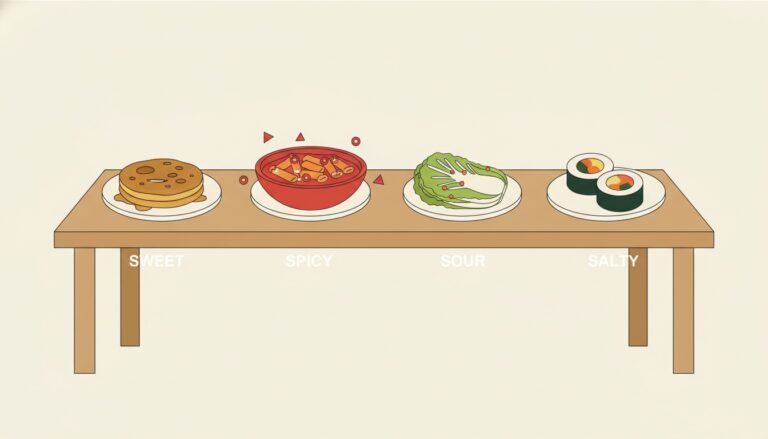
Have you ever watched a Korean mukbang or a K-drama and wished you could describe the food just like they do? You’re in luck! Today, we’re going to learn the essential words to describe food tastes in Korean. Especially with trends like tanghulu (탕후루 – fruit skewers with a hard candy coating) taking over social media in Korea, knowing these words will make you sound like a local foodie!
Let’s dive in and make your Korean taste descriptions more colorful!
Core Expressions: Your Korean Flavor Palette
Here are the must-know words to describe what you’re eating.
1. 달다 (Dalda) – Sweet
- Pronunciation [Romanization]: Dal-da
- English Meaning: Sweet
- Detailed Description: This is your go-to word for anything sweet, from candy and cake to sweet fruits like strawberries. When you talk about it in the present tense, it becomes 달아요 (darayo).
- 💡 Pronunciation Tip: The Korean letter ‘ㄷ’ (d) sounds like a soft ‘d’ at the beginning of a word. ‘ㅏ’ (a) is like the ‘a’ in ‘father’. ‘ㄹ’ (l) at the end of a syllable sounds like a soft ‘l’. So, it’s a smooth [dal-da].
2. 짜다 (Jjada) – Salty
- Pronunciation [Romanization]: Jja-da
- English Meaning: Salty
- Detailed Description: Use this for salty snacks like potato chips or savory dishes like kimchi jjigae. In the present tense, it’s 짜요 (jjayo).
- 💡 Pronunciation Tip: The first letter ‘ㅉ’ (jj) is a ‘tense’ consonant. It’s stronger and tighter than the regular ‘ㅈ’ (j). To make this sound, press your tongue firmly against the roof of your mouth and release a short, strong ‘jj’ sound, almost like saying ‘ch’ without the puff of air.
3. 시다 (Sida) – Sour
- Pronunciation [Romanization]: Si-da
- English Meaning: Sour
- Detailed Description: This word is perfect for describing lemons, yogurt, or sour kimchi. The present tense form is 셔요 (syeoyo).
- 💡 Pronunciation Tip: Notice how ‘시다 (sida)’ changes to ‘셔요 (syeoyo)’? The vowels ‘ㅣ’ (i) and ‘ㅓ’ (eo) combine to make the ‘ㅕ’ (yeo) sound. This is a common vowel combination in Korean verbs!
4. 맵다 (Maepda) – Spicy
- Pronunciation [Romanization]: Maep-da
- English Meaning: Spicy
- Detailed Description: An absolutely essential word for Korean cuisine! Use it for tteokbokki, buldak ramen, or spicy kimchi. Be careful, this word is irregular! In the present tense, it becomes 매워요 (maewoyo).
- 💡 Pronunciation Tip: The ‘ㅂ’ (b/p) at the end of ‘맵’ (maep) is an irregular consonant. When you add a vowel like ‘-어요’ (-eoyo) after it, the ‘ㅂ’ sound changes into a ‘w’ sound. So, ‘maep-eoyo’ magically becomes [mae-wo-yo]. This happens with other words like ‘덥다 (deopda -> 더워요 deowoyo – hot)’ too!
Example Dialogue: Trying Tanghulu!
Let’s see how these words are used in a real conversation about the super trendy snack, tanghulu!
- A: 와, 탕후루다! 먹어봤어? (Wa, tanghuruda! Meogeobwasseo?)
Wow, it’s tanghulu! Have you tried it? - B: 응! 딸기 탕후루는 정말 달아요. (Eung! Ttalgi tanghuru-neun jeongmal darayo.)
Yes! The strawberry tanghulu is really sweet. - A: 나는 신 거 좋아하는데… 샤인머스캣은 어때? (Naneun sin geo joahaneunde… syainmeoseukaet-eun eottae?)
I like sour things… How is the shine muscat grape one? - B: 그것도 달지만 조금 셔요. 맛있어! (Geugeotdo daljiman jogeum syeoyo. Masisseo!)
That one is sweet too, but it’s a little sour. It’s delicious!
Culture Tip: The Magic of ‘단짠단짠’ (Dan-Jjan-Dan-Jjan)
In Korea, there’s a huge trend for combining sweet and salty flavors. This is called ‘단짠단짠’ (dan-jjan-dan-jjan), which literally means ‘sweet-salty-sweet-salty’. It describes the irresistible combination of flavors you find in snacks like honey butter chips or sweet and savory fried chicken. If you want to sound like a real Korean foodie, you can say, “I love the ‘dan-jjan’ combination!” (저는 단짠 조합을 좋아해요!)
Let’s Practice!
Time to check what you’ve learned!
- Fill in the blank: Kimchi is delicious, but sometimes it can be a little too ______ for me. (김치는 맛있지만, 저한테는 가끔 너무 ______.)
- A) 달아요 (darayo)
- B) 매워요 (maewoyo)
- Your Turn! Think of your favorite food. How would you describe its main taste in Korean? (e.g., Chocolate is sweet. -> 초콜릿은 달아요.)
Great job today! You’re now ready to describe all the delicious Korean food you’ll eat.
Leave a comment below describing your favorite food using the words we learned today!
Frequently Asked Questions (FAQ)
Q: What does "달다 (Dalda) - Sweet" mean in Korean and how do you pronounce it?
A: In Korean, "달다 (Dalda) - Sweet" is pronounced [Romanization] and means: Sweet
Q: What does "짜다 (Jjada) - Salty" mean in Korean and how do you pronounce it?
A: In Korean, "짜다 (Jjada) - Salty" is pronounced [Romanization] and means: Salty
Q: What does "시다 (Sida) - Sour" mean in Korean and how do you pronounce it?
A: In Korean, "시다 (Sida) - Sour" is pronounced [Romanization] and means: Sour
Q: What does "맵다 (Maepda) - Spicy" mean in Korean and how do you pronounce it?
A: In Korean, "맵다 (Maepda) - Spicy" is pronounced [Romanization] and means: Spicy







