

Hello! This is Maeil Hangul, here to upgrade your Korean skills!
Have you ever been invited to something you couldn’t attend? Saying ‘no’ can be tricky in any language, but in Korean, being polite and considerate is key! Today, we’ll learn how to gracefully decline an invitation while promising to meet next time.
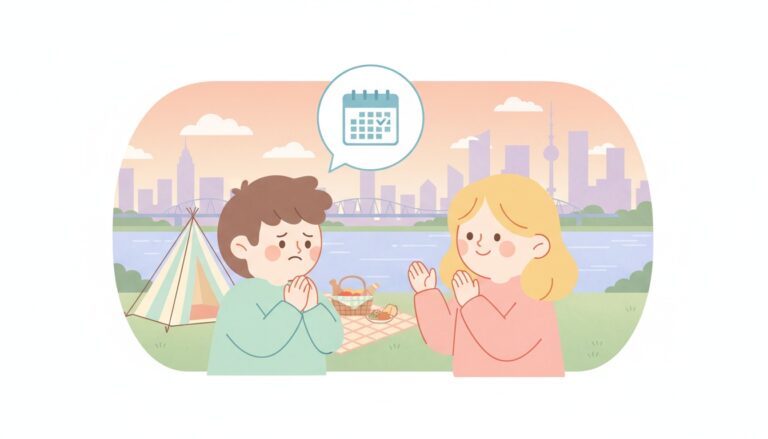
Lately in Korea, with the beautiful spring weather, everyone is having ‘healing picnics’ (힐링 피크닉) by the Han River. Imagine your friend asks you to go, but you’re busy. Don’t worry! After this lesson, you’ll know exactly what to say.
Key Expressions for a ‘Rain Check’
Here are three essential phrases to politely say, “Maybe next time!”
1. 아쉽지만 다음에 봐요 (Aswipjiman da-eume bwayo)
* Pronunciation [Romanization]: Aswipjiman da-eume bwayo
* English Meaning: That’s a shame, but let’s meet next time.
* Detailed Explanation: This is a perfect combination of expressing your regret and suggesting a future plan. ‘아쉽지만’ (aswipjiman) comes from the verb ‘아쉽다’ (aswipda), meaning ‘to be a pity’ or ‘a shame’. ‘다음에 봐요’ (da-eume bwayo) is a friendly way to say ‘see you next time’. It’s a very soft and warm way to turn down an offer.
* 💡 Pronunciation Tip: In the word ‘아쉽지만’ (aswipjiman), the final consonant ‘ㅂ’ in ‘쉽’ is pronounced clearly because it’s followed by the consonant ‘ㅈ’. So you don’t drop the ‘b’ sound. Practice saying ‘aswip-jiman’ slowly.
2. 오늘은 좀 어려울 것 같아요 (Oneureun jom eoryeoul geot gatayo)
* Pronunciation [Romanization]: Oneureun jom eoryeoul geot gatayo
* English Meaning: It seems a bit difficult today.
* Detailed Explanation: This is a classic example of indirect Korean speech. Instead of a direct “I can’t,” you say it seems ‘difficult’ (어렵다). The grammar pattern ‘-(으)ㄹ 것 같다’ means ‘it seems like…’ or ‘I think…’. This phrase is incredibly useful and sounds very natural and polite.
* 💡 Pronunciation Tip: Let’s look at ‘것 같아요’ [geot gatayo]. The final consonant ‘ㅅ’ in ‘것’ is pronounced like a ‘ㄷ’ [d/t] sound when it comes before another consonant. So, instead of making an ‘s’ sound, it sounds like [geot-gatayo]. This is a very common sound rule in Korean!
3. 다음에 꼭 같이 가요 (Da-eume kkok gachi gayo)
* Pronunciation [Romanization]: Da-eume kkok gachi gayo
* English Meaning: Let’s definitely go together next time.
* Detailed Explanation: This is the perfect follow-up phrase! It shows your genuine interest in hanging out later. ‘꼭’ (kkok) is a key word here, meaning ‘definitely’ or ‘surely’. It adds sincerity to your promise. ‘같이 가요’ (gachi gayo) means ‘let’s go together’.
* 💡 Pronunciation Tip: The word ‘같이’ is not pronounced ‘gat-i’ but [gachi]. This is because of a rule called ‘palatalization’ (구개음화). When the final consonant ‘ㅌ’ (t) is followed by the vowel ‘ㅣ’ (i), it transforms into a ‘ㅊ’ [ch] sound. It makes the pronunciation smoother! The word ‘굳이’ (gudi – needlessly) is another example, pronounced as [구지 – guji].
Example Dialogue
Let’s see these phrases in action!
- A: 소민아, 오늘 날씨 좋은데 한강에서 피크닉 할까? 요즘 유행하는 크로플 사 갈게!
(Somina, the weather is great today, shall we have a picnic at the Han River? I’ll buy the trendy croffles!) - B: 우와, 정말 좋겠다! 아쉽지만 오늘은 가족 저녁 식사가 있어서 좀 어려울 것 같아.
(Wow, that sounds amazing! That’s a shame, but it seems a bit difficult today because I have a family dinner.) - A: 아, 그렇구나. 괜찮아!
(Oh, I see. No problem!) - B: 대신 우리 다음에 꼭 같이 가자! 다음 주 어때?
(But let’s definitely go together next time! How about next week?)
Culture Tip & Trend Deep Dive
In Korea, maintaining harmony in relationships is very important. Directly saying “no” (아니요) or “I can’t go” (못 가요) can sometimes sound too strong or blunt, especially to friends. That’s why using indirect expressions like ‘어려울 것 같아요’ (it seems difficult) is so common.
Adding a phrase like ‘다음에 꼭 같이 가요’ is more than just a phrase; it’s a cultural practice to reassure your friend that you value their invitation and your relationship. It shows you’re not rejecting them, just the timing. So next time you have to say no, remember to express your regret and promise a ‘next time’ to keep the friendship strong!
Wrap-up & Practice!
Today we learned how to politely decline an invitation in Korean.
- 아쉽지만 다음에 봐요. (It’s a shame, let’s see each other next time.)
- 오늘은 좀 어려울 것 같아요. (It seems a bit difficult today.)
- 다음에 꼭 같이 가요. (Let’s definitely go together next time.)
Now, it’s your turn! Your friend invites you to a K-pop concert this Friday, but you have an important exam. How would you respond?
Fill in the blank: 와, 콘서트! 정말 가고 싶다. 하지만 금요일에 시험이 있어서 ______.
Leave your answer in the comments using the expressions we learned today!







