

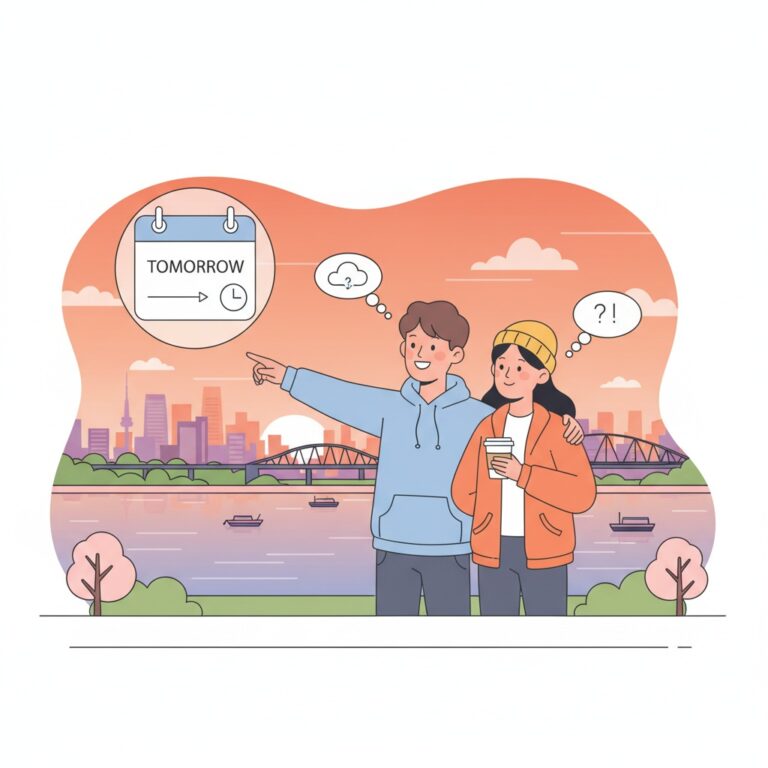
What Are You Doing Tomorrow? Plan Like a Local in Korea! 🇰🇷
Hello! This is Maeil Hangul (매일한글), here to upgrade your Korean skills! 😊
Ever wanted to ask a new friend in Seoul to hang out? Or maybe you want to plan a fun day with your language exchange partner? Today, we’re going to learn the essential phrases for making plans for tomorrow.
Lately in Korea, with the beautiful weather, everyone is busy making plans to visit trendy new cafes (we call them ‘신상 카페’) or go for a walk along the Han River. You’ll hear the phrases we’re learning today everywhere, so let’s master them and get you ready to make some fun plans of your own!
Core Expressions for Making Plans
Here are three key expressions that will turn you into a planning pro!
1. 내일 뭐 해요? (Naeil mwo haeyo?)
- Romanization: Naeil mwo haeyo?
- English Meaning: What are you doing tomorrow?
- Detailed Explanation: This is the most common and natural way to ask someone about their plans for the next day. It’s in the standard polite
해요(haeyo) form, so you can use it with friends, colleagues, or anyone you’re comfortable with but still want to be polite to. It’s the perfect conversation starter! -
💡 Pronunciation Tip:
The word ‘뭐’ (mwo) can sometimes sound like [bwo] in fast, natural speech. While pronouncing it clearly as [mwo] is perfectly correct, don’t be surprised if you hear Koreans say it more like [bwo]. It’s a small change that makes you sound more like a native speaker!
2. -(으)ㄹ 거예요 (-(eu)l geoyeyo)
- Romanization: -(eu)l geoyeyo
- English Meaning: I am going to… / I will… (future tense)
-
Detailed Explanation: This is the go-to grammar pattern for talking about your future plans and intentions. It’s super useful! You attach it to a verb stem.
- Use -ㄹ 거예요 (-l geoyeyo) after a verb stem ending in a vowel.
- 보다 (boda – to see) → 보 + ㄹ 거예요 → 볼 거예요 (bol geoyeyo) – I’m going to see.
- Use -을 거예요 (-eul geoyeyo) after a verb stem ending in a consonant.
- 먹다 (meokda – to eat) → 먹 + 을 거예요 → 먹을 거예요 (meogeul geoyeyo) – I’m going to eat.
- Use -ㄹ 거예요 (-l geoyeyo) after a verb stem ending in a vowel.
- 💡 Pronunciation Tip:
Even though it’s written as ‘거예요’ (geoyeyo), in everyday conversation, it’s often pronounced closer to [거에요 / geoeyo]. The ‘예’ (ye) sound softens to ‘에’ (e). Both are understood, but using [geoeyo] will make you sound a little more natural.
3. 같이 ~ㄹ/을래요? (Gachi ~l/eullaeyo?)
- Romanization: Gachi ~l/eullaeyo?
- English Meaning: Shall we…? / Do you want to… together?
-
Detailed Explanation: This is a friendly and gentle way to suggest doing something together. It’s less direct than “Let’s do it!” and more like asking for the other person’s opinion. It’s perfect for asking someone out for coffee or a movie.
- Example: 영화 보다 (yeonghwa boda – to watch a movie) → 같이 영화 볼래요? (Gachi yeonghwa bollaeyo?) – Shall we watch a movie together?
- 💡 Pronunciation Tip:
This is a super important one! The word ‘같이’ is written as ‘gat-i’ but is NEVER pronounced that way. It’s pronounced [가치 / gachi]. Why? When the final consonant ‘ㅌ’ (t) is followed by the vowel ‘ㅣ’ (i), it changes to a ‘ㅊ’ (ch) sound. This rule is called palatalization, and it makes the pronunciation smoother. The same thing happens with ‘굳이’ (gud-i), which is pronounced [구지 / guji].
Example Dialogue
Let’s see how these phrases work in a real conversation. Two friends, Alex and Yuna, are planning to meet.
A (Alex): 유나 씨, 내일 뭐 해요?
Yuna, what are you doing tomorrow?
(Yuna-ssi, naeil mwo haeyo?)
B (Yuna): 저는 집에서 쉴 거예요. 왜요?
I’m going to rest at home. Why?
(Jeoneun jibeseo swil geoyeyo. Waeyo?)
A (Alex): 홍대에 새로 생긴 카페가 있는데, 같이 갈래요?
There’s a new cafe in Hongdae, do you want to go together?
(Hongdae-e saero saenggin kapega inneunde, gachi gallaeyo?)
B (Yuna): 와, 좋아요! 그럼 내일 거기서 만나요!
Wow, sounds great! Then let’s meet there tomorrow!
(Wa, joayo! Geureom naeil geogiseo mannayo!)
Culture Tip & Trend Deep Dive ☕️
In Korea, asking “내일 뭐 해요?” is more than just a question—it’s often a friendly opening to make a plan and strengthen a friendship.
And here’s a pro tip: suggesting a trip to a ‘신상 카페’ (sinsang kape – a brand new cafe) is a very trendy thing to do, especially among young Koreans. Cafes in Korea aren’t just for coffee; they are important social spaces for studying, chatting, and of course, taking amazing pictures for Instagram! If you suggest visiting one using “같이 카페 갈래요?” (Gachi kape gallaeyo?), you’ll sound just like a local who’s in on the latest trends.
Let’s Practice!
Time to check what you’ve learned!
1. Fill in the blank:
You want to tell your friend, “I’m going to study Korean tomorrow.” How would you say it?
저는 내일 한국어를 (________________).
(Jeoneun naeil hangugeoreul…)
2. Make a suggestion:
How would you ask a friend, “Shall we eat dinner together?” using one of today’s key phrases?
(Scroll down for the answers!)
.
.
.
Answers:
1. 공부할 거예요 (gongbuhal geoyeyo)
2. 같이 저녁 먹을래요? (Gachi jeonyeok meogeullaeyo?)
Great job, everyone! Making plans is the first step to making wonderful memories in Korea.
Now it’s your turn! What are your plans for tomorrow? Leave a comment below using the -(으)ㄹ 거예요 grammar pattern. I can’t wait to read them!
Frequently Asked Questions (FAQ)
Q: What does "'뭐'" mean in Korean and how do you pronounce it?
A: In Korean, "'뭐'" is pronounced [mwo] and means: can sometimes sound like
Q: What does "-ㄹ 거예요" mean in Korean and how do you pronounce it?
A: In Korean, "-ㄹ 거예요" is pronounced [-l geoyeyo] and means: after a verb stem ending in a vowel.
Q: What does "볼 거예요" mean in Korean and how do you pronounce it?
A: In Korean, "볼 거예요" is pronounced [bol geoyeyo] and means: - I'm going to see.
Q: What does "-을 거예요" mean in Korean and how do you pronounce it?
A: In Korean, "-을 거예요" is pronounced [-eul geoyeyo] and means: after a verb stem ending in a consonant.







