

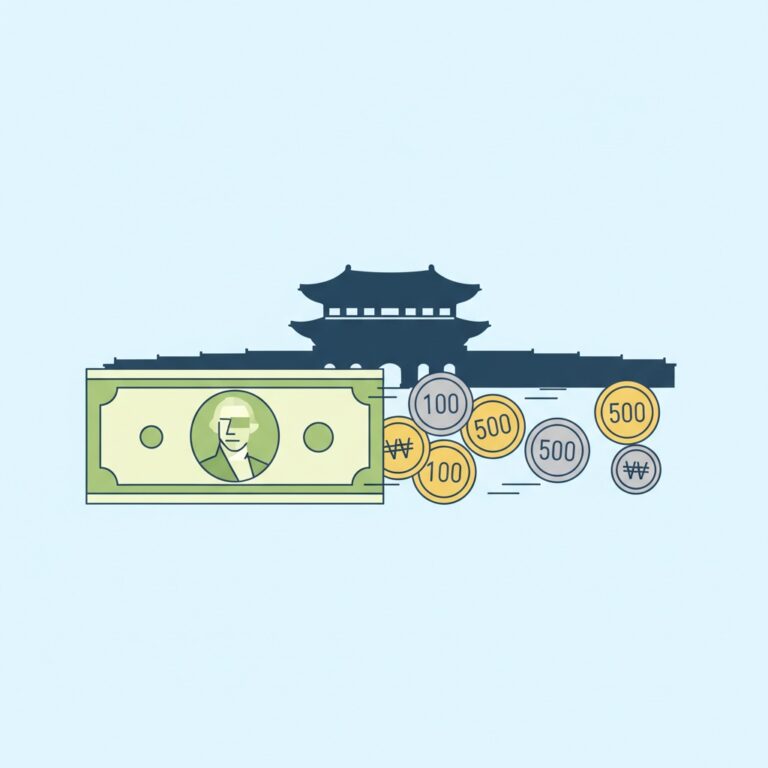
From Dollars to Won: Your Guide to Korean Currency Exchange!
Hello! This is Maeil Hangeul, here to upgrade your Korean skills!
Are you planning a trip to Korea? Amazing! Today, we’re going to learn some super useful phrases that will make you feel confident from the moment you land: how to exchange currency. This is your key to unlocking all the amazing food, shopping, and experiences Korea has to offer.
These days in Korea, while it’s becoming a “cashless society” where credit cards and mobile payments are used everywhere, you’ll still absolutely need cash (현금, hyeonggeum) for the best local experiences! Think of tasting delicious tteokbokki from a street vendor, buying unique souvenirs at Namdaemun Market, or exploring the vibrant Gwangjang Market. For these authentic adventures, cash is king! So let’s get you ready.
Core Expressions You Need to Know
Here are three essential phrases for exchanging money like a pro.
1. I’d like to exchange currency.
- Korean: 환전하고 싶어요.
- Pronunciation [Romanization]: Hwanjeonhago sipeoyo.
- English Meaning: I’d like to exchange currency.
- Detailed Explanation: This is the perfect, polite phrase to start the conversation at any bank or exchange booth. It’s made up of 환전 (hwanjeon), which means “currency exchange,” and the grammar pattern -고 싶어요 (-go sipeoyo), which means “I want to…”. It’s a standard and respectful way to state your purpose.
-
💡 Pronunciation Tip:
The word 환전 (hwanjeon) might look like ‘hwan-jeon’, but the ‘n’ sound flows smoothly into the ‘j’ sound. Practice saying it as one fluid word: [Hwan-jeon]. Don’t pause between the two syllables. This will make you sound much more natural!
2. What is the exchange rate today?
- Korean: 오늘 환율이 어떻게 되나요?
- Pronunciation [Romanization]: Oneul hwanyuri eotteoke doenayo?
- English Meaning: What is the exchange rate today?
-
Detailed Explanation: This is the most important question! 오늘 (oneul) means “today,” and 환율 (hwanyul) means “exchange rate.” The phrase 어떻게 되나요? (eotteoke doenayo?) is a very polite way of asking “How is it?” or “What is it?”. You can use this pattern to ask for other information, too.
-
💡 Pronunciation Tip:
Notice the word 어떻게 (eotteoke). It’s written with a ‘ㅎ (h)’ in the middle (eo-tteoh-ge), but you don’t really hear the ‘h’ sound. Instead, the ‘ㅎ (h)’ combines with the next consonant ‘ㄱ (g)’ to create an aspirated ‘ㅋ (k)’ sound. So, it’s pronounced [어떠케/eotteoke], not eotteohge. This sound change, called aspiration, also happens in words like ‘좋다 (johda),’ which is pronounced [조타/jota].
3. Please give it to me in small bills.
- Korean: 잔돈으로 바꿔 주세요.
- Pronunciation [Romanization]: Jandoneuro bakkwo juseyo.
- English Meaning: Please change it into small bills/change.
-
Detailed Explanation: This is a lifesaver! 잔돈 (jandon) means “change” or “small money.” When you exchange a large amount, you might get big 50,000 won bills, which can be difficult to use at small shops or markets. Using this phrase ensures you get a mix of 10,000 won, 5,000 won, and 1,000 won bills, making your life much easier.
-
💡 Pronunciation Tip:
The double consonant ‘ㄲ’ in 바꿔 (bakkwo) is a tensed sound. This means you should make the ‘kk’ sound short, sharp, and without a puff of air. It’s different from ‘ㄱ (g)’ (as in gayo) and ‘ㅋ (k)’ (as in keopi). Practice making the sound in the back of your throat with a bit of tension: [bakkwo].
Example Dialogue
Let’s see how these phrases work in a real conversation at a bank!
- A (Traveler): 안녕하세요. 환전하고 싶어요.
(Annyeonghaseyo. Hwanjeonhago sipeoyo.)
Hello. I’d like to exchange currency. - B (Bank Teller): 네, 어떤 통화를 바꾸시겠어요?
(Ne, eotteon tonghwareul bakkusigesseoyo?)
Yes, which currency would you like to exchange? - A (Traveler): 미국 달러요. 오늘 환율이 어떻게 되나요?
(Miguk deolleoyo. Oneul hwanyuri eotteoke doenayo?)
US Dollars. What’s the exchange rate today? - B (Bank Teller): 1달러에 1,350원입니다.
(Il deolle-e cheonsambaegosibwonimnida.)
It’s 1,350 won per dollar. - A (Traveler): 좋아요. 100달러 바꿔 주세요. 아, 그리고 잔돈으로 바꿔 주세요.
(Joayo. Baek deolleo bakkwo juseyo. A, geurigo jandoneuro bakkwo juseyo.)
Great. Please exchange 100 dollars. Oh, and please give it to me in small bills. - B (Bank Teller): 네, 알겠습니다.
(Ne, algesseumnida.)
Yes, I understand.
Culture Tip: Cash is King at Korean Markets!
While Korea is a high-tech, ‘card-first’ country, don’t be fooled! The heart of Korean food and culture often lies in its traditional markets (시장, sijang). At places like Gwangjang Market in Seoul, famous for its delicious bindaetteok (mung bean pancakes), or Busan’s Jagalchi Fish Market, cash is essential.
Many vendors are small, family-run businesses. Using cash is often faster for them, and they appreciate it as it helps them avoid credit card fees. Sometimes, if you pay with cash, they might even give you a little extra for free—this is called 서비스 (seobiseu, service)! So, when you use “잔돈으로 바꿔 주세요,” you’re not just getting change; you’re preparing to dive deep into authentic Korean culture. You’ll look like a seasoned traveler, not just a tourist!
Let’s Practice!
You did a fantastic job today! Let’s quickly review what you’ve learned.
- Fill in the Blank: You are at the exchange counter and want to ask for smaller bills. You say:
“____________ 바꿔 주세요.” -
Make a Sentence: How would you politely say, “I want to exchange 200 Euros”? (Hint: Euro is 유로, yuro).
Great work today! Now it’s your turn to be the star. Leave a comment below using one of the phrases we learned! I can’t wait to read your sentences. 파이팅! (Fighting!)
Frequently Asked Questions (FAQ)
Q: What does "환전" mean in Korean and how do you pronounce it?
A: In Korean, "환전" is pronounced [hwanjeon] and means: , which means "currency exchange," and the grammar pattern
Q: What does "-고 싶어요" mean in Korean and how do you pronounce it?
A: In Korean, "-고 싶어요" is pronounced [-go sipeoyo] and means: , which means "I want to...". It's a standard and respectful way to state your purpose.
Q: What does "환전" mean in Korean and how do you pronounce it?
A: In Korean, "환전" is pronounced [hwanjeon] and means: might look like 'hwan-jeon', but the 'n' sound flows smoothly into the 'j' sound. Practice saying it as one fluid word:
Q: What does "오늘" mean in Korean and how do you pronounce it?
A: In Korean, "오늘" is pronounced [oneul] and means: means "today," and







