

Hello! It’s your friendly guide, [매일한글] (Maeil Hangeul), here to upgrade your Korean skills!
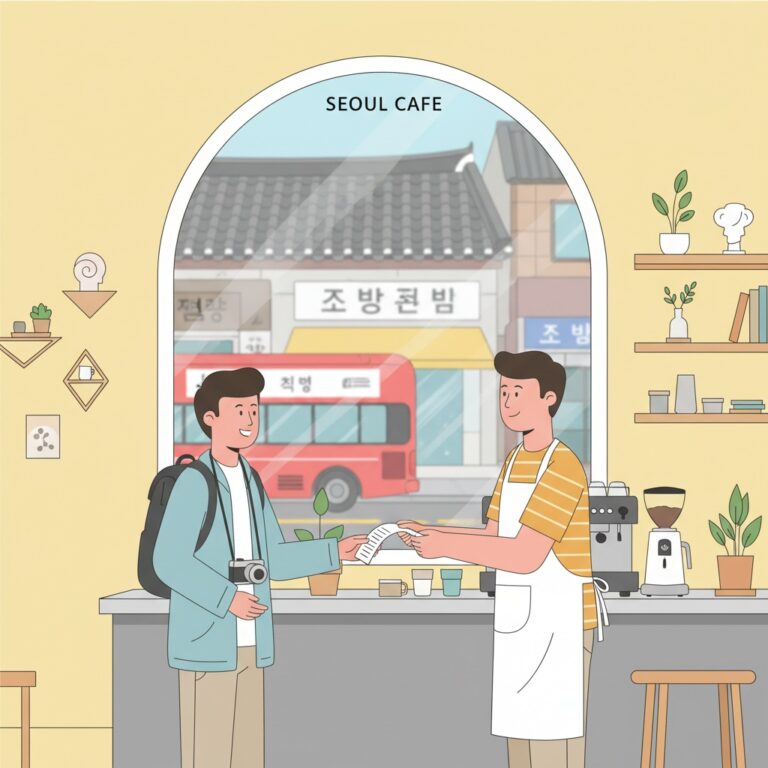
Imagine you’re in a beautiful, aesthetic cafe in Seoul. You’ve just ordered a delicious drink, and now you need the receipt to track your travel budget. What do you say? Don’t worry, we’ve got you covered!
Today, we’re going to learn a super simple but incredibly useful phrase for asking for a receipt. Lately in Korea, “cafe hopping” (카페 투어) is a huge trend, and people love sharing “proof shots” (인증샷) of their cafe adventures on Instagram. Being able to ask for your receipt confidently is a small step that will make you feel like a real local!
Let’s get started!
Core Expressions You Need to Know
Here are the key building blocks for today’s mission.
1. The Magic Noun: 영수증 (Receipt)
- Korean Expression: 영수증
- Pronunciation [Romanization]: Yeong-su-jeung
- English Meaning: Receipt
- Detailed Explanation: This is the most important word for today! It’s a noun you can use in any store, restaurant, or cafe. It’s a slightly formal word, so it’s perfect for using with staff.
- 💡 Pronunciation Tip: The first syllable ‘영’ [yeong] has a sound similar to the “-ng” in the English word “song“. The last syllable ‘증’ [jeung] is a bit tricky. It’s not “jung” but more of a “juh-ng” sound pronounced quickly.
2. The Polite Request: 주세요 (Please give me…)
- Korean Expression: 주세요
- Pronunciation [Romanization]: Ju-se-yo
- English Meaning: Please give me…
- Detailed Explanation: This is your golden key in Korea! You can attach [Noun] + 주세요 to politely ask for almost anything. It comes from the verb ‘주다’ (juda – to give) and the polite ending ‘-세요’ (-seyo). It’s a must-know phrase for every beginner.
- 💡 Pronunciation Tip: ‘주’ [ju] sounds like the “ju” in “juice”. ‘세’ [se] is like “say” but a bit shorter and sharper. The final ‘요’ [yo] makes the whole phrase polite and friendly.
3. Putting It All Together: 영수증 주세요!
- Korean Expression: 영수증 주세요!
- Pronunciation [Romanization]: Yeong-su-jeung ju-se-yo!
- English Meaning: Please give me a receipt!
- Detailed Explanation: You did it! By combining the noun and the polite request, you’ve formed a perfect, natural-sounding sentence. You can say this right after you pay with your card or cash. It’s simple, direct, and everyone will understand you.
- 💡 Pronunciation Tip: Let’s break down the pronunciation of a similar word, 같이 (together). It’s written as ‘gat-i’ but pronounced as [gachi]. This is because the ‘ㅌ’ (t) sound at the end of a syllable changes to a ‘ㅊ’ (ch) sound when it’s followed by an ‘ㅣ’ (i) vowel. This rule is called palatalization (구개음화). It makes the pronunciation smoother! So instead of a hard “gat-i,” it flows into a soft “ga-chi.”
Example Dialogue in a Cafe
Let’s see how this works in a real conversation. Imagine you (B) are at a trendy cafe that was featured in the latest K-drama.
- A: Cafe Staff (직원)
- B: You (손님)
A: 주문 도와드릴까요?
[Jumun dowa-deurilkkayo?]
(May I take your order?)B: 아이스 아메리카노 한 잔 주세요.
[Aiseu Amerikano han jan juseyo.]
(One iced Americano, please.)A: 네, 5,000원입니다.
[Ne, o-cheon-won-imnida.]
(Yes, that’s 5,000 won.)B: (You pay with your card.)
A: 감사합니다.
[Gamsahamnida.]
(Thank you.)B: 저기요, 영수증 주세요.
[Jeogiyo, yeong-su-jeung juseyo.]
(Excuse me, please give me a receipt.)A: 네, 여기 있습니다.
[Ne, yeogi itseumnida.]
(Of course, here you are.)
See? So simple and smooth!
Culture Tip & Trend Analysis
Why is a receipt so important in Korea?
Beyond just tracking your budget, receipts have a special place in modern Korean culture!
- The “Proof Shot” (인증샷): On Instagram, you’ll see many Koreans posting photos of their cafe table, which often includes the drink, a cute dessert, and the cafe’s uniquely designed receipt. It’s part of the aesthetic and proves you visited a trendy spot!
- The Wi-Fi Password: Pro-tip! Many cafes in Korea print the Wi-Fi password directly on the receipt. So asking “영수증 주세요” isn’t just about money—it’s your key to getting free internet!
- Budgeting Challenges (무지출 챌린지): It’s a popular trend among the Korean Z-generation to try and have “no-spend days.” They collect receipts from the days they do spend money to hold themselves accountable. Your receipt is proof of your spending!
So next time you ask for a receipt, you’re not just being a tourist—you’re participating in a modern Korean cultural trend!
Let’s Wrap It Up & Practice!
Awesome work today! You’ve learned the essential phrase “영수증 주세요” and the key components “영수증” (receipt) and the polite request “주세요” (please give me). You are now ready to conquer any Korean cafe!
Quick Quiz:
- Fill in the blank: You want a bottle of water at a convenience store. You should say: “물 한 병 __________.” (물 한 병 = mul han byeong = one bottle of water)
- T / F: The phrase “주세요” is a casual expression you should only use with close friends.
(Answers: 1. 주세요 / 2. False – It’s a polite expression perfect for use in stores and restaurants!)
Now it’s your turn to practice! Try creating a sentence using “주세요” in the comments below. You could ask for coffee (커피), bread (빵), or anything else! We’d love to see what you come up with
Frequently Asked Questions (FAQ)
Q: What does "[매일한글]" mean in Korean and how do you pronounce it?
A: In Korean, "[매일한글]" is pronounced [Maeil Hangeul] and means: , here to upgrade your Korean skills!
Q: What does "같이" mean in Korean and how do you pronounce it?
A: In Korean, "같이" is pronounced [together] and means: . It's written as 'gat-i' but pronounced as







