

Beyond ‘Jikju-geunjeop’: Korea’s New Real Estate Trends Post-COVID
Hello! Welcome to Maeil Hangeul, here to upgrade your Korean skills to the next level!
Today, we’re diving into a fascinating and very current topic: how the real estate market in Korea is changing. Specifically, we’ll explore the impact of remote work since the pandemic. Understanding this topic is perfect for C1 learners who want to read Korean news articles, understand economic trends, and engage in sophisticated conversations about modern Korean society.
Lately in Korea, the conversation around housing has been shifting dramatically. The absolute golden rule used to be proximity to work, but with the rise of remote work, people are asking new questions. Is a long commute still worth it? What makes a home truly desirable now? Let’s learn the essential vocabulary to discuss this major social shift!
Core Expressions You Need to Know
Here are some key terms that are absolutely essential for understanding recent discussions about the Korean property market.
1. 직주근접 (Jikju-geunjeop)
- Pronunciation [Romanization]: Jikju-geunjeop
- English Meaning: Proximity of work and home.
- Detailed Explanation: This is a crucial Sino-Korean term (Hanja: 職 work, 住 live, 近 close, 接 connect) that has dominated the Korean housing market for decades. It refers to the concept of living close to one’s workplace. For years, properties with good access to major business districts like Gangnam, Yeouido, or Gwanghwamun were considered the most valuable. This concept is deeply intertwined with Korea’s traditionally office-centric and fast-paced work culture.
- 💡 Pronunciation Tip:
The final consonant ‘ㄱ’ (k) in ‘직’ (jik) and the initial consonant ‘ㄱ’ (g) in ‘근’ (geun) can sometimes create a tensed sound due to a pronunciation rule called tensification (경음화). So, while written as ‘jikju-geunjeop’, you might hear native speakers pronounce it with a subtle emphasis, almost like [직쭈근접, jik-jju-geun-jeop]. Listening for this will sharpen your comprehension skills!
2. 탈서울 (Tal-Seoul)
- Pronunciation [Romanization]: Tal-Seoul
- English Meaning: “Escape Seoul” or the Seoul Exodus.
- Detailed Explanation: The prefix ‘탈(脫)’ means to escape or break away from something. When combined with ‘서울’ (Seoul), it describes the growing trend of people moving out of the hyper-expensive and densely populated capital city. This phenomenon has been significantly accelerated by remote work, as the necessity of a daily commute into Seoul has diminished for many, allowing them to seek more affordable and spacious housing in surrounding provinces like Gyeonggi-do.
- 💡 Pronunciation Tip:
When the syllable ‘탈’ (tal), which ends in ‘ㄹ’ (l), is followed by the ‘ㅅ’ (s) in ‘서울’ (Seoul), the ‘ㅅ’ is pronounced as the tense consonant ‘ㅆ’ [ss]. This is another example of tensification (경음화). Therefore, the natural pronunciation is closer to [탈써울, tal-sseoul].
3. 숲세권 (Supsekwon)
- Pronunciation [Romanization]: Supsekwon
- English Meaning: An area with convenient access to a forest (숲).
- Detailed Explanation: This is a fantastic example of a modern Korean real estate neologism. The suffix ‘-세권’ (-sekwon) originates from the word ‘역세권’ (yeoksekwon), which means the area around a subway station. This suffix is now attached to various amenities to describe a desirable location. Other popular variations include 공세권 (gongsekwon) for parks and even 스세권 (seusekwon) for a Starbucks! The popularity of ‘숲세권’ shows a clear shift in values: people now prioritize quality of life, well-being, and access to nature over just a short commute.
- 💡 Pronunciation Tip:
The final consonant ‘ㅍ’ (p) in ‘숲’ (sup) is pronounced as an unreleased ‘ㅂ’ [p̚] sound when it’s in the final position (받침). When followed by ‘세권’ (sekwon), the initial ‘ㅅ’ (s) also becomes tensed. So, the correct pronunciation is [숩쎄권, sup-sse-kwon].
4. 재택근무 (Jaetaek-geunmu)
- Pronunciation [Romanization]: Jaetaek-geunmu
- English Meaning: Remote work; telecommuting; work-from-home (WFH).
- Detailed Explanation: This is the standard, formal term for working from home. It’s another Sino-Korean word: 在 (jae) means ‘to be at,’ 宅 (taek) means ‘home,’ and 勤務 (geunmu) means ‘work.’ You will see this term constantly in news articles, company policies, and formal conversations about work arrangements.
- 💡 Pronunciation Tip:
Pay close attention to the vowels. Both ‘재’ (jae) and ‘택’ (taek) use the ‘애’ [ae] vowel, which is a bright, open sound similar to the ‘a’ in “apple.” Don’t confuse it with the ‘에’ [e] vowel, as in “egg.” Practicing the distinction between words like 재 (jae) and 제 (je) is great for your pronunciation accuracy.
Example Dialogue
Let’s see how these expressions are used in a natural conversation.
- A: 민준아, 너 곧 이사한다며? 어디로 가? 지금 사는 곳이 회사랑 가까워서 좋았잖아.
(Minjun, I heard you’re moving soon. Where to? I thought you liked living where you are now because it was close to your office.) - B: 응, 경기도 외곽으로 이사 가. 우리 회사가 주 3일 재택근무를 정식으로 도입해서, 이제 직주근접은 크게 중요하지 않게 됐어.
(Yeah, I’m moving to the outskirts of Gyeonggi province. My company officially implemented a 3-day remote work policy, so jikju-geunjeop isn’t a major priority anymore.) - A: 와, 진짜? 완전 부럽다. 나도 기회만 되면 탈서울하고 싶어. 서울은 집값도 비싸고 너무 복잡해.
(Wow, really? I’m so jealous. I’d love to ‘escape Seoul’ if I had the chance. The housing prices in Seoul are insane and it’s so crowded.) - B: 맞아. 새로 이사 가는 곳은 근처에 큰 숲이 있어서 완전 숲세권이야. 주말마다 등산하려고!
(I know, right? The new place is a perfect ‘supsekwon’ with a big forest nearby. I plan on hiking every weekend!)
Cultural Tip & Trend Analysis
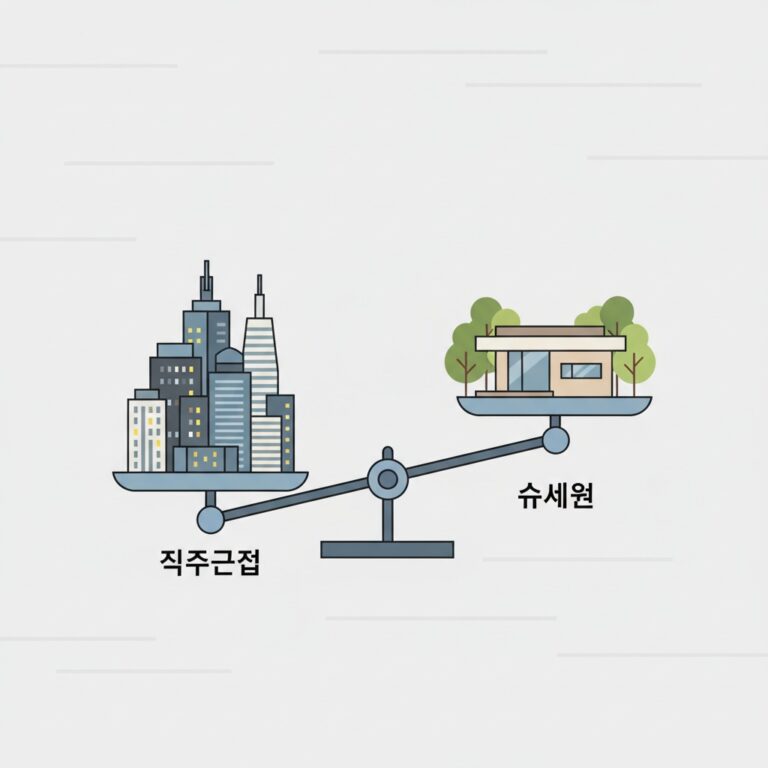
The shift from a 직주근접-focused market to one that values 숲세권 is more than just a real estate trend; it’s a profound cultural shift.
For decades, the Korean dream involved securing a stable job at a big company in Seoul and buying an apartment as close to it as possible. The pandemic acted as a massive catalyst, forcing companies to experiment with 재택근무. This experience showed many workers, especially the Millennial and Gen Z generations who highly value work-life balance (워라밸), that a different lifestyle is possible.
As a result, you’ll now see news headlines like “재택근무 확산, ‘직주근접’ 공식 깨졌다” (The Spread of Remote Work Has Shattered the ‘Jikju-geunjeop’ Formula). Understanding these key terms allows you to decode the complex social and economic changes happening in Korea right now. Knowing this context will make you sound incredibly knowledgeable when discussing Korean society!
Let’s Practice!
Time to check your understanding!
- Fill in the blank:
Before the pandemic, the most important factor in the Korean real estate market was undoubtedly __________.
(Answer: 직주근접) -
Scenario Question:
Your friend tells you they are tired of living in crowded Seoul and are moving to a quieter city in another province to work remotely. Which key term best describes your friend’s action?
(Answer: 탈서울)
Great job today! You’ve learned some advanced and highly relevant vocabulary for discussing modern Korea.
Now, it’s your turn! What are the housing trends in your country? Do you prefer 직주근접 or 숲세권? Leave a comment below using the expressions we learned today!
Frequently Asked Questions (FAQ)
Q: What does "공세권" mean in Korean and how do you pronounce it?
A: In Korean, "공세권" is pronounced [gongsekwon] and means: for parks and even
Q: What does "스세권" mean in Korean and how do you pronounce it?
A: In Korean, "스세권" is pronounced [seusekwon] and means: for a Starbucks! The popularity of '숲세권' shows a clear shift in values: people now prioritize quality of life, well-being, and access to nature over just a short commute.







