

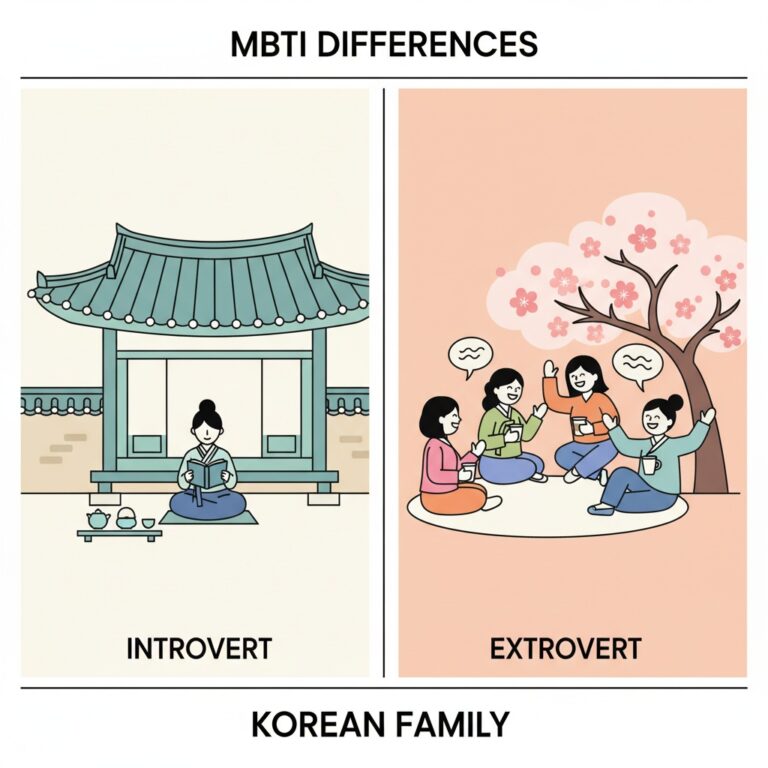
Hello! This is [매일한글] Daily Hangul, here to upgrade your Korean skills! 😊
Have you ever noticed how you and your family members can be so similar yet so different? Maybe your dad is super organized, but your brother is more spontaneous. Today, we’re going to learn how to talk about these fascinating differences in Korean!
These days in Korea, talking about your MBTI personality type is a huge trend! It’s a common icebreaker, a way to understand friends, and even a fun way to analyze family dynamics. So, get ready to learn some key expressions that will not only help you describe personalities but also make you sound like a true local when discussing this popular topic.
Let’s dive in!
Core Expressions for Comparing Personalities
Here are some essential phrases you’ll need to compare and contrast the people in your life.
1. ~와/과 달리 (~wa/gwa dalli)
- Korean Expression: 저와 달리, 제 동생은 외향적이에요.
- Pronunciation [Romanization]: Jeo-wa dalli, je dongsaeng-eun oehyangjeog-ieyo.
- English Meaning: Unlike me, my younger sibling is extroverted.
- Detailed Explanation: This is the perfect pattern to use when you want to directly contrast two people or things. It literally means “differently from…”. You attach ~와 to nouns ending in a vowel (like 저) and ~과 to nouns ending in a consonant (like 사람, saram).
- 💡 Pronunciation Tip:
The pronunciation is straightforward! Just remember to link the noun and the particle together smoothly. For example,사람과(saram-gwa) is pronounced as one fluid sound, not “saram… gwa.”
2. ~ㄴ/은/는 편이다 (~n/eun/neun pyeon-ida)
- Korean Expression: 저는 계획적인 편이에요.
- Pronunciation [Romanization]: Jeo-neun gyehoekjeog-in pyeon-ieyo.
- English Meaning: I tend to be a planner. / I’m on the planning side.
- Detailed Explanation: Koreans often avoid making absolute statements about personality. Instead of saying “I am a planner” (저는 계획적인 사람이에요), it sounds more natural and humble to say you “tend to be” one. This expression softens your statement.
- Use ~ㄴ/은 편이다 with adjectives (e.g., 조용하다 → 조용한 편이다).
- Use ~는 편이다 with verbs (e.g., 말을 많이 하다 → 말을 많이 하는 편이다).
- 💡 Pronunciation Tip:
The magic of linking sounds (연음, yeoneum) happens here! In편이에요(pyeon-i-e-yo), the final consonantㄴ(n) from편“moves over” to the next syllable. So, instead of a choppy “pyeon… i… e… yo,” you pronounce it smoothly as [pyeo-ni-e-yo]. It’s a small change that makes a big difference in sounding natural!
3. ~에 비해(서) (~e bihae(seo))
- Korean Expression: 아빠에 비해서 엄마는 더 감성적이세요.
- Pronunciation [Romanization]: Appa-e bihaeseo eomma-neun deo gamseongjeog-iseyo.
- English Meaning: Compared to my dad, my mom is more emotional.
- Detailed Explanation: This is another fantastic tool for comparison. It’s very similar to
~보다(more than), but~에 비해서often implies a more thoughtful or detailed comparison. You can use~에 비해and~에 비해서interchangeably. - 💡 Pronunciation Tip:
In비해서[bi-hae-seo], theㅎ(h) sound can sometimes become very soft when it’s between two vowels, almost like [bi-ae-seo]. Focusing on a clear but gentle ‘h’ sound will sound perfect.
Example Dialogue
Let’s see how these expressions work in a real conversation about family MBTI types!
A: 민준 씨, 가족들은 성격이 다 비슷해요? (Minjun, is everyone in your family similar in personality?)
B: 아니요, 저와 달리 제 동생은 완전 E(외향형)예요. (No, unlike me, my younger brother is a total E (Extrovert).)
A: 아, 정말요? (Oh, really?)
B: 네. 저는 혼자 있는 걸 좋아하는 편인데, 동생은 항상 친구들이랑 약속이 있어요. (Yeah. I tend to enjoy being alone, but my brother always has plans with friends.)
A: 저희 집이랑 비슷하네요! 저도 언니에 비해서 훨씬 조용한 편이에요. (That’s similar to my family! Compared to my older sister, I tend to be much quieter.)
B: 재미있네요! 역시 가족이라도 성격은 다 다른가 봐요. (That’s interesting! I guess even in a family, everyone’s personality is different.)
Culture Tip & Trend Deep Dive: The MBTI Craze in Korea
In Korea, MBTI isn’t just a personality test; it’s a cultural phenomenon! Here’s what you need to know:
- It’s a Social Icebreaker: Asking “MBTI가 뭐예요?” (What’s your MBTI?) is one of the most common questions you’ll hear when meeting new people. It’s a quick and fun way to get a basic understanding of someone’s character.
- MBTI in Daily Life: You’ll see MBTI types mentioned everywhere—on dating apps, in job descriptions, and even in marketing for products! There are endless memes and jokes online about the stereotypes of each type (e.g., “A ‘J’ type planning a trip vs. a ‘P’ type”).
- Sounding Like a Native: When you use phrases like ~는 편이다, you’re not just using correct grammar; you’re adopting a Korean way of speaking. This nuanced way of describing tendencies rather than absolute facts is key to sounding more fluent, especially when talking about something as subjective as personality. Knowing this will definitely make you sound more like a local!
Let’s Wrap Up & Practice!
Great job today! We learned some fantastic expressions for comparing personalities—a super useful skill, especially with the MBTI trend in Korea.
You’ve learned:
* ~와/과 달리 (Unlike…)
* ~ㄴ/은/는 편이다 (To tend to be…)
* ~에 비해(서) (Compared to…)
Now, it’s your turn to practice!
1. Fill in the blank:
활발한 제 친구____ ____, 저는 조용한 편이에요.
(Unlike my energetic friend, I tend to be quiet.)
2. Make your own sentence:
Describe your personality using ~는 편이다. For example: “저는 웃음이 많은 편이에요.” (I tend to laugh a lot.)
We’d love to hear from you! What’s your personality like compared to your family members? Leave a comment below using the expressions you learned today! 👇
Frequently Asked Questions (FAQ)
Q: What does "~에 비해" mean in Korean and how do you pronounce it?
A: In Korean, "~에 비해" is pronounced [서] and means: (Compared to...)







