

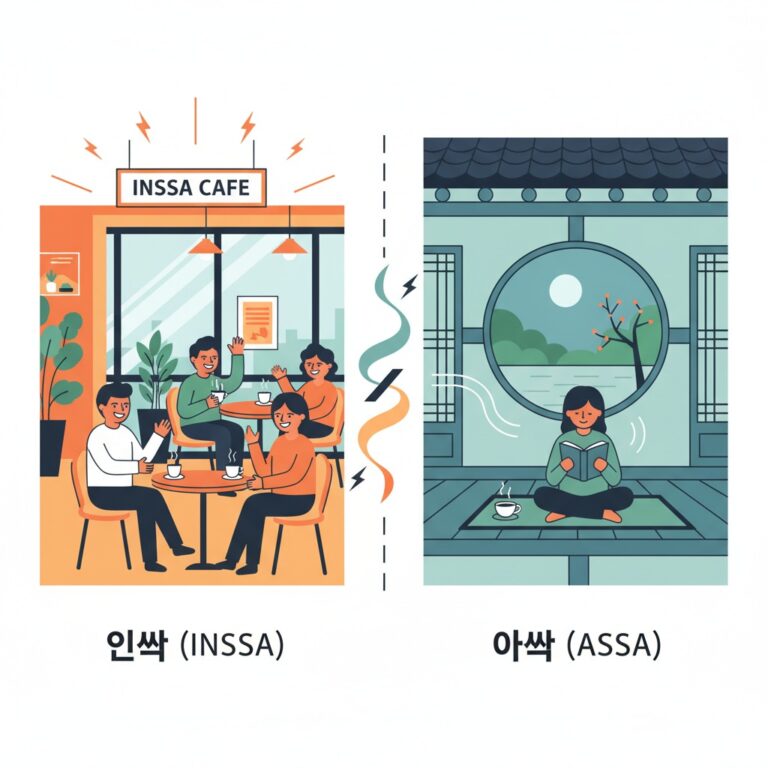
“Are You an Inssa or an Assa?” Master Korean Personality Talk!
Hello! It’s your favorite Korean booster, Maeil Hangeul (매일한글), here to upgrade your Korean skills!
Have you ever wondered how to describe your personality in Korean? Or maybe you want to understand why your favorite K-pop idol is so energetic while another is calm and quiet. Well, you’re in the right place! Lately in Korea, talking about personality types, especially MBTI, is a huge trend. It’s a super common topic of conversation, from casual chats with friends to even icebreakers at work. Today, we’re diving into the most fundamental difference: Extraversion (E) vs. Introversion (I). Let’s learn how to talk about it like a native speaker!
🌟 Core Expressions You Need to Know
Here are three essential expressions to describe whether you get your energy from being around people or from spending time alone.
1. The Basics: Extrovert & Introvert
- Korean Expression: 저는 외향적인 사람이에요. / 저는 내향적인 사람이에요.
- Pronunciation [Romanization]: Jeoneun oehyangjeogin saram-ieyo. / Jeoneun naehyangjeogin saram-ieyo.
- English Meaning: I am an extroverted person. / I am an introverted person.
- Detailed Explanation: This is the most direct and standard way to state your personality type.
외향적 (oehyangjeok)means “extroverted,” and내향적 (naehyangjeok)means “introverted.” By adding-인 사람이에요 (-in saram-ieyo), you are politely saying “I am a(n) … person.” You can use this in almost any situation, from introducing yourself to a new friend to more formal settings.- 💡 Pronunciation Tip: The syllable
적 (jeok)can be tricky. The finalㄱ (k)sound isn’t a hard “k” like in “look.” It’s an unreleased stop, meaning you put your tongue in the position to make the ‘k’ sound but don’t release the puff of air. It’s a soft, clipped sound at the end of the word.
- 💡 Pronunciation Tip: The syllable
2. Describing Your Social Battery
- Korean Expression: 사람 만나는 걸 좋아해요. / 집에 있는 걸 좋아해요.
- Pronunciation [Romanization]: Saram mannaneun geol joaheyo. / Jibe inneun geol joaheyo.
- English Meaning: I like meeting people. / I like being at home.
- Detailed Explanation: This is a fantastic way to show rather than tell your personality. Instead of just saying “I’m an extrovert,” you can explain why by saying you enjoy meeting people.
-(으)ㄴ/는 걸 좋아해요is a very common pattern that means “I like doing…” It sounds natural and is great for elaborating on your personality. The opposite,집에 있는 걸 좋아해요, is the classic phrase for introverts who love to recharge at home (we call them집순이/집돌이– homebody girl/boy!).- 💡 Pronunciation Tip: Notice how
만나는 걸 (mannaneun geol)flows together. Theㄴ (n)sound at the end of만나는is a clear nasal sound. Also, theㄹin걸 (geol)is a light ‘l’ sound, similar to the ‘l’ in “light,” not the dark ‘l’ in “full.” Practice saying it smoothly:man-na-neun-geol.
- 💡 Pronunciation Tip: Notice how
3. Sounding More Nuanced: “I tend to be…”
- Korean Expression: 저는 활발한 편이에요. / 저는 조용한 편이에요.
- Pronunciation [Romanization]: Jeoneun hwalbalhan pyeoni-eyo. / Jeoneun joyonghan pyeoni-eyo.
- English Meaning: I tend to be active/lively. / I tend to be quiet.
- Detailed Explanation: This grammar point,
-ㄴ/은/는 편이다 (-n/eun/neun pyeon-ida), is a game-changer for intermediate learners! Instead of making absolute statements, it softens them to mean “I’m on the side of…” or “I tend to be…” This sounds much more natural and less rigid.활발하다 (hwalbalhada)means “active” or “lively” (perfect for E types), while조용하다 (joyonghada)means “quiet” (great for I types).- 💡 Pronunciation Tip: Listen closely to 편이에요 [pyeoni-eyo]. Even though it’s written
pyeon-i-e-yo, the finalㄴ (n)consonant of편 (pyeon)links directly to the next vowelㅣ (i). This is a rule called liaison (or 연음, yeon-eum). So, you don’t say “pyeon… i-e-yo,” but rather a smooth [pyeo-ni-e-yo]. This rule is everywhere in Korean and mastering it will make you sound so much more fluent!
- 💡 Pronunciation Tip: Listen closely to 편이에요 [pyeoni-eyo]. Even though it’s written
🤔 Let’s See It in Action: Example Dialogue
Imagine two friends, A and B, talking about a member of their favorite K-pop group, “K-Idols.”
A: The new K-Idols behind-the-scenes video was so fun! Minjun has so much energy.
(새로운 케이아이돌 비하인드 영상 너무 재밌었어! 민준이는 에너지가 정말 넘쳐.)
B: I know, right? He’s definitely 외향적인 것 같아. He always looks so happy on stage.
(그러게 말이야. 완전 외향적인 것 같아. 무대에서 항상 행복해 보여.)
A: For sure. He said in an interview that he 사람 만나는 걸 좋아해요. What about you, B? Are you more like him?
(맞아. 인터뷰에서 사람 만나는 걸 좋아한다고 했어. B 너는 어때? 너도 민준이랑 비슷해?)
B: Me? Oh, no. I’m the opposite. I’m pretty 내향적인 편이야. After a long week, I just love 집에 있는 걸.
(나? 아냐, 정반대야. 나는 꽤 내향적인 편이야. 힘든 한 주를 보내고 나면 그냥 집에 있는 걸 제일 좋아해.)
🎤 Culture Tip & Trend Deep Dive: The World of “Inssa” and “Assa”
In Korea, the E vs. I conversation goes beyond the official MBTI terms. You’ll hear young people use two very popular slang words:
- 인싸 (Inssa): Comes from the English word “insider.” An inssa is someone who is popular, has a wide circle of friends, is always up-to-date on trends, and loves being in social gatherings. Think of the classic, super-social extrovert.
“Wow, you’re going to three parties this weekend? You’re a real 인싸!”
- 아싸 (Assa): Comes from the English word “outsider.” An assa is someone who prefers being alone or with a small group of close friends. They aren’t necessarily unpopular, but they don’t actively seek out large social events. This term aligns closely with introversion.
“I’m canceling my plans to stay home and watch a drama. I’m a proud 아싸.”
These terms are used playfully to describe social styles. So next time you hear your Korean friends talking about MBTI, you can surprise them by asking, “그래서 너는 인싸야, 아싸야?” (So, are you an inssa or an assa?). They’ll be super impressed!
✍️ Time to Practice!
Great job making it this far! Now, let’s check what you’ve learned.
1. Fill in the blank:
My friend loves parties and has hundreds of friends on Instagram. She gets energy from being with people.
제 친구는 _________ 사람이에요. (My friend is an _________ person.)
(Answer: 외향적인)
2. Make your own sentence!
Using the -(으)ㄴ/는 편이다 grammar, how would you describe yourself? Are you more active or more quiet?
저는 ____________________. (I tend to be ________.)
(Example Answers: 활발한 편이에요 / 조용한 편이에요)
You did an amazing job today! Understanding how to talk about personalities is a huge step toward having deeper and more interesting conversations in Korean.
Now it’s your turn! Leave a comment below and tell us your personality type using the phrases we learned today. Are you 외향적 or 내향적? We can’t wait to read your answers
Frequently Asked Questions (FAQ)
Q: What does "The Basics: Extrovert & Introvert" mean in Korean and how do you pronounce it?
A: In Korean, "The Basics: Extrovert & Introvert" is pronounced [Romanization] and means: I am an extroverted person. / I am an introverted person.
Q: What does "Describing Your Social Battery" mean in Korean and how do you pronounce it?
A: In Korean, "Describing Your Social Battery" is pronounced [Romanization] and means: I like meeting people. / I like being at home.
Q: What does "Sounding More Nuanced: "I tend to be..."" mean in Korean and how do you pronounce it?
A: In Korean, "Sounding More Nuanced: "I tend to be..."" is pronounced [Romanization] and means: I tend to be active/lively. / I tend to be quiet.







