

Unlock Korean News: A Deep Dive into Real Estate Taxes
Hello! This is Maeil Hangeul, here to upgrade your Korean proficiency to the next level!
Today, we’re tackling a topic you’ll see constantly in Korean news and hear in serious adult conversations: real estate tax policy. Sounds complex? Don’t worry! Understanding these key terms will not only help you master advanced Korean but also give you a fascinating insight into the Korean economy and society.
These days in Korea, discussions around real estate are hotter than ever. The government is constantly debating how to adjust tax policies, and these changes affect millions of people. By the end of this post, you’ll be able to understand the headlines and even share your own informed opinion, just like a local expert. Let’s get started!
Core Expressions You Must Know
Here are three essential terms that are the keys to unlocking any discussion about Korean real estate taxes.
1. 종합부동산세 (종부세) (Jonghapbudongsanse / Jongbuse)
- Pronunciation [Romanization]: [Jong-hap-bu-dong-san-se]
- English Meaning: Comprehensive Real Estate Tax
- Detailed Explanation: This is a national tax levied on individuals who own high-value properties (houses or land) exceeding a certain threshold. Think of it as a form of wealth tax aimed at curbing real estate speculation and promoting tax equity. It’s one of the most politically sensitive and debated taxes in Korea. The abbreviated form, 종부세 (Jongbuse), is extremely common in everyday speech and news headlines. Using this abbreviation will make you sound much more natural.
- 💡 Pronunciation Tip: When the syllable ‘합’ (hap) is followed by ‘부’ (bu), the initial ‘ㅂ’ (b) sound in ‘부’ often becomes tensed. This phenomenon is called 된소리되기 (fortis articulation). So, instead of a soft [hap-bu], it sounds closer to [합뿌/hap-ppu]. This subtle change is a hallmark of a fluent speaker.
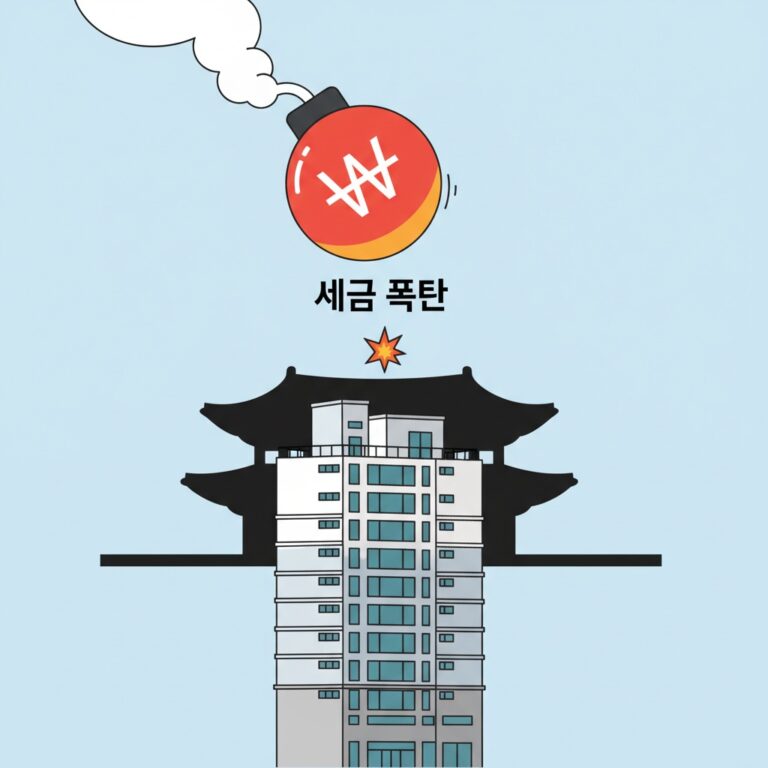
2. 세금 폭탄 (Segeum Poktan)
- Pronunciation [Romanization]: [Se-geum Pok-tan]
- English Meaning: Tax Bomb
- Detailed Explanation: This is not an official term but a powerful and widely used metaphor. It refers to a sudden and substantial increase in a person’s tax burden, which feels like a bomb has been dropped on their finances. You’ll hear this term constantly from news anchors, politicians, and ordinary citizens expressing their frustration or fear about rising taxes, especially the
종부세. It’s a highly evocative phrase that perfectly captures public sentiment. - 💡 Pronunciation Tip: Notice the word ‘폭탄’ (poktan). The first consonant ‘ㅍ’ (p) is an aspirated sound, meaning you should release a strong puff of air, like the ‘p’ in “park.” The second consonant ‘ㅌ’ (t) is also aspirated. Differentiating these aspirated sounds (ㅍ, ㅌ, ㅋ, ㅊ) from their plain (ㅂ, ㄷ, ㄱ, ㅈ) and tensed (ㅃ, ㄸ, ㄲ, ㅉ) counterparts is crucial for clear, advanced pronunciation.
3. 재정 건전성 (Jaejeong Geonjeonseong)
- Pronunciation [Romanization]: [Jae-jeong Geon-jeon-seong]
- English Meaning: Fiscal Soundness / Fiscal Health
- Detailed Explanation: This is a more formal, economic term that refers to the stability and sustainability of a government’s finances. A government is considered to have strong fiscal soundness when its revenue is stable and its debt is manageable. In policy debates, proponents of higher taxes often argue that it’s necessary to secure 재정 건전성 for the country’s future, funding social welfare programs and infrastructure projects.
- 💡 Pronunciation Tip: In the word ‘건전성’ (geon-jeon-seong), pay attention to the nasal sound ‘ㄴ’ (n) in ‘건’ (geon). When a syllable ending in ‘ㄴ’ (n) or ‘ㅁ’ (m) is followed by a syllable starting with a vowel, the nasal sound carries over. However, here ‘건’ is followed by ‘전’. The key is to clearly articulate each syllable in these longer, Sino-Korean words: [건-전-성]. Practice saying it slowly at first to ensure each part is distinct.
Example Dialogue
Here’s how you might hear these terms used in a real conversation while watching the 9 o’clock news.
A: 뉴스 봤어? 정부가 내년에 종합부동산세를 일부 완화하는 방안을 검토 중이래.
(Bwasseo? Jeongbuga naenyeone jonghapbudongsanse-reul ilbu wanhwahaneun banganeul geomto jungirae.)
A: Did you see the news? They said the government is considering a plan to partially ease the Comprehensive Real Estate Tax next year.
B: 정말? 다행이다. 이대로 가다간 우리 집도 세금 폭탄을 맞을까 봐 걱정했는데.
(Jeongmal? Dahaengida. Idaero gadan uri jipdo segeum poktan-eul majeulkka bwa geokjeonghaenneunde.)
B: Really? That’s a relief. I was worried we’d get hit with a tax bomb on our house if things continued this way.
A: 그런데 반대 의견도 만만치 않아. 세수를 줄이면 국가 재정 건전성에 문제가 생길 수 있다고 하더라고.
(Geureonde bandae uigyeondo manmanchi ana. Sesureul jurimyeon gukga jaejeong geonjeonseong-e munjega saenggil su itdago hadeorago.)
A: But there’s significant opposition, too. They say reducing tax revenue could cause problems for the nation’s fiscal soundness.
Culture Tip & Trend Analysis
In Korea, homeownership is more than just having a place to live; for many, it’s a primary investment and a symbol of stability. This is why real estate policy, and especially taxes, is a topic of national obsession.
Unlike in some other countries where tax policy is a dry subject for experts, terms like 종부세 and 세금 폭탄 are part of daily conversation here. The media plays a huge role in this, using the dramatic term 세금 폭탄 in headlines to frame policy changes as a direct threat to household finances. Understanding this context helps you see why these debates are so passionate. When you use these terms correctly, you’re not just showing off your vocabulary; you’re demonstrating a deep understanding of the economic and social pressures that shape modern Korean society.
Let’s Practice!
Ready to test your knowledge? Try this short exercise.
- Fill in the blanks using the words we learned today: 종합부동산세, 세금 폭탄, 재정 건전성.
정부는 (A)___________을 개편하여 세금 부담을 줄이겠다고 발표했지만, 일각에서는 이러한 정책이 국가의 (B)___________을 해칠 수 있다는 우려를 표했다. 많은 시민들은 매년 날아오는 (C)___________ 고지서에 부담을 느끼고 있다.
(A: 종합부동산세, B: 재정 건전성, C: 세금 폭탄) - Your Turn: What is the general public opinion on property taxes in your country? Try to write one or two sentences in Korean using at least one of today’s expressions.
Great job today! You’ve taken a huge step toward understanding complex social issues in Korean.
Leave your answers to the practice questions in the comments below! We’d love to see you use these new expressions.
Frequently Asked Questions (FAQ)
Q: What does "종부세" mean in Korean and how do you pronounce it?
A: In Korean, "종부세" is pronounced [Jongbuse] and means: , is extremely common in everyday speech and news headlines. Using this abbreviation will make you sound much more natural.
Q: What does "된소리되기" mean in Korean and how do you pronounce it?
A: In Korean, "된소리되기" is pronounced [fortis articulation] and means: . So, instead of a soft [hap-bu], it sounds closer to







