

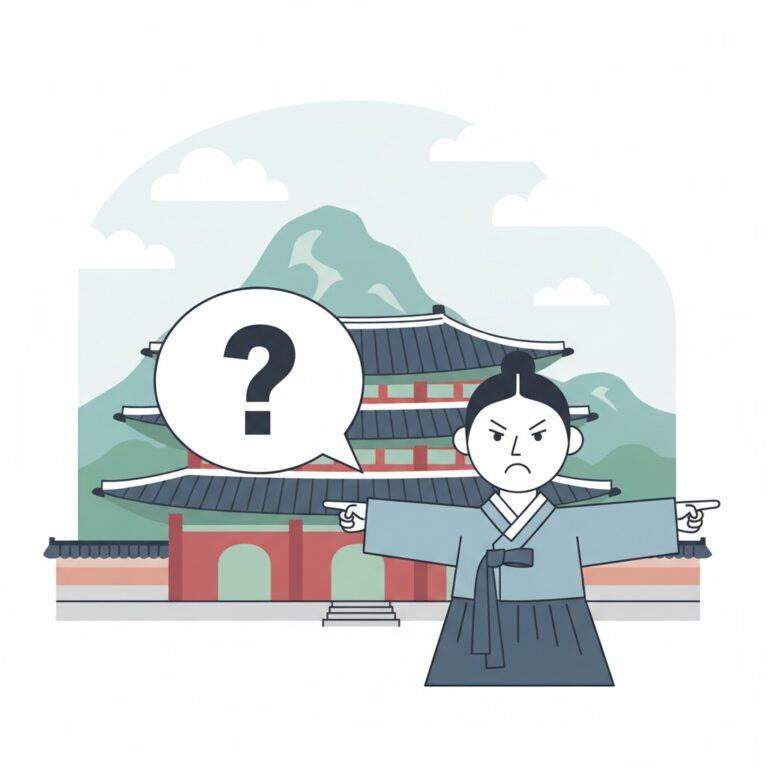
Unfair! How to Express Your Anger in Korean
Hello! This is Maeil Hangeul, here to upgrade your Korean skills! 😊
Have you ever been watching a K-drama where the main character, after being treated unfairly, finally stands up for themselves? It’s such a satisfying moment! In Korea these days, it’s becoming more and more common for people, especially the younger generation, to voice their feelings when they feel wronged.
Today, we’re going to learn how to do just that! We’ll explore some key Korean phrases to express your anger and frustration when you face an unfair situation. Let’s get ready to channel your inner K-drama hero! 🔥
Core Expressions You Need to Know
Here are four essential phrases to have in your emotional toolkit.
1. 너무해(요) (Neomuhae-yo)
- Pronunciation [Romanization]: Neo-mu-hae-yo
- English Meaning: That’s too much! / That’s unfair!
- Detailed Explanation: This is a fantastic, versatile phrase. It’s less of an aggressive “I’m angry!” and more of a “How could you do that to me?” It expresses disappointment and a sense of being wronged. You can use 너무해 (neomuhae) with close friends and 너무해요 (neomuhaeyo) in most other situations to be polite.
- 💡 Pronunciation Tip: The Korean vowel ‘ㅓ’ (eo) can be tricky. It’s an open sound, similar to the ‘o’ in “song” but without rounding your lips. Try saying “uh” as in “but” and opening your mouth a little wider. That’s the sound for 너 (neo)!
2. 화나(요) (Hwa-na-yo)
- Pronunciation [Romanization]: Hwa-na-yo
- English Meaning: I’m angry. / I’m getting angry.
- Detailed Explanation: This is the most direct way to state your anger. It comes from 화 (hwa), which means “anger,” and 나다 (nada), which means “to arise” or “to occur.” So, you’re literally saying “Anger is arising in me.” If you are really angry, you can add 진짜 (jinjja) or 정말 (jeongmal) before it, meaning “really.”
- 💡 Pronunciation Tip: The ‘ㅎ’ (h) sound in 화 (hwa) is aspirated. This means you should release a strong puff of air when you say it. It’s not just ‘wa’, but ‘H-wa’. Hold your hand in front of your mouth—you should feel the air hit it!
3. 말이 돼(요)? (Mari dwae-yo?)
- Pronunciation [Romanization]: Ma-ri dwae-yo?
- English Meaning: Does that even make sense? / Are you kidding me?
- Detailed Explanation: This is a rhetorical question you can use to challenge a situation or statement that is completely illogical or unfair. 말 (mal) means “words” or “speech,” and 되다 (doeda) means “to make sense” or “to be possible.” You’re questioning the very logic of the situation, which makes it a powerful phrase.
- 💡 Pronunciation Tip: Notice how 말이 is pronounced [mari], not [mal-i]. When a consonant at the end of a syllable (like ‘ㄹ’ in ‘말’) is followed by a vowel (like ‘ㅣ’), the consonant sound moves over to the next syllable. This rule, called liaison (연음, yeoneum), makes Korean sound smooth and connected.
4. 어이가 없네(요) (Eo-i-ga eom-ne-yo)
- Pronunciation [Romanization]: Eo-i-ga eom-ne-yo
- English Meaning: That’s absurd. / I’m speechless. / This is ridiculous.
- Detailed Explanation: This is an iconic phrase! It expresses a feeling of being so dumbfounded and shocked by a situation that you don’t even know how to react. It’s a mix of disbelief, frustration, and sometimes even dark humor. It’s perfect for when a situation is just beyond belief.
- 💡 Pronunciation Tip: The pronunciation of 없네 is [eom-ne], not [eop-ne]. When the final consonant ‘ㅂ’ (p) is followed by ‘ㄴ’ (n), the ‘ㅂ’ sound changes to a soft ‘ㅁ’ (m) sound. This is called nasalization (비음화, bieumhwa) and it helps the sounds flow more easily.
Example Dialogue
Let’s see how these phrases work in a real-life conversation. Imagine two colleagues, Minjun (A) and Sora (B), talking about their boss.
A (Minjun): 소라 씨, 부장님이 우리 팀 아이디어를 자기 아이디어인 것처럼 발표했어요.
(Sora, the department head presented our team’s idea as if it were his own.)B (Sora): 네? 우리가 며칠 밤새워서 만든 건데… 너무해요!
(What? But we worked on that for several nights… That’s too much!)A (Minjun): 맞아요. 저 진짜 화나요.
(I know. I’m really angry.)B (Sora): 어떻게 그럴 수가 있죠? 말이 돼요?
(How could he do that? Does that even make sense?)A (Minjun): 하… 정말 어이가 없네요.
(Sigh… This is just ridiculous.)
Culture Tip & Trend Deep Dive
In the past, Korea’s hierarchical culture often made it difficult for junior employees or younger people to express disagreement. However, this is changing fast!
The phrase “어이가 없네 (eoiga eomne)” became a massive cultural phenomenon after being famously delivered by actor Yoo Ah-in in the 2015 hit movie Veteran. The line perfectly captured the public’s frustration with injustice and abuse of power. It became a popular meme and is now used widely in everyday life, showing how much this sentiment resonates with modern Koreans.
Today, especially among the MZ Generation, speaking up against unfairness (while still being respectful) is seen as a positive trait. Using these phrases shows that you not only understand the language but also the evolving cultural sentiments in Korea!
Let’s Review and Practice!
Great job today! We learned four powerful phrases to express our feelings in unfair situations:
- 너무해요! (That’s too much!)
- 화나요! (I’m angry!)
- 말이 돼요? (Does that make sense?)
- 어이가 없네요. (This is ridiculous.)
Now, let’s test your knowledge!
1. Quick Quiz: Fill in the blank!
Your friend cancels your dinner plans for the third time in a row, just 10 minutes before you were supposed to meet. What would you most likely say?
- A) 괜찮아요. (It’s okay.)
- B) 축하해요! (Congratulations!)
- C) 진짜 ________! (That’s really too much!)
(The answer is C: 너무해요!)
2. Make a Sentence!
Imagine you were charged double for your coffee by mistake. How would you express your disbelief to your friend using one of today’s phrases?
Try making a sentence with “말이 돼요?” or “어이가 없네요.”
Now it’s your turn! Leave a comment below and share a short story (real or imagined) where you could use one of these expressions. We can’t wait to read them
Frequently Asked Questions (FAQ)
Q: What does "너무해" mean in Korean and how do you pronounce it?
A: In Korean, "너무해" is pronounced [neomuhae] and means: with close friends and
Q: What does "너무해요" mean in Korean and how do you pronounce it?
A: In Korean, "너무해요" is pronounced [neomuhaeyo] and means: in most other situations to be polite.
Q: What does "화" mean in Korean and how do you pronounce it?
A: In Korean, "화" is pronounced [hwa] and means: , which means "anger," and
Q: What does "나다" mean in Korean and how do you pronounce it?
A: In Korean, "나다" is pronounced [nada] and means: , which means "to arise" or "to occur." So, you're literally saying "Anger is arising in me." If you are







