

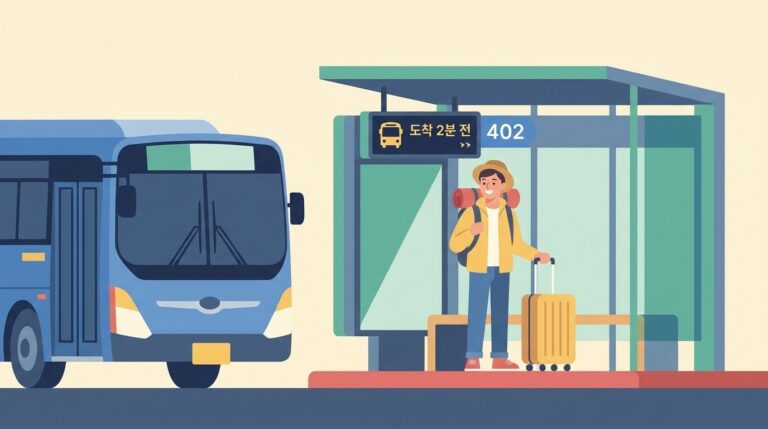
Phase 1: Why Seoul Bus Stops Feel Like a K-Drama Cliffhanger
안녕하세요! 매일한글 에디터입니다. (Annyeonghaseyo! Hello, this is the Daily Hangul Editor!) Imagine standing at a glowing bus stop in Hongdae, holding an iced Americano just like your favorite K-drama lead. Suddenly, the digital screen flashes “곧 도착 (Got dochak)”, and a giant blue bus zooms around the corner! Wait—is it stopping? Does it go to Myeongdong? Many of our beginner students told us they froze and missed their ride because they didn’t know what to say or read. Based on real learner feedback, this friendly guide gives you the exact beginner Korean phrases and local bus etiquette you need so you can ride across Korea with total confidence!
Phase 2: Top 3 Core Expressions Deep Dive
1. 곧 도착해요 (Got dochakaeyo)
- Pronunciation: Got do-cha-kae-yo (Think of “got” as in “I got it,” followed by “doe-cha-kay-yo” said smoothly like a gentle wave.)
- Meaning: Literally “Soon it arrives.” In real life, it means “It’s arriving right now—get ready!” On digital bus stop screens, you will see the shortened sign 곧 도착 (Got dochak).
- K-Culture Moment: In K-dramas like My Liberation Notes, weary commuters check their phones and dash down the street the second they see “곧 도착 (Got dochak)” flashing on the bus app.
- Editor’s Insight: When a Korean bus screen says “곧 도착 (Got dochak),” it usually means 1 to 2 minutes away—or literally rounding the corner! Even as a Seoul local, I still sprint in my sneakers whenever I see those two syllables.
- Situation Spectrum: Casual ⚠️ / Semi-formal ✅ / Formal ✅
- 🤔 Think About It: In English, “soon” can mean five or ten minutes. Why do you think Korean transit culture treats “곧 (got / soon)” as an urgent countdown? How does your home country’s bus culture compare?
2. 이 버스 명동 가요? (I beoseu Myeongdong gayo?)
- Pronunciation: Ee buh-seu Myeong-dong ga-yo? (“Buh-seu” sounds like “bus-uh” with a soft “uh” at the end, and “ga-yo” rhymes with “sky-oh.”)
- Meaning: Literally “This bus Myeongdong goes?” Naturally, it means “Does this bus go to Myeongdong?” You can swap “명동 (Myeongdong)” for any destination!
- K-Culture Moment: Just like travel variety shows (Youn’s Kitchen or Earth Arcade) where cast members frantically verify directions with bus drivers before hopping on, this is the ultimate beginner lifesaver.
- Editor’s Insight: Keep it short! You do not need complex grammar like “에 (e)” for “to” when speaking fast at the bus door. Bus drivers appreciate quick, clear questions because they are on a tight schedule.
- Situation Spectrum: Casual 🚫 / Semi-formal ✅ / Formal ⚠️
- 🤔 Think About It: Notice how Korean puts the verb “가요? (gayo? / goes?)” at the very end! How does hearing the destination before the action help both you and a busy bus driver communicate faster?
3. 잠시만요! (Jamsimanyo!)
- Pronunciation: Jam-si-man-yo! (“Jam” like strawberry jam, “si” like “she,” and “man-yo” like “mahn-yo.”)
- Meaning: Literally “Just a moment!” In bus situations, it means “Excuse me, coming through!” or “Wait a second, I’m getting on/off!”
- K-Culture Moment: Whenever a K-drama protagonist tries to squeeze onto a crowded Seoul bus during rush hour—or gently parts the crowd to reach the back exit door—they softly repeat “잠시만요! (Jamsimanyo!)”
- Editor’s Insight: This is the Swiss Army knife of Korean politeness. Say it with a slightly raised tone when asking the driver to wait a second, or say it softly when stepping past people on the bus.
- Situation Spectrum: Casual ⚠️ / Semi-formal ✅ / Formal ✅
- 🤔 Think About It: In English, we say “Excuse me” or “Sorry” when squeezing past someone. Why do Koreans say “Just a moment” instead? Think about how it focuses on sharing time and space politely!
Phase 3: Textbook Korean vs. Real Korean
Situation 1: Saying “The bus is coming right now!”
- 📖 Textbook Korean: 버스가 곧 도착합니다. (Beoseuga got dochakamnida.) — The bus will arrive soon.
- 🗣️ Real Korean: 어! 버스 온다! (Eo! Beoseu onda!) — Oh! The bus is coming!
- 💡 Why is it different? Textbooks love formal endings like “-합니다 (-hamnida),” which sound like a subway announcement! When chatting with a friend at the bus stop, Koreans naturally drop formal endings and use the lively present tense “온다! (onda! / it’s coming!)”.
Situation 2: Asking a stranger at the stop if the bus has arrived yet
- 📖 Textbook Korean: 버스가 언제 도착합니까? (Beoseuga eonje dochakamnikka?) — When does the bus arrive?
- 🗣️ Real Korean: 혹시 버스 금방 와요? (Hoksi beoseu geumbang wayo?) — By any chance, is the bus coming right away?
- 💡 Why is it different? Adding “혹시 (hoksi / by any chance)” softens the question so you don’t sound like a strict interviewer, and “금방 와요? (geumbang wayo?)” sounds much warmer and friendlier to everyday Seoulites.
Phase 4: K-Culture Deep Dive & Non-Verbal Manners
4-1. Nunchi (눈치) & Gestures at the Bus Stop
In Korea, reading the room—눈치 (nunchi)—at a bus stop is huge! First, Korean bus drivers do not always stop if you are sitting far back on a bench looking at your phone. When your bus shows “곧 도착 (Got dochak)”, stand up, step neatly toward the curb, and make brief eye contact with the driver (a tiny hand wave works too!). Second, have your transit card ready before the doors hiss open. Holding up the line while digging through your backpack is a major nunchi fail—trust me, I’ve gotten the classic Korean grandparent sigh before!
4-2. Culture Code Analysis: K-Travel & “Palli-palli” Bus Culture
Korea’s famous 빨리빨리 (palli-palli / hurry-hurry) culture shines brightest on Seoul buses! Seoul buses are color-coded so you can spot yours fast: Blue (간선) for long routes across districts, Green (지선) for short neighborhood loops, and Red (광역) for express rides to the suburbs. Just like those bustling commuting scenes in K-dramas like Our Blues or Twenty-Five Twenty-One, buses move briskly. That is why Koreans board through the front door, tap their card, and exit through the back door—keeping the flow smooth for everyone.
Phase 5: Real-Life Roleplay Scenario
Setting: A lively evening at the Hongdae Station bus stop. Neon signs glow behind you, and the digital arrival board is blinking. Next to you stands Minjun, a friendly local college student wearing headphones around his neck.
- You: 🎭 (Points nervously at the flashing board) 저기요! (Jeogiyo!) — Excuse me!
- Minjun: 🎭 (Takes a step closer with a warm smile) 네? 무슨 일이세요? (Ne? Museun iriseyo?) — Yes? What’s going on?
- You: 이 버스 명동 가요? (I beoseu Myeongdong gayo?) — Does this bus go to Myeongdong?
- Minjun: 🎭 (Glances at the route map) 네! 271번 버스 타시면 돼요. (Ne! Ibaekchilsibil-beon beoseu tasimyeon dwaeyo.) — Yes! You just need to take bus number 271.
- You: 감사합니다! 언제 와요? (Gamsahamnida! Eonje wayo?) — Thank you! When does it come?
- Minjun: 🎭 (Points up at the screen) 저기 보세요! 곧 도착해요! (Jeogi boseyo! Got dochakaeyo!) — Look over there! It’s arriving soon!
- You: 🎭 (Eyes widen as a blue bus approaches) 아! 온다! 감사합니다! (A! Onda! Gamsahamnida!) — Ah! It’s coming! Thank you!
- Minjun: 🎭 (Waves cheerfully) 조심해서 가세요! (Josimhaeseo gaseyo!) — Have a safe trip!
🔀 Interactive Branching Point: The bus doors open, and a passenger is still stepping down while people behind you wait. What do you say as you step up?
- A) “잠시만요! (Jamsimanyo!)” with a slight nod while letting the person exit first.
- Feedback (Best!): Politeness perfection! Waiting half a second for exiting passengers and saying “잠시만요!” shows top-tier Korean bus etiquette.
- B) Push straight in silently without saying anything.
- Feedback (Bad): Yikes! Blocking people trying to get off breaks bus nunchi and might earn you some grumpy stares.
- C) Shout “빨리! (Palli! / Hurry!)” to the driver.
- Feedback (Risk!): Way too casual and rude to a stranger or driver! Save “빨리!” only for close friends.
Phase 6: 10-Second Emotion Shadowing Drill
Read these out loud! Pause at the / marks and match the emotion tags:
- [😊 Cheerfully and excitedly] 어! / 버스 온다! (Eo! / Beoseu onda!) — Oh! / The bus is coming!
- [🧐 Curiously and politely] 저기요, / 이 버스 / 명동 가요? (Jeogiyo, / i beoseu / Myeongdong gayo?) — Excuse me, / does this bus / go to Myeongdong?
- [😌 Relieved and grateful] 아, / 곧 도착해요! / 감사합니다! (A, / got dochakaeyo! / Gamsahamnida!) — Ah, / it’s arriving soon! / Thank you!
Phase 7: K-Culture Mini Dictionary
- 정류장 (jeongnyujang) | Bus stop | You’ll hear this on bus speakers before every stop—e.g., “다음 정류장은 홍대입구입니다” (Next stop is Hongdae Entrance).
- 곧 도착 (got dochak) | Arriving soon | The golden words flashing on digital bus boards and Korean map apps when your ride is 1–2 minutes away.
- 교통카드 (gyotongkadeu) | Transit card | Your T-money or Climate Card! You tap it on the sensor when getting on and getting off.
- 환승 (hwanseung) | Transfer | Switching from a bus to the subway (or another bus) within 30 minutes for free or a tiny fee—just remember to tap out!
Phase 8: Traveler’s Survival Kit
Top 3 Survival Phrases
- 곧 도착해요? (Got dochakaeyo?) — Is it arriving soon? | Pro Tip: Use this when checking the stop screen with a local!
- 잠시만요, 내릴게요! (Jamsimanyo, naerilgeyo!) — Excuse me, I’m getting off! | Pro Tip: Say this if the bus is packed and you need to reach the back door.
- 카드 안 찍혔어요! (Kadeu an jjikyeosseoyo!) — My card didn’t scan! | Pro Tip: If the reader beeps angrily, smile and tap again—drivers are used to helping travelers.
Editor’s Travel Note
Google Maps doesn’t show real-time walking or bus routes accurately in Korea. Before landing in Seoul, grab the Naver Map App for Real-Time Korean Bus Tracking or the KakaoBus App Guide for Color-Coded Seoul Routes—both have English settings and literally show a tiny bus icon moving toward your stop! Also, always tap your 교통카드 (gyotongkadeu) on the sensor at the back door when exiting, or you’ll lose your transfer discount and pay extra next time.
Phase 9: One Step Deeper — The Heartbeat of the Bus Stop
In Korea, waiting for the bus is a quiet dance between 빨리빨리 (palli-palli) speed and shared 배려 (baeryeo / consideration). Even though everyone wants to get home fast, locals naturally line up, give up yellow priority seats to elders and pregnant riders, and call out “잠시만요! (Jamsimanyo!)” to avoid bumping into neighbors. Learning just a few polite Korean words isn’t only about getting from point A to point B—it connects you to the everyday warmth of Korean community life.
💬 Your Turn: Have you ever had a funny or panicked moment catching a bus in Korea (or in your own city)? Drop your story in the comments—we love cheering you on!
Phase 10: FAQ & Common Mistakes
Q: How do I know which bus is coming soon at a Korean bus stop?
A: Look up at the electronic BIS (Bus Information System) board at the stop! When your bus number is 1 to 2 minutes away, it will flash 곧 도착 (got dochak) in red or yellow text.
Q: Do Korean buses automatically stop at every bus stop?
A: No! If nobody presses the red stop button inside and nobody stands near the curb outside, the driver may zoom right past. Step forward and make yourself visible when you see your bus approaching.
Q: Can I pay with cash on Seoul buses?
A: Most Seoul buses are now cashless! Always buy and load a T-money 교통카드 (gyotongkadeu) at any convenience store (CU, GS25, 7-Eleven) before heading to the bus stop.
🚨 Common Mistakes Warning Board
- Forgetting to tap off at the back door: Correct Action: Always tap your transit card on the exit sensor before stepping off so you get free transfers!
- Trying to board through the back door: Correct Action: Board ONLY through the front door (next to the driver) and exit through the back door.
- Saying “이 버스 어디 가요? (Where does this bus go?)” instead of naming your stop: Correct Action: Bus routes have 40+ stops! Ask “이 버스 [명동] 가요? (I beoseu [Myeongdong] gayo?)” with your exact destination.
Phase 11: Action Mission & Engagement
- 🥉 Bronze Mission (Solo Practice): Stand up right now and say “이 버스 명동 가요? (I beoseu Myeongdong gayo?)” three times out loud, swapping “명동 (Myeongdong)” for “홍대 (Hongdae)” and “강남 (Gangnam)”!
- 🥈 Silver Mission (Share It): Screenshot your favorite phrase from Phase 2 and share it on Instagram Stories tagging
@dailyhangulwith your dream Seoul destination! - 🥇 Gold Mission (Real-World Use): Next time you are in Korea—or at a Korean restaurant/market—use “잠시만요! (Jamsimanyo!)” smoothly when passing someone.
- 🎮 K-Culture Mission: Watch a slice-of-life K-drama (like My Liberation Notes or Hospital Playlist) this week and see if you can spot the blue/green buses or hear the word “정류장 (jeongnyujang)”!
Phase 12: Interactive Quiz Challenge
Quiz 1 (Situation): You are in Hongdae and want to make sure bus 271 goes to Gangnam. What should you ask the driver? (If you pick A, remember that “언제 (eonje)” asks when, not where!)
* A) 이 버스 언제 와요? (I beoseu eonje wayo?)
* B) 이 버스 강남 가요? (I beoseu Gangnam gayo?)
* C) 잠시만요! (Jamsimanyo!)
Click to Reveal Answer & Explanation for Quiz 1
Answer: B! “이 버스 강남 가요? (I beoseu Gangnam gayo?)” directly asks if the bus goes to Gangnam. Option A means “When does this bus come?” and Option C means “Excuse me / Just a moment!”
Quiz 2 (Fill in the Blank): You look at the digital bus stop board and see it flashing ____ 도착 (Arriving soon). What Korean word goes in the blank?
Click to Reveal Answer & Explanation for Quiz 2
Answer: 곧 (Got)! Together, “곧 도착 (Got dochak)” means “Arriving soon”—your cue to step toward the curb with your card ready!
Quiz 3 (True / False Culture Quiz): True or False: In Seoul, you only need to tap your transit card once when boarding at the front door, and you never need to tap it when getting off.
Click to Reveal Answer & Explanation for Quiz 3
Answer: False! You must tap your 교통카드 (gyotongkadeu) when boarding at the front door AND when exiting at the back door so the system calculates the right distance and gives you free transfers!
🎬 Watch Our Daily Videos! (Daily Hangul Official Instagram)
Review the expressions you learned in this article with our fun daily short videos! Check out native pronunciation and real-life nuances in action.
- Instagram @dailyhangul_en






