

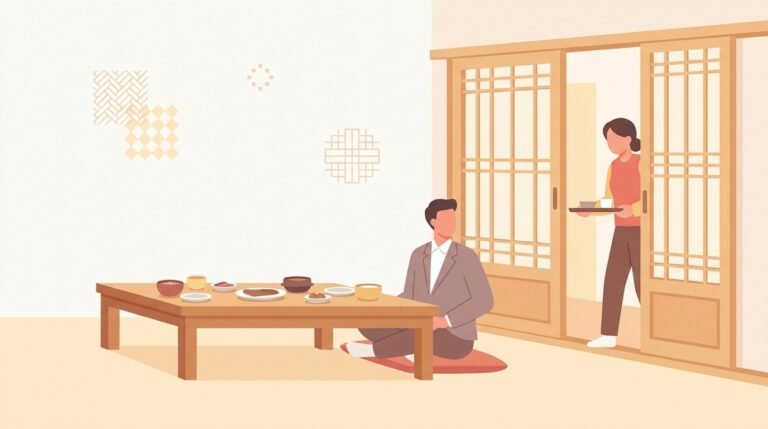
Phase 1: The Seat by the Door Dilemma
안녕하세요! 매일한글 에디터입니다. (Hello! I’m your Daily Hangul Editor.) Picture this: you finally land a meeting in Seoul, and your team invites clients to a sizzling Hanwoo BBQ restaurant. As the doors slide open, everyone pauses near the plush cushions at the far end. You try to be polite and grab the seat right next to the exit, only to realize your Korean boss is frantically waving you away—wait, why? In Korean business dining, the seat nearest the door is the ‘mal-seok’ (lowest seat), reserved for the junior host who handles extra orders and discreetly slips out to settle the bill! Based on real feedback from expat learners who accidentally took the VIP seat, this B2 guide gives you the exact phrases and cultural radar to navigate business dinners like a pro.
Phase 2: Top 3 Core Expressions Deep Dive
1. 이쪽으로 안내해 드릴게요 (Ijjogeuro annaehae deurilgeyo) — I will guide you this way
- Pronunciation: Ijjogeuro annaehae deurilgeyo (Think of ee-joh-geu-roh ahn-nae-hae deu-reel-geh-yoh, where the double jj has a crisp, popped ‘j’ sound like biting into a crunchy apple, and eu sounds like the quick ‘uh’ when someone pokes your stomach).
- Meaning: Literally means “I will guide you toward this direction.” In a business dining context, it is the polite, proactive signal that you are taking charge of seating the guests in the sang-seok (seat of honor) before taking the mal-seok (seat near the door) yourself.
- K-Culture Moment: You see this all the time in Korean office dramas like Misaeng or Business Proposal—right as a team enters a private room at a hanjeongsik (traditional course meal) restaurant, the sharp junior associate steps ahead, extends an open palm toward the back wall, and delivers this line smoothly.
- Editor’s Insight: Notice the honorific auxiliary verb -아/어 드리다 (-a/eo deurida) instead of 주다 (juda). At a B2 level, switching to deurida instantly elevates your professionalism, showing humility toward clients or superiors without sounding stiff or robotic.
- Situation Spectrum:
- Casual (Friends/Peers): 🚫 (Too formal; sounds like you’re a restaurant waiter!)
- Semi-formal (Colleagues): ⚠️ (Used playfully or when organizing a big team outing)
- Formal (Clients/Executives): ✅ (Absolute gold standard for hosting)
- 🤔 Think About It: In Western business dinners, guests often pick their own chairs casually or sit wherever their name card is. Why do you think Korean culture places such careful choreography on physically gesturing someone toward the innermost seat?
2. 제가 문 쪽에 앉겠습니다 (Jega mun jjoge anketseumnida) — I will sit by the door
- Pronunciation: Jega mun jjoge anketseumnida (Jeh-gah moon joh-geh ahn-ket-seum-nee-dah; note that 앉겠습니다 simplifies the final consonant cluster so it sounds cleanly like an-ket, with a sharp ‘k’ hit).
- Meaning: Literally “I will sit on the door side.” Beyond stating a physical location, it subtly communicates, “I am the junior host here, so leave the ordering, pouring, and bill-handling to me.”
- K-Culture Moment: Think of the classic hoesik (company dinner) scenes in Extraordinary Attorney Woo or Reply 1988—when everyone hesitates around the table doing the polite “No, you sit inside” dance, the youngest team member breaks the deadlock with this decisive phrase.
- Editor’s Insight: Using 제가 (jega)—the humble form of “I”—paired with -겠- (-get-) expresses strong personal willingness. If a senior guest insists you take a nicer spot, repeating this lightly with a smile proves you genuinely understand Korean workplace etiquette.
- Situation Spectrum:
- Casual (Friends/Peers): ⚠️ (Usually only said if you know you’ll need to use the restroom often)
- Semi-formal (Team lunches): ✅ (Shows great team spirit as a junior member)
- Formal (Client hosting): ✅ (Essential power-move of humility for the junior host)
- 🤔 Think About It: In many English-speaking cultures, sitting nearest the door might feel awkward or like getting stuck in a drafty spot. How does reframing that exact seat as the “command center of hospitality” change how you view the role of the junior host?
3. 계산은 제가 하고 오겠습니다 (Gyesaneun jega hago ogetseumnida) — I’ll go ahead and take care of the bill
- Pronunciation: Gyesaneun jega hago ogetseumnida (Gyeh-sah-neun jeh-gah hah-goh oh-get-seum-nee-dah; gye glides smoothly like ‘geh’ with a tiny ‘y’ at the start, like ‘yeh’ with a ‘g’).
- Meaning: Literally “I will do the calculation and come back.” In practice, it means stepping out discreetly near the end of the meal—often pretending to go to the restroom—so the client never sees the awkward check-splitting or payment moment.
- K-Culture Moment: Watch any K-drama dinner between a startup founder and an investor: right before dessert arrives, the assistant or junior manager slips out from the door-side seat, taps the corporate card at the counter, and whispers to the staff so the VIP never even sees a receipt.
- Editor’s Insight: Koreans rarely say “I will pay money” (돈을 내다 / doneul naeda) in business hosting because mentioning money feels blunt. Using 계산하다 (gyesanhada)—literally “to calculate”—softens the transaction, and -고 오다 (-go oda) signals you’ll return right away to wrap up the conversation.
- Situation Spectrum:
- Casual (Friends/Peers): ⚠️ (Only if you’re treating a close friend for their birthday)
- Semi-formal (Team dinner): ✅ (When picking up the tab on the company card)
- Formal (Client hosting): ✅ (Smooth, classy, and expected when your side is hosting)
- 🤔 Think About It: Why do you think paying out of sight (while seated right by the exit) is considered more respectful in Korea than bringing the bill to the table and announcing “It’s on me”?
Phase 3: Textbook Korean vs. Real Korean
When you reach B2, the biggest leap is dropping robotic textbook phrasing for expressions that carry social warmth and nunchi (social awareness).
Situation 1: Guiding a guest away from the door seat
- 📖 Textbook Korean: 여기는 문 근처라서 추우니 안쪽에 앉으세요. (Yeogineun mun geuncheoraseo chuuni anjjoge anjeuseyo.) — “Because it is cold near the door here, please sit inside.”
- 🗣️ Real Korean: 이쪽이 훨씬 편하실 거예요. 안으로 쭉 들어가시죠. (Ijjogi hwolssin pyeonhasil geoyeyo. Aneureo jjuk deureogasijyo.) — “This side will be much more comfortable for you. Please head all the way inside.”
- 💡 Why the difference? Textbooks give literal reasons like temperature, which can sound slightly transactional. Real Korean focuses on the guest’s comfort (편하실 거예요 / pyeonhasil geoyeyo) and uses -시죠 (-sijyo)—a softer, polite suggestion rather than a direct command (앉으세요 / anjeuseyo).
Situation 2: Calling the server discreetly from the door seat
- 📖 Textbook Korean: 저기요, 여기 반찬을 더 가져다 주세요. (Jeogiyo, yeogi banchaneul deo gajyeoda juseyo.) — “Excuse me, please bring more side dishes here.”
- 🗣️ Real Korean: 사장님, 여기 반찬 조금만 더 부탁드릴게요! (Sajangnim, yeogi banchang jogeumman deo butakdeurilgeyo!) — “Boss/Owner, could we trouble you for just a bit more side dishes here!”
- 💡 Why the difference? Calling servers 저기요 (jeogiyo) can sound brusque in upscale business restaurants. Addressing staff respectfully as 사장님 (sajangnim) or 이모님 (imonim) (in casual spots) and using 부탁드릴게요 (butakdeurilgeyo) shows polished manners in front of clients.
Phase 4: K-Culture Deep Dive & Non-Verbal Manners
4-1. Nunchi (눈치) & Gestures
Sitting in the mal-seok (말석, lowest seat) by the door isn’t a punishment—it’s a strategic hospitality role! Here is your non-verbal checklist:
* The Open-Palm Sweep: When ushering guests into a private dining room, never point with one finger. Extend your entire open hand, palm facing slightly upward, while tilting your torso in a gentle 15-degree bow.
* Door & Coat Duty: As the person nearest the entrance, keep an eye on the door draft, help take guests’ coats if there isn’t a coat attendant, and ensure bags aren’t blocking the server’s path.
* Two-Handed Everything: Whether handing over a wet towel (물수건 / mulsugeon), pouring drinks, or accepting a business card, always support your right wrist or forearm with your left hand. Never turn your full back to the VIP; pivot smoothly toward the aisle when calling the server.
4-2. Cultural Code Analysis: K-Food & Dining Hierarchy
In Korean K-Food culture—especially at traditional galbi (grilled ribs) or hanjeongsik spots—table geography mirrors Confucian respect for seniority and hospitality. The 상석 (sang-seok), or seat of honor, is always the spot farthest from the entrance, facing the door so the VIP doesn’t feel startled by people walking behind them and isn’t bothered by traffic or kitchen noise. Meanwhile, the 말석 (mal-seok) right by the door gives the junior host direct sightlines to the servers. When the grill gets smoky or the water pitcher runs low, the mal-seok occupant handles it seamlessly without interrupting the senior executive’s small talk.
Phase 5: Real-Life Roleplay Scenario
- Setting: A warm, wood-paneled Hanwoo (Korean beef) private dining room in Gangnam. The subtle aroma of charcoal and sesame oil lingers in the air. Director Kim (김 부장님) is hosting Mr. Park (박 대표님), an important partner, alongside Alex (you), the junior account manager.
- Alex: 안녕하세요, 대표님! 오늘 귀한 시간 내주셔서 감사합니다. (Annyeonghaseyo, daepyonim! Oneul gwihan sigan naejusyeoseo gamsahamnida.) — “Hello, CEO Park! Thank you for making valuable time today.”
🎭 Action cue: Stands near the open sliding door, bowing respectfully at 30 degrees. - Mr. Park: 아닙니다, 초대해 주셔서 제가 더 감사하죠. (Animnida, chodaehae jusyeoseo jega deo gamsahajyo.) — “Not at all, I’m even more grateful for the invitation.”
🎭 Action cue: Smiles warmly and steps into the room, glancing at the long table. - Alex: 대표님, 이쪽으로 안내해 드릴게요. 안쪽 자리가 훨씬 조용하고 편하실 거예요. (Daepyonim, ijjogeuro annaehae deurilgeyo. Anjjok jariga hwolssin joyonghago pyeonhasil geoyeyo.) — “CEO Park, let me guide you this way. The inner seat will be much quieter and more comfortable.”
🎭 Action cue: Gestures gracefully toward the far corner farthest from the door with both palms open. - Mr. Park: 어휴, 제가 뭐라고 상석에 앉나요. 그냥 여기 문 앞에 앉을게요. (Eohyu, jega mworago sangseoge annayo. Geunyang yeogi mun ape anjeulgeyo.) — “Oh my, who am I to sit in the seat of honor? I’ll just sit right here by the door.”
🎭 Action cue: Politely waves a hand in modesty, hovering near the entrance seat. - Director Kim: 아이고, 대표님이 당연히 안쪽에 앉으셔야죠! 알렉스 씨가 문 쪽에 앉을 겁니다. (Aigo, daepyonimi dangyeonhi anjjoge anjeusyeoyajyo! Allekeuseu ssiga mun jjoge anjeul geomnida.) — “Oh come on, of course you must sit inside, CEO Park! Alex will sit by the door.”
🎭 Action cue: Chuckles warmly and gently steers Mr. Park’s elbow toward the inner seat. - Alex: 네, 대표님! 제가 문 쪽에 앉겠습니다. 추가 주문할 때 편해서 이 자리가 딱 좋습니다. (Ne, daepyonim! Jega mun jjoge anketseumnida. Chuga jumunhal ttae pyeonhaeseo i jariga ttak joseumnida.) — “Yes, CEO Park! I’ll sit by the door. It’s actually great here because it’s convenient when ordering extras.”
🎭 Action cue: Pulls out the door-side chair lightly to claim it with a cheerful smile. - Mr. Park: 하하, 알렉스 씨 센스가 넘치네요! 그럼 잘 먹겠습니다. (Haha, Allekeuseu ssi senseuga neomchineyo! Geureom jal meokgetseumnida.) — “Haha, Alex, you’ve got great instincts! Well then, I’ll enjoy the meal.”
🎭 Action cue: Finally sits down at the sang-seok looking genuinely impressed. - Alex: (Two hours later, as fruit arrives) 잠시만 실례하겠습니다. 계산은 제가 하고 오겠습니다. (Jamsiman sillyehagetseumnida. Gyesaneun jega hago ogetseumnida.) — “Excuse me for just a moment. I’ll go ahead and take care of the bill.”
🎭 Action cue: Quietly slips out the sliding door right beside them without disrupting the laughter.
🔀 Interactive Branching Point
Right in the middle of the meal, Mr. Park’s water glass is empty and the meat grill looks slightly charred. What is your next move from the mal-seok?
* Option A: Quietly catch the server’s eye through the slightly ajar door, raise a discreet hand, and whisper, “여기 불판 좀 갈아주시고 물도 부탁드릴게요! (Yeogi bulpan jom garajusigo muldo butakdeurilgeyo!)”
* Option B: Shout across the room at full volume, “저기요! 불판 빨리 갈아주세요! (Jeogiyo! Bulpan ppalli garajuseyo!)” while interrupting Mr. Park’s story.
* Option C: Wait silently for Director Kim to notice and handle it himself so you don’t look pushy.
Feedback:
* Option A (Best ✅): Absolute B2 mastery! You used nunchi from the door seat, kept the conversation flowing smoothly, and used polite phrasing (부탁드릴게요).
* Option B (Bad ❌): Shouting 빨리 (ppalli) interrupts the VIP and creates awkward tension. Keep requests calm and directed smoothly toward staff.
* Option C (Risk ⚠️): Trying too hard not to interrupt can look like a lack of attentiveness. As the junior host in the mal-seok, proactive care is expected!
Phase 6: 10-Second Emotion Shadowing Drill
Read these aloud, pausing briefly at / and matching the emotional tone!
[😊 Warm & Welcoming]
이쪽으로 / 안내해 드릴게요. / 안쪽이 / 훨씬 편하실 거예요.
(Ijjogeuro / annaehae deurilgeyo. / Anjjogi / hwolssin pyeonhasil geoyeyo.)
“Let me guide you this way. The inside will be much more comfortable.”-
[😌 Polite & Reassuring]
아닙니다, / 제가 문 쪽에 / 앉겠습니다. / 주문하기가 편해서요.
(Animnida, / jega mun jjoge / anketseumnida. / Jumunhagiga pyeonhaeseoyo.)
“No, really, I’ll sit by the door. It’s convenient for ordering.” -
[🤫 Smooth & Discreet]
잠시만 / 실례하겠습니다. / 계산은 제가 / 하고 오겠습니다.
(Jamsiman / sillyehagetseumnida. / Gyesaneun jega / hago ogetseumnida.)
“Excuse me for a moment. I’ll go take care of the bill.”
Phase 7: K-Culture Mini Dictionary
- 상석 (Sang-seok) | Seat of honor | The seat farthest from the entrance, facing the door, reserved for the highest-ranking guest or client.
- 말석 (Mal-seok) | Lowest seat (Door seat) | The seat closest to the door; occupied by the junior host or youngest team member to manage orders and payments.
- 막내 (Maknae) | Youngest member | Not just in K-Pop groups! In offices, the maknae is the most junior employee, who often handles hoesik logistics gracefully.
- 추가 주문 (Chuga jumun) | Additional order | Ordering extra meat, drinks, or side dishes mid-meal—a key responsibility of whoever sits in the mal-seok.
Phase 8: Traveler’s Survival Kit
Top 3 Survival Phrases
- 물 좀 더 주시겠어요? (Mul jom deo jusigesseoyo?) — “Could you give us some more water?” (Pro Tip: Always look toward the kitchen aisle when saying this so you don’t startle nearby diners.)
- 불판 좀 갈아주세요. (Bulpan jom garajuseyo.) — “Please change the grill grate.” (Pro Tip: Essential at Korean BBQ spots when the grate gets dark—servers expect you to ask!)
- 계산서 따로 주시겠어요? (Gyesanseo ttaro jusigesseoyo?) — “Could you give us separate receipts?” (Pro Tip: Handy when expensing drinks separately from food for your corporate card report.)
Editor’s Travel Note
Before heading to a business dinner in Seoul, make sure to grab the Naver Map app download for pinpoint restaurant entrances (Google Maps rarely shows walking routes accurately in Korea!) and set up Kakao T taxi booking so you can call a ride for your VIP guest right after you finish settling the bill. Most upscale restaurants accept international credit cards, and remember: there is no tipping in Korea—your polite attitude is the best tip!
Phase 9: One Step Deeper
In Western egalitarian workplaces, sitting by the exit might feel like getting the short end of the stick, or being excluded from the main conversation. In Korean corporate culture, however, the mal-seok is not a mark of inferiority—it is an active gesture of care, responsibility, and respect for order. By taking the seat closest to the door, the junior host shields the guest from logistical friction so that relationships can flourish uninterrupted. Mastering this seating choreography isn’t about blind hierarchy; it’s about tuning into the unspoken choreography of Korean hospitality.
- 💬 Your Turn: Have you ever been confused about where to sit at a dinner in Korea, or had a funny seating mix-up abroad? Drop your story in the comments below!
Phase 10: FAQ & Common Mistakes
Q: What if a senior client insists on sitting near the door because they like fresh air or want to leave early?
A: Politely decline once or twice using “이쪽이 더 편하실 거예요” (This side will be more comfortable), which shows good manners. However, if they firmly insist a third time—especially for health or mobility reasons—gracefully honor their preference instead of forcing them inside.
Q: Should I still sit near the door if I am the foreign guest being hosted by a Korean company?
A: No! If you are the invited guest or client, your Korean hosts will guide you to the sang-seok (inner seat). Trying too hard to take the door seat as a guest can actually make your hosts feel awkward because they want to treat you properly.
Q: Do I have to pay the bill with my own money if I’m the junior host sitting in the mal-seok?
A: Definitely not! In Korean business dining, the maknae or junior host physically walks to the counter to pay, usually using the team’s 법인카드 (beobin kadeu, corporate card) handed over by the boss beforehand.
🚨 Common Mistakes TOP 3
- Rushing straight to the corner booth seat as a junior host → Correct Action: Pause by the doorway, let guests enter first, and gesture toward the inner sang-seok.
- Leaving the table noisily while announcing “I’m going to pay!” → Correct Action: Excuse yourself softly with 계산은 제가 하고 오겠습니다 or slip out seamlessly when stepping away near dessert.
- Forgetting to check the entrance for departing guests’ taxis → Correct Action: After paying, step outside first to hold the door and confirm their ride has arrived safely.
Phase 11: Action Mission & Engagement
- 🥉 Bronze Mission (Solo Practice): Stand in front of a mirror, extend your open palm smoothly to your left, and practice saying “이쪽으로 안내해 드릴게요 (Ijjogeuro annaehae deurilgeyo)” three times with a calm, confident smile.
- 🥈 Silver Mission (Share Online): Screenshot your favorite phrase from Phase 2 and tag #DailyHangul on social media, sharing which Korean restaurant dish you’d love to host a dinner around!
- 🥇 Gold Mission (Real-World Use): Next time you dine with Korean friends or colleagues, consciously spot the sang-seok and mal-seok when you walk in, and offer to take the door seat using “제가 문 쪽에 앉겠습니다”!
- 🎮 K-Culture Mission: Watch any office K-drama scene set in a restaurant (try Misaeng or Vincenzo) and see if you can spot who sits nearest the sliding door—and notice how quickly they jump up when food or bills arrive!
Phase 12: Interactive Quiz Challenge
Test your Korean business dining radar! Click the toggles below to reveal the answers.
Quiz 1 (Situation Judgment): You are hosting an important client in Seoul. As you enter a private BBQ room, where should you guide the client to sit?
A) Right next to the door so they can get fresh air.
B) The seat farthest from the door, facing the entrance.
C) Whichever chair happens to be closest to the air conditioner.
👉 Click to reveal Quiz 1 Answer & Feedback
Answer: B) The seat farthest from the door, facing the entrance.
Feedback: That’s the 상석 (sang-seok)! Sitting farthest from the door spares the VIP from drafts, server traffic, and awkward bill-handling moments. If you picked A, you accidentally put your VIP in the junior host’s 말석 (mal-seok)!
Quiz 2 (Fill in the Blank): Complete the polite sentence you say before stepping out quietly at the end of a hosted dinner:
“_______ 제가 하고 오겠습니다.” (I will go ahead and take care of the bill.)
👉 Click to reveal Quiz 2 Answer & Feedback
Answer: 계산은 (Gyesaneun)
Feedback: Full sentence: 계산은 제가 하고 오겠습니다 (Gyesaneun jega hago ogetseumnida). Remember, avoiding the blunt word money (돈) and using 계산 (calculation) sounds much smoother and more refined in business Korean.
Quiz 3 (True or False): If you are the invited foreign client at a Korean business dinner, it is rude if you don’t insist on sitting in the mal-seok by the door.
👉 Click to reveal Quiz 3 Answer & Feedback
Answer: False!
Feedback: If you are the guest being hosted, allowing your Korean hosts to guide you to the sang-seok is actually the best manners! Fighting for the door seat as an invited guest prevents your hosts from showing you proper Korean hospitality.
🎬 Watch Our Daily Videos! (Daily Hangul Official Instagram)
Review the expressions you learned in this article with our fun daily short videos! Check out native pronunciation and real-life nuances in action.
- Instagram @dailyhangul_en







