

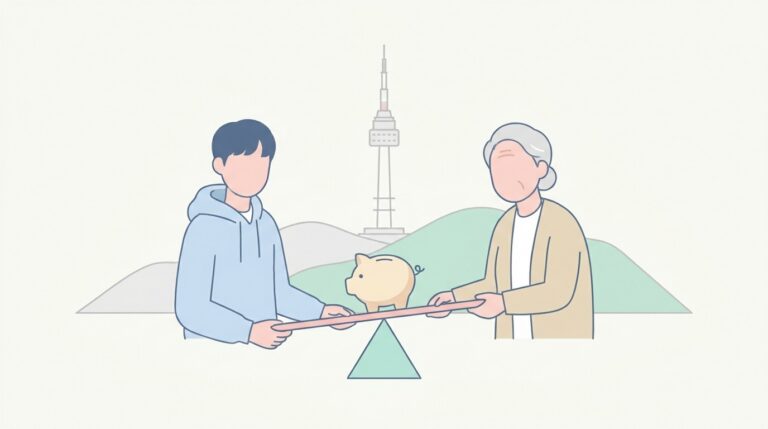
Phase 1: Why Everyone at the Pub Is Suddenly Talking About Pensions
안녕하세요! 매일한글 에디터입니다. (Annyeonghaseyo! Maeil Hangeul editeoimnida. / Hello! I’m your Daily Hangul Editor.) Picture this: it’s Friday night at a bustling Euljiro pub. You’re clinking glasses with Korean friends, expecting K-Drama gossip. Instead, someone sighs at a news alert, muttering about 인구절벽 (ingujeolbyeok / demographic cliff) and 모수 개혁 (mosu gaehyeok / parametric reform). Suddenly, the table debates future paychecks! Even at C1, policy terms like 저부담-고급여 (jeobudam-gogeubyeo / low-contribution, high-benefit) can make you freeze. Built on real feedback from our advanced learners, this guide unpacks the exact vocabulary, idioms, and cultural nuance you need to join Korea’s biggest generational conversation.
Phase 2: Top 3 Core Expressions Deep Dive
1. 모수 개혁 (mosu gaehyeok)
- Pronunciation: [mo-su gae-hyeok] — Say “mo-sue” + “geh-hyuck” (rhymes with “yuck,” with a soft ‘h’ breath right before it).
- Meaning: Literal: “parameter reform.” Nuance: Adjusting the specific numbers (contribution rates and payout ratios) of the pension system without tearing down and rebuilding its entire structural framework.
- K-Culture Moment: Think of a tense newsroom or legislative hallway scene in a political K-Drama like The Whirlwind (Dolpung), where lawmakers clash over whether tweaking the dials is brave leadership or just kicking the can down the road.
- Editor’s Insight: Koreans constantly contrast
모수 개혁(parametric reform) with구조 개혁(gujo gaehyeok / structural reform). Dropping모수 개혁naturally in conversation instantly signals to native speakers that you understand the difference between adjusting the math versus overhauling the entire welfare architecture.- Situation Spectrum: Casual ⚠️ / Semi-formal ✅ / Formal ✅
- 🤔 Think About It: In English, we usually say “pension reform” as a catch-all phrase. Why do Korean headlines hyper-specify parametric versus structural reform? Because in a hyper-aging society, every decimal point feels deeply personal to workers watching their pay stubs.
2. 저부담-고급여 구조 (jeobudam-gogeubyeo gujo)
- Pronunciation: [jeo-bu-dam go-geu-byeo gu-jo] — “juh-boo-dahm” (“uh” like in “up”) + “go-geu-byuh” (make “eu” like the vowel in “pull” with flat, unrounded lips) + “goo-joh.”
- Meaning: Literal: “low-burden, high-salary/payout structure.” Nuance: An economic critique describing Korea’s early pension design—a system that promised generous retirement payouts for relatively small monthly contributions, which is now financially unsustainable.
- K-Culture Moment: Picture popular Korean finance YouTubers like Syuka World (Syukawoldeu) drawing giant red downward arrows on a digital whiteboard to explain why this 1980s formula is running out of steam.
- Editor’s Insight: You will almost never hear this phrase used positively today. It is nearly always paired with action verbs like
개혁하다(gaehyeokhada / to reform) or탈피하다(talpihada / to break away from) because Koreans view it as an outdated relic of high-growth decades.- Situation Spectrum: Casual ⚠️ / Semi-formal ✅ / Formal ✅
- 🤔 Think About It: How does your native language describe unsustainable legacy benefits? Notice how Korean uses crisp, balanced Sino-Korean four-syllable pairs (
저부담-고급여) to pack an entire historical policy critique into a single breath.3. 보험료율과 소득대체율 (boheomnyoyulgwa sodeukdaecheyul)
- Pronunciation: [bo-heom-nyo-yul-gwa so-deuk-dae-che-yul] — Watch out for the sneaky sound change!
보험료looks like “-ryo,” but after ‘m’ (ㅁ), it nasalizes into “-nyo”: “bo-hum-nyo-yool-gwah” + “so-deuk-deh-cheh-yool.”- Meaning: Literal: “insurance fee rate and income replacement ratio.” Nuance: The twin levers of the pension tug-of-war—how much is deducted from your paycheck today (
보험료율) versus what percentage of your pre-retirement income you’ll receive later (소득대체율).- K-Culture Moment: Imagine a tired office worker in Misaeng staring at their monthly
급여 명세서(geubyeo myeongseseo / pay stub) over instant ramyeon, trying to figure out whether “pay more, get more” actually works in their favor.- Editor’s Insight: Even native Koreans joke that saying
보험료율fast is a tongue twister! In casual chats, people often bypass the mouthful and summarize the debate as더 내고 더 받기(deo naego deo batgi / pay more, get more) versus더 내고 그대로 받기(deo naego geudaero batgi / pay more, get the same).- Situation Spectrum: Casual ⚠️ / Semi-formal ✅ / Formal ✅
- 🤔 Think About It: While many Western debates obsess over raising the retirement age, Korean discourse fixates on these exact two percentages. That reflects how Koreans view the National Pension as a direct, transparent monthly contract between their salary and the state.
Phase 3: Textbook Korean vs. Real Korean
Situation 1: Expressing frustration about paying more with uncertain returns
- 📖 Textbook Korean: 보험료율을 인상할 경우 청년층의 경제적 부담이 가중될 우려가 있습니다. (Boheomnyoyureul insanghal gyeongu cheongnyeoncheungui gyeongjejeok budami gajungdoel uryeoga itseumnida. / If the contribution rate is raised, there are concerns that the economic burden on young people will increase.)
- 🗣️ Real Korean: 지금도 빠듯한데 보험료까지 올리면 진짜 밑 빠진 독에 물 붓기 아니야? (Jigeumdo ppadeuthande boheomnyokkaji ollimyeon jinjja mit ppajin doge mul butgi aniya? / Money’s already tight—if they hike the rates too, isn’t it just pouring water into a bottomless jar?)
- 💡 Why the difference? Native speakers rarely speak in stiff policy memos over dinner. Using vivid idioms like
밑 빠진 독에 물 붓기(pouring water into a cracked jar) turns dry fiscal anxiety into emotional, relatable storytelling.
Situation 2: Talking about intergenerational fairness
- 📖 Textbook Korean: 세대 간 형평성을 제고하기 위해 사회적 합의를 도출해야 합니다. (Sedae gan hyeongpyeongseongeul jegohagi wihae sahoejeok habuireul dochulhaeya hamnida. / We must reach a social consensus to enhance intergenerational equity.)
- 🗣️ Real Korean: 결국 우리 세대만 독박 쓰는 거 아니냐고 다들 난리야. (Gyeolguk uri sedaeman dokbak sseuneun geo aninyago dadeul nalliya. / Everyone’s freaking out that our generation will end up taking the fall alone.)
- 💡 Why the difference?
독박 쓰다(dokbak sseuda / to bear all the blame or penalty alone) comes from traditional card games. Young Koreans use it constantly in office banter to voice generational frustration without sounding like an academic paper.
Phase 4: K-Culture Deep Dive & Non-Verbal Manners
4-1. Nunchi (눈치) & Gestures
Talking about money and generational fairness in Korea requires world-class 눈치 (nunchi / social awareness). At a 회식 (hoesik / company dinner) or a Chuseok family gathering, younger Koreans avoid pointing fingers directly at older relatives or senior bosses—doing so feels disrespectful and confrontational. Instead, watch their body language: they’ll tilt their head slightly, let out a quiet 한숨 (hansum / sigh) while glancing at their smartphone news feed, and open with an impersonal buffer like 요즘 뉴스 보니까... (Yojeum nyuseu bonikka… / Seeing the news lately…). Older listeners will often nod empathetically—맞장구 (matjjangu / chiming in sympathetically)—and say something warm like 요즘 젊은 사람들이 힘들지 (Yojeum jeolmeun saramdeuri himdeulji / Young folks have it tough these days) to keep harmony intact.
4-2. Cultural Code Analysis: K-Drama & Korea’s YouTube Finance Boom
If you’ve watched gritty workplace K-Dramas like Misaeng or My Mister (Naui Ajeossi), you know the Korean salaryman’s paycheck carries immense emotional weight. That same real-world anxiety explains why Korea has one of the world’s most intense YouTube finance ecosystems. Channels like Syuka World or Sampro TV regularly pull millions of views breaking down 모수 개혁 and 소득대체율 with charts and humor—turning dense demographic math into shared pop-culture conversation among 20- and 30-somethings at every coffee shop.
Phase 5: Real-Life Roleplay Scenario
Setting: Friday, 8:30 PM at a lively Euljiro 호프집 (hofjip / beer pub). The air smells of crispy garlic chicken and cold draft beer. Your senior Korean colleague, Min-jae (33, an assistant manager with loosened tie and tired eyes), taps his phone screen and groans.
- Min-jae: 야, 오늘 뉴스 봤어? 연금 모수 개혁 얘기 또 나왔더라.
(Ya, oneul nyuseu bwasseo? Yeongeum mosu gaehyeok yaegi tto nawatdeora.)
“Hey, did you see the news today? Talk about pension parametric reform came up again.”
🎭 Sets down his beer glass with a heavy sigh and rubs his temples. -
You: 응, 봤어. 기존의 ‘저부담-고급여’ 구조를 손보겠다는 거잖아.
(Eung, bwasseo. Gijonui ‘jeobudam-gogeubyeo’ gujoreul sonbogetdaneun geojana.)
“Yeah, I saw. They’re trying to fix the existing ‘low-contribution, high-benefit’ structure, right?”
🎭 Leans forward slightly, matching his serious yet casual tone. -
Min-jae: 맞아. 근데 보험료율을 올리는 건 다들 동의하는데, 소득대체율이 문제래.
(Maja. Geunde boheomnyoyureul ollineun geon dadeul donguihaneunde, sodeukdaecheyuri munjerae.)
“Right. Everyone agrees on raising the contribution rate, but they say the income replacement ratio is the sticking point.”
🎭 Points at a chart on his smartphone screen. -
You: 그러게. 더 내고 더 받자니 기금 고갈이 빨라질 거고, 덜 받자니 노후 보장이 약해지니까.
(Geureoge. Deo naego deo batjani gigeum gogari ppallajil geogo, deol batjani nohu bojagi yakhaejinikka.)
“Totally. If we pay more and get more, the fund depletes faster; if we get less, old-age security gets weaker.”
🎭 Nods thoughtfully while picking up a piece of pickled radish. -
Min-jae: 와, 너 한국 경제 뉴스 진짜 꿰뚫고 있네! 솔직히 우리 세대 입장에선 막막하지 않아?
(Wa, neo hanguk gyeongje nyuseu jinjja kkwettulko itne! Soljikhi uri sedae ipjangeseon mangmakhaji ana?)
“Whoa, you really know Korean economic news inside out! Honestly, from our generation’s perspective, doesn’t it feel bleak?”
🎭 Looks genuinely impressed, raising his eyebrows. -
You: 솔직히 그렇지. 세대 간 형평성을 맞추는 게 말처럼 쉬운 일이 아니니까.
(Soljikhi geureochi. Sedae gan hyeongpyeongseongeul matchuneun ge malcheoreom swiun iri aninikka.)
“Honestly, yeah. Balancing intergenerational equity isn’t as easy as it sounds.”
🎭 Offers an understanding smile and clinks glasses lightly. -
Min-jae: 에이, 일단 오늘 밤은 걱정 접고 치맥이나 즐기자. 짠!
(Ei, ildan oneul bameun geokjeong jeopgo chimaegina jeulgija. Jjan!)
“Ah, for tonight, let’s put the worries aside and just enjoy chicken and beer. Cheers!”
🎭 Laughs it off, raising his frosted mug high. -
You: 좋아, 내일 걱정은 내일의 우리에게 맡기자고. 건배!
(Joa, naeil geokjeongeun naeirui uriege matgijago. Geonbae!)
“Deal, let’s leave tomorrow’s worries to tomorrow’s us. Cheers!”
🎭 Clinks glasses cheerfully.
🔀 Interactive Branching Point: What if Min-jae’s 58-year-old team leader joins the table and asks your opinion?
- Option A: “인구절벽 속도가 워낙 빨라서 모두가 조금씩 양보하는 합의가 필요한 것 같아요.” (Ingujeolbyeok sokdoga wonak ppallaseo moduga jogeumssik yangbohaneun habuiga piryohan geot gatayo. / Since the demographic cliff is moving so fast, I think we need a compromise where everyone yields a little.)
- Feedback (Best ✅): Brilliant C1 diplomacy! You acknowledge the systemic urgency (
인구절벽) without blaming any specific age group, earning instant respect from both your senior and your peer.
- Feedback (Best ✅): Brilliant C1 diplomacy! You acknowledge the systemic urgency (
- Option B: “기성세대가 혜택을 다 누렸으니 젊은 세대는 억울할 수밖에 없죠.” (Giseongsedega hyetaegeul da nuryeosseuni jeolmeun sedaeneun eogulhal subakke eopjyo. / Since the older generation enjoyed all the benefits, young people can’t help but feel wronged.)
- Feedback (Bad 🚫): Ouch! Even if many young Koreans feel this way privately, saying it bluntly to a senior Korean boss violates
눈치and will freeze the whole dinner table instantly.
- Feedback (Bad 🚫): Ouch! Even if many young Koreans feel this way privately, saying it bluntly to a senior Korean boss violates
- Option C: “저는 외국인이라 한국 연금은 관심 없어요.” (Jeoneun oeguginira hanguk yeongeumeun gwansim eopseoyo. / I’m a foreigner, so I’m not interested in Korean pensions.)
- Feedback (Risk ⚠️): Grammatically fine, but socially a conversation killer—plus, if you work in Korea, you actually pay into the National Pension too!
Phase 6: 10-Second Emotional Shadowing Drill
Read these aloud at natural speed, pausing briefly at each / to nail the native rhythm:
- [😤 Frustrated but analytical]
보험료율을 / 올리는 건 좋은데 / 소득대체율도 / 같이 봐야죠.
(Boheomnyoyureul / ollineun geon joeunde / sodeukdaecheyuldo / gachi bwayajyo.)
“Raising the contribution rate is one thing, / but we have to look at the income replacement ratio too.” -
[😔 Sighing with empathy]
저부담-고급여 구조가 / 이제는 / 한계에 다다른 것 같아요.
(Jeobudam-gogeubyeo gujoga / ijeneun / hangyee dadareun geot gatayo.)
“It feels like the low-contribution, high-benefit structure / has finally / reached its limit.” -
[🧐 Seriously questioning]
세대 간 형평성을 / 지키려면 / 어떤 개혁이 최선일까요?
(Sedae gan hyeongpyeongseongeul / jikiryeomyeon / eotteon gaehyeogi choeseonilkkayo?)
“To protect intergenerational equity, / what kind of reform / would be best?”
Phase 7: K-Culture Mini Dictionary
- 국민연금 (Gungminyeongeum) | National Pension | Korea’s mandatory public pension scheme. Every salaried worker—including most foreign residents—sees this deduction on their monthly
월급 명세서(pay stub). - 인구절벽 (Ingujeolbyeok) | Demographic Cliff | A dramatic phrase describing a sudden drop in the working-age population as birthrates plummet. Used constantly across Korean news, real estate blogs, and cafe small talk.
- 초고령사회 (Chogoryeongsahoe) | Super-Aged Society | A society where 20% or more of the population is aged 65+. Korea entered this milestone at record speed, making pension talk unavoidable in business meetings.
- 세대 간 형평성 (Sedae gan hyeongpyeongseong) | Intergenerational Equity | Fairness in how financial burdens and benefits are shared between older and younger generations. A powerhouse C1 phrase for essays, interviews, and debates.
Phase 8: Survival Kit for Travelers & Expats
Even if you’re only visiting Korea on a working holiday, short-term contract, or long stay, pension vocabulary pops up faster than you think—from reading subway newspaper screens to claiming your lump-sum refund (반환일시금) when leaving the country!
Top 3 Survival Phrases
- 국민연금 환급 신청하러 왔어요. (Gungminyeongeum hwangeup sincheonghareo wasseoyo. / I’m here to apply for my National Pension refund.) — Pro Tip: Certain nationalities can claim back their pension contributions upon departing Korea permanently—visit an office a few weeks before your flight!
- 제 급여에서 보험료가 얼마나 빠져나가나요? (Je geubyeoeseo boheomnyoga eolmana ppajeonaganayo? / How much is deducted from my salary for pension contributions?) — Pro Tip:
빠져나가다(to slip out/be deducted) sounds way more natural than textbook공제되다(gongjedoeda). - 요즘 뉴스에서 연금 개혁 얘기가 많네요. (Yojeum nyuseueseo yeongeum gaehyeok yaegiga manneyo. / There’s a lot of talk about pension reform in the news lately.) — Pro Tip: A super safe, neutral icebreaker for taxi drivers or language exchange partners!
Editor’s Travel Note
Need to find the nearest National Pension Service branch or navigate Seoul’s administrative districts? Skip generic global maps and Download the Naver Map app before you land—it gives accurate walking exits and real-time bus transfers. If you’ve worked in Korea and want to check refund eligibility rules by nationality, Check the official National Pension Service English portal ahead of time. While running errands around town, grab a T-money card at any GS25 or CU convenience store and tap on and off every subway and bus ride seamlessly.
Phase 9: One Step Deeper
At the heart of Korea’s pension debate lies a collision between traditional Confucian filial piety (효 / hyo) and modern welfare economics. For generations, Korea’s rapid rise was powered by 우리 (uri / “we”) collectivism—children directly supported aging parents inside tight-knit family structures. Today, shrinking households and skyrocketing living costs mean that private family duty is shifting onto public systems like 국민연금. When Koreans argue over 모수 개혁, they aren’t just arguing over percentages; they’re renegotiating an emotional social contract about what one generation owes another.
💬 Your Turn: How do people talk about pensions and generational fairness in your home country—is it seen as an individual responsibility, a family duty, or a national promise? Share your perspective in the comments!
Phase 10: FAQ & Myth-Busting
Q: What is the exact difference between 모수 개혁 (parametric reform) and 구조 개혁 (structural reform)?
A: 모수 개혁 focuses on adjusting numerical parameters within the current system—specifically the 보험료율 (contribution rate) and 소득대체율 (income replacement ratio). In contrast, 구조 개혁 means redesigning the architecture itself, such as merging the National Pension with the Basic Pension (기초연금) or changing how funds are linked to economic growth.
Q: Do foreigners working in Korea have to worry about 보험료율 too?
A: Yes! Most foreign employees aged 18–59 in Korea are automatically enrolled in the National Pension on the exact same terms as Korean citizens (typically splitting the contribution 50/50 with their employer). Depending on bilateral agreements with your home country, you may be able to get a lump-sum refund when leaving Korea permanently.
Q: Why does 보험료 sound like “boheom-nyo” instead of “boheom-ryo”?
A: Korean phonology loves smooth transitions! Whenever the consonant ㄹ (r/l) follows ㅁ (m) or ㅇ (ng), it nasalizes into an ㄴ (n) sound. So 보험 (boheom) + 료 (ryo) naturally glides into 보함뇨 [bo-heom-nyo].
🚨 Common Mistakes Warning Board
- Confusing 소득대체율 (income replacement ratio) with 소득세율 (income tax rate): One tells you how much pension you’ll receive compared to your working salary; the other is your tax bracket. Correct Action: Look closely for
대체(daeche / replacement) when reading pension news. - Saying “보-험-료-율” with a hard ‘r’ sound: Pronouncing
보험료율as boheom-ryo-yul immediately flags non-native pronunciation. Correct Action: Practice gliding smoothly from ‘m’ to ‘nyo’: bo-hum-nyo-yool. - Using blaming language with older Koreans: Saying
기성세대 탓(it’s the older generation’s fault) kills rapport. Correct Action: Frame it around systemic change using phrases like인구 구조 변화(ingu gujo byeonhwa / demographic structure shift).
Phase 11: Action Mission & Engagement
- 🥉 Bronze Mission (Solo Practice): Record yourself doing the Phase 6 shadowing drill once on your phone, focusing especially on nasalizing
보험료율[bo-heom-nyo-yul] smoothly. - 🥈 Silver Mission (Community Share): Post one sentence in your study group or social feed summarizing what
저부담-고급여means in English and Korean. - 🥇 Gold Mission (Real-World Use): Next time you chat with a Korean friend or tutor, casually drop
요즘 뉴스 보니까 모수 개혁 얘기가 많더라고요(I saw a lot of talk about parametric reform in the news lately) and see how impressed they look!
🎮 K-Culture Mission: Search 연금 모수 개혁 on YouTube or Naver News and watch a 2-minute Korean explainer clip (try a finance creator like Syuka World). Spot at least three terms from today’s lesson in the captions!
Phase 12: Interactive Quiz Challenge
Test your C1 instincts! Try answering before opening the spoiler toggle below.
1. Situation Judgment: Your Korean team leader asks why young workers are anxious about the current pension reform talks. Which response shows the best C1 fluency AND 눈치?
* a) 윗세대가 돈을 다 써서 우리 세대가 독박 쓰는 중이에요.
* b) 저부담-고급여 구조를 바꾸는 과정에서 세대 간 형평성을 어떻게 맞출지가 큰 고민인 것 같아요.
* c) 보험료율과 소득세율이 너무 높아서 회사를 그만두고 싶어요.
2. Fill in the Blank: Tweaking the contribution rate and income replacement ratio without changing the entire pension framework is called ____ ____.
3. True or False (Culture Quiz): When discussing sensitive pension debates with older Korean colleagues, speaking directly and assigning blame to past policies is considered refreshing and polite.
Click here to reveal the answers & detailed explanations!
- 1. Answer: b)
- Why b is best: It naturally uses
저부담-고급여 구조and세대 간 형평성while keeping a thoughtful, non-confrontational tone. - Why a is wrong: Using
독박 쓰다and blaming윗세대directly in front of a senior boss is way too blunt and breaks눈치. - Why c is wrong: It confuses
소득대체율(income replacement ratio) with소득세율(income tax rate) and sounds unprofessional.
- Why b is best: It naturally uses
- 2. Answer: 모수 개혁 (mosu gaehyeok)
- Explanation:
모수means “parameter.” Adjusting numerical levers like보험료율and소득대체율is called parametric reform (모수 개혁), distinct from structural reform (구조 개혁).
- Explanation:
- 3. Answer: False
- Explanation: Even when everyone feels financial pressure, Korean workplace and family etiquette prizes indirect framing and systemic language (
인구절벽,구조 변화) to preserve harmony across generations.
- Explanation: Even when everyone feels financial pressure, Korean workplace and family etiquette prizes indirect framing and systemic language (
🎬 Watch Our Daily Videos! (Daily Hangul Official Instagram)
Review the expressions you learned in this article with our fun daily short videos! Check out native pronunciation and real-life nuances in action.
- Instagram @dailyhangul_en







