

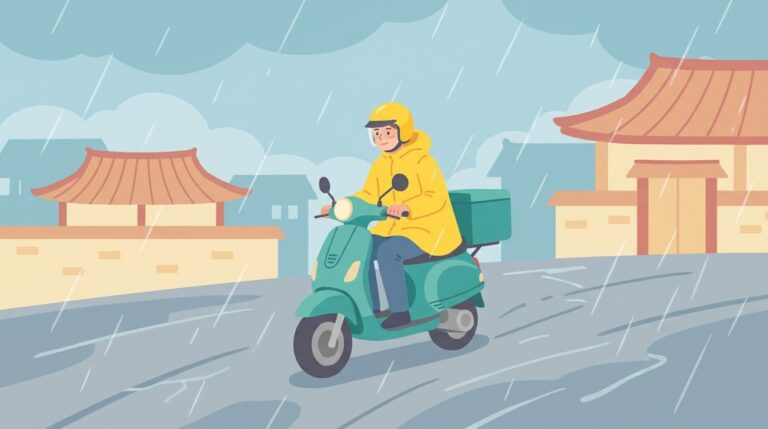
Phase 1: Annyeonghaseyo! Let’s Talk About Rainy-Day Deliveries
Annyeonghaseyo! (안녕하세요!) This is your Daily Hangul editor. Picture a stormy Friday night in Seoul, just like a cozy yet chaotic scene from your favorite K-drama. Rain pours against your apartment window, and you crave steaming hot tteokbokki, so you open a delivery app. Suddenly, a weather surcharge alert pops up. While Korea’s delivery speed feels like magic, real riders face slippery roads and non-stop orders. Many of my B2 learners tell me they can order food easily, yet freeze when locals or Korean news debate gig workers’ safety surcharges and rest rights. Today, based on real student feedback, we will bridge that gap so you can discuss this timely social issue naturally and empathetically.
Phase 2: Deep Dive into 3 Core B2 Expressions
1. 안전배달료 (anjeonbaedallyo / Safety Delivery Fee)
- Pronunciation: anjeonbaedallyo (Think: ahn-juhn-bae-dahl-lyo, where the double ‘l’ rolls softly off the roof of your mouth like the ‘ll’ in “million,” not a hard ‘r’.)
- Meaning: Literally “safety delivery fee.” In reality, it refers to a legally or platform-guaranteed minimum delivery fee designed to prevent riders from speeding recklessly just to hit daily income targets.
- K-Culture Moment: Imagine a Korean current-affairs documentary or a realistic slice-of-life K-drama where a part-time delivery rider sits at a convenience store after a close call on a snowy hill, watching a news anchor discuss 안전배달료 (anjeonbaedallyo) on the store TV.
- Editor’s Insight: At the B2 level, notice how 안전 (anjeon – safety) combines with 배달료 (baedallyo – delivery fee). While 기상 할증 (gisang haljeung – weather surcharge) covers temporary bad-weather bonuses, 안전배달료 (anjeonbaedallyo) carries a heavier socio-political nuance about long-term labor rights and fair minimum compensation.
- Situation Spectrum: Casual ✅ / Semi-formal ✅ / Formal ✅
- 🤔 Think About It: In your home country, who usually absorbs the extra cost of dangerous weather—the customer via higher fees, the platform company, or the worker through lower margins? How does that compare to Korea’s debate?
2. 휴식권을 보장하다 (hyusikgwoneul bojanghada / To Guarantee the Right to Rest)
- Pronunciation: hyusikgwoneul bojanghada (Think: hyoo-sheek-gwoh-neul boh-jahng-hah-dah, with a crisp ‘gwo’ like “guacamole” without the ‘a’.)
- Meaning: Literally “to guarantee the rest right.” Practically, it means ensuring gig and platform workers can take breaks or log off during typhoons, heavy snow, or extreme heat without facing algorithmic penalties.
- K-Culture Moment: Picture a heated debate on a Korean variety-talk show like You Quiz or a workplace drama inspired by Misaeng, where a labor advocate explains why platforms must 휴식권을 보장하다 (hyusikgwoneul bojanghada) instead of penalizing riders who pause orders during a downpour.
- Editor’s Insight: The suffix -권 (-gwon) attaches to nouns to signify a formal “right” (like 생존권 / saengjongwon – right to survival or 노동권 / nodonggwon – labor rights). Pairing it with the formal verb 보장하다 (bojanghada – to guarantee) instantly elevates your Korean from casual chatter to articulate, news-ready B2 fluency.
- Situation Spectrum: Casual ⚠️ (a bit stiff with close friends) / Semi-formal ✅ / Formal ✅
- 🤔 Think About It: In fast-paced societies, “flexibility” is often advertised as the biggest perk of gig work. Why do you think Korean unions still push hard to formally 휴식권을 보장하다 (hyusikgwoneul bojanghada)?
3. 배달 주문이 폭주하다 (baedal jumuni pokjuhada / Delivery Orders Surge Wildly)
- Pronunciation: baedal jumuni pokjuhada (Think: bae-dahl joo-moo-nee pohk-joo-hah-dah, where ‘pok’ has a sharp, explosive ‘p’ like popping bubble wrap.)
- Meaning: Literally “delivery orders violently rush in.” It describes an overwhelming flood of orders crashing in all at once, far beyond normal capacity.
- K-Culture Moment: Think of those hilarious yet stressful scenes in Korean restaurant variety shows (like Jinny’s Kitchen) when a sudden rainstorm hits outside and the order tablet starts beeping nonstop—that exact chaos is 배달 주문이 폭주하다 (baedal jumuni pokjuhada).
- Editor’s Insight: A common B2 synonym is 급증하다 (geupjeunghada – to increase sharply), which sounds neutral and statistical. 폭주하다 (pokjuhada), however, paints a vivid, almost out-of-control picture—just like a flood bursting through a dam. You can also use it for phone calls (전화 문의가 폭주하다 / jeonhwa muniga pokjuhada – phone inquiries flood in).
- Situation Spectrum: Casual ✅ / Semi-formal ✅ / Formal ✅
- 🤔 Think About It: When rain falls in your city, do people rush indoors to order delivery, or do they still go out? Why do you think bad weather triggers such an intense delivery surge in Korea?
Phase 3: Textbook Korean vs. Real Korean
Situation 1: Reacting to Long Wait Times During a Storm
- 📖 Textbook Korean: 비가 많이 와서 배달 주문이 아주 많습니다. 그래서 음식이 늦게 옵니다. (Biga mani waseo baedal jumuni aju manseumnida. Geuraeseo eumsigi neutge omnida. — Because it is raining a lot, there are very many delivery orders. Therefore, the food is coming late.)
- 🗣️ Real Korean: 날씨가 궂어서 배달이 엄청 밀리네요. (Nalssiga gujeoseo baedari eomcheong millineyo. — Because the weather is nasty, deliveries are super backed up.)
- 💡 Why the difference? Textbooks love neutral adjectives like 많다 (manta – many), which sound robotic over dinner. Native speakers use 궂다 (gutda – gloomy/inclement) for bad weather and 밀리다 (millida – to be backed up/pushed back) to capture the relatable frustration of waiting for food—or traffic!
Situation 2: Showing Empathy When Your Rider Arrives in Heavy Rain
- 📖 Textbook Korean: 위험한 날씨에 일하셔서 감사합니다. 조심히 가세요. (Wiheomhan nalssie ilhasyeoseo gamsahamnida. Josimhi gaseyo. — Thank you for working in dangerous weather. Go carefully.)
- 🗣️ Real Korean: 비도 많이 오는데 천천히 오셔도 돼요! 빗길 조심하세요. (Bido mani oneunde cheoncheonhi osyeodo dwaeyo! Bitgil josimhaseyo. — Since it’s pouring, you can take your time! Watch out on the wet roads.)
- 💡 Why the difference? Simply thanking someone for working in danger can unintentionally sound awkward or overly formal. Telling a rider 천천히 오셔도 돼요 (cheoncheonhi osyeodo dwaeyo – you may come slowly) directly relieves Korea’s famous “hurry-hurry” pressure, and 빗길 (bitgil – rainy road) or 눈길 (nungil – snowy road) adds genuine warmth.
Phase 4: K-Culture Deep Dive & Non-Verbal Manners
4-1. Nunchi (눈치) & Gestures on Stormy Nights
In Korea, good 눈치 (nunchi – social awareness) isn’t just for office meetings—it matters at your front door, too! When thunder rumbles or snow piles up outside, checking your delivery app’s real-time map and opening the door promptly saves a shivering rider precious seconds. If you choose face-to-face handoff, offer a gentle nod and hold the bag with both hands. On freezing nights, many Koreans keep a pack of hot canned coffee or warm barley tea by the shoe rack to hand over with a warm 고생 많으세요 (gosaeng maneuseyo – you are working so hard)—no big speech needed, just sincere eyes and a quick bow.
4-2. Cultural Code Analysis: Beyond “Ppalli-Ppalli” (빨리빨리)
For decades, Korea’s K-Food boom and digital convenience were powered by 빨리빨리 (ppalli-ppalli – hurry-hurry) culture. Whether you’re watching a variety show where stars order jajangmyeon to a Han River park or bingeing a thriller where detectives survive on late-night delivery, hyper-speed service feels effortless. Yet behind the screen, real platform workers face icy roads, algorithm ratings, and uncovered injuries. Today, Korean society—and modern K-dramas focusing on everyday workers—is shifting from blind speed toward 안전 (anjeon – safety) and empathy, asking viewers to see the human being beneath the helmet.
Phase 5: Practical Roleplay Scenario
Setting: A rainy Friday evening in a cozy rooftop apartment in Mapo-gu, Seoul. Rain drums loudly against the window. You and your Korean friend Min-su (a thoughtful grad student who once worked part-time as a delivery rider) are waiting for hot kimchi stew while watching the 8 PM news.
- Min-su: 🎭 (Sighing as he points at the TV news report) 야, 저기 뉴스 좀 봐. 오늘처럼 폭우 내릴 때마다 배달 주문이 폭주한대 (baedal jumuni pokjuhandae). (Ya, jeogi nyuseu jom bwa. Oneulcheoreom pogu naeril ttaemada baedal jumuni pokjuhandae. — Hey, look at the news over there. They say whenever it pours like today, delivery orders surge wildly.)
- You: 🎭 (Leaning forward with a worried look) 진짜? 도로도 미끄러울 텐데 라이더분들 너무 위험하겠다. (Jinjja? Dorodo mikkeureoul tende raideobundeul neomu wiheomhagetda. — Really? The roads must be slippery too; it must be so dangerous for the riders.)
- Min-su: 🎭 (Nodding seriously) 응, 나도 예전에 잠깐 해 봐서 아는데, 비 올 때 시간 맞추려고 과속하다가 사고 많이 나거든. (Eung, nado yejeone jamkkan hae bwaseo aneunde, bi ol ttae sigan matchuryeogo gwasokadaga sago mani nageodeun. — Yeah, I did it briefly before so I know—when it rains, people speed to meet the deadline and get into a lot of accidents.)
- You: 🎭 (Glancing at your delivery app on the table) 그래서 요즘 안전배달료 (anjeonbaedallyo) 도입하자는 얘기가 나오는 거구나? (Geuraeseo yojeum anjeonbaedallyo doipajaneun yaegiga naoneun geoguna? — So that’s why people are talking about introducing a safety delivery fee these days, huh?)
- Min-su: 🎭 (Taking a sip of water) 맞아. 기본 단가가 보장돼야 무리하게 안 달리니까. 게다가 휴식권을 보장하다 (hyusikgwoneul bojanghada) 보면 악천후엔 쉴 수도 있고. (Maja. Gibon dangaga bojangdwaeya murihage an dallinikka. Gedaga hyusikgwoneul bojanghada bomyeon akcheonhuen swil sudo itgo. — Right. Only when the base rate is guaranteed do they avoid pushing too hard. Plus, if rest rights are guaranteed, they can take breaks in severe weather.)
- You: 🎭 (Checking the app notification) 어, 우리 찌개 거의 다 왔대! 근데 앱에 악천후 할증이 이미 붙었네. (Eo, uri jjigae geoui da watdae! Geunde ebe akcheonhu haljeungi imi buteonne. — Oh, our stew is almost here! By the way, a bad-weather surcharge was already added on the app.)
- Min-su: 🎭 (Walking toward the front door) 잠깐만, 나 현관에 따뜻한 캔커피 하나 챙겨 놓을게. 너도 문 열 때 한마디 해 드려. (Jamkkanman, na hyeongwane ttatteutan kaenkeopi hana chaenggyeo noeulge. Neodo mun yeol ttae hanmadi hae deuryeo. — Hold on, I’ll grab a warm canned coffee for the entryway. Say a nice word to them when you open the door too.)
- You: 🎭 (Smiling warmly as the doorbell rings) 응, 걱정 마! 빗길 조심하시라고 꼭 말씀드릴게. (Eung, geokjeong ma! Bitgil josimhasirago kkok malsseumdeurilge. — Yeah, don’t worry! I’ll definitely tell them to be safe on the wet roads.)
🔀 Interactive Branching Point
Right after the rider leaves, Min-su turns to you and asks: “솔직히 비 올 때 안전배달료 때문에 배달비가 2,000원 더 올라도 낼 의향 있어? (Soljikhi bi ol ttae anjeonbaedallyo ttaemune baedalbigga icheonwon deo ollado nael uihyang isseo? — Honestly, if delivery fees go up by 2,000 won during rain because of a safety surcharge, would you be willing to pay it?)” How do you respond?
- Choice A (Best): “당연하지! 내 편리함만큼 라이더 안전도 중요하니까 기꺼이 낼 수 있어. (Dangyeonhaji! Nae pyeollihammankeum raideo anjeondo jungyohanikka gikkeoi nael su isseo. — Of course! Rider safety is just as important as my convenience, so I’m happy to pay it.)” -> Feedback: Spot on! Using 기꺼이 (gikkeoi – willingly) shows high-level B2 vocabulary and deep cultural empathy.
- Choice B (Bad): “아니, 난 무조건 무료 배달이 좋아. 비 오든 말든 회사 문제지. (Ani, nan mujogeon muryo baedari joa. Bi odeun maldeun hoesa munjeji. — No, I strictly want free delivery. Rain or shine, that’s the company’s problem.)” -> Feedback: Grammatically fine, but socially tone-deaf! Saying 비 오든 말든 (bi odeun maldeun – whether it rains or not) sounds cold toward a friend who literally just shared his past experience as a rider.
- Choice C (Risk): “음, 취지는 좋은데 플랫폼 회사가 수수료를 좀 부담하면 안 될까? (Eum, chwijineun joeunde peullaetpom hoesaga susuryoreul jom budamhamyeon an doelkka? — Hmm, the intention is good, but couldn’t the platform company cover part of the fee?)” -> Feedback: Smart, nuanced B2 response! Raising the role of 플랫폼 회사 (peullaetpom hoesa – platform company) using 취지 (chwiji – intention/purpose) sparks a genuine, thoughtful policy debate with Min-su without sounding dismissive of riders.
Phase 6: 10-Second Emotional Shadowing Drill
Read these aloud, pausing briefly at / and matching the emotional cue!
- [😟 Concerned & Empathetic] 비가 이렇게 많이 오는데 / 천천히 오셔도 돼요! (Biga ireoke mani oneunde / cheoncheonhi osyeodo dwaeyo! — Since it’s raining this hard / you can take your time!)
- [😤 Passionate & Serious] 날씨가 위험할 때는 / 라이더의 휴식권을 / 꼭 보장해야 해요. (Nalssiga wiheomhal ttaeneun / raideoeui hyusikgwoneul / kkok bojanghaeya haeyo. — When the weather is dangerous / riders’ right to rest / must definitely be guaranteed.)
- [😮 Surprised & Urgent] 태풍 때문에 / 배달 주문이 / 완전히 폭주하고 있네요! (Taepung ttaemune / baedal jumuni / wanjeonhi pokjuhago inneyo! — Because of the typhoon / delivery orders are / totally surging out of control!)
Phase 7: K-Culture Mini Dictionary (4 Core Keywords)
- 플랫폼 노동자 (peullaetpom nodongja) | Platform Worker | Used in news and business to describe app-based workers like delivery riders, designated drivers (대리운전 기사 / daeriunjeon gisa), and freelancers who work via digital platforms.
- 기상 할증 (gisang haljeung) | Inclement Weather Surcharge | The extra delivery fee automatically added by apps during heavy rain, snow, or heatwaves; a hot topic on Korean community forums whenever storms hit.
- 산업재해 / 산재 (saneopjaehae / sanjae) | Industrial / Occupational Accident | Almost always shortened to 산재 (sanjae) in daily Korean; crucial when discussing whether gig riders receive insurance coverage after traffic accidents.
- 라이더 (raideo) | Delivery Rider | Borrowed from English “rider,” this is the universal, respectful everyday term Koreans use for motorbike or e-bike couriers instead of older terms.
Phase 8: Survival Kit for Travelers
Top 3 Survival Expressions
- 문 앞에 두고 벨 눌러 주세요. (Mun ape dugo bel nullo juseyo. — Please leave it at the door and ring the bell.) -> Pro Tip: Selecting contactless delivery (비대면 배달 / bidaemyeon baedal) keeps riders from waiting awkwardly outside in raincoats.
- 날씨가 궂은데 고생 많으세요. (Nalssiga gujeunde gosaeng maneuseyo. — Thank you for your hard work in this rough weather.) -> Pro Tip: Dropping this single phrase when picking up food at a hotel lobby will instantly brighten a courier’s stressful night.
- 늦어도 괜찮으니 조심히 오세요. (Neujeodo gwaenchaneuni josimhi oseyo. — It’s okay even if it’s late, so please come safely.) -> Pro Tip: You can type this directly into the delivery request memo box (요청사항 / yocheongsahang) in Korean delivery apps!
Editor’s Travel Note
If you’re visiting Korea during summer monsoon season (장마 / jangma) or snowy winters, prepare your phone before stepping outside! Download Naver Map for real-time transit routes and weather alerts to track subway delays when above-ground traffic jams up. For late-night cravings during a storm, explore the Baedal Minjok delivery app guide or ask your accommodation front desk for help ordering, as many Korean apps require local phone verification. Also, remember that cash tipping isn’t traditional in Korea—clear app memos, polite ratings, and a warm drink mean much more!
Phase 9: “One Step Deeper” (Thought Question)
Korea’s famous 새벽배송 (saebyeokbaesong – dawn delivery) and 30-minute hot meals built one of the most convenient urban lifestyles on earth, turning digital speed into a cultural point of pride. Yet behind every instant notification stands a human worker navigating icy intersections and strict app timers. As Korea matures from rapid growth toward 상생 (sangsaeng – mutual coexistence), society is learning that true convenience shouldn’t cost someone else’s safety. Even as a traveler or Korean learner, choosing patience on a stormy night lets you participate in that kinder, more sustainable side of Korean culture.
💬 Your Turn: Have you ever noticed how delivery culture differs between Korea and your hometown? Drop a comment below sharing your favorite rainy-day comfort food and how riders are treated where you live!
Phase 10: FAQ & Common Mistakes
Q: Is it rude to order delivery food when it is raining or snowing heavily in Korea?
A: Not at all! In fact, bad-weather shifts are often when riders earn higher 기상 할증 (gisang haljeung – weather surcharges) bonuses. What truly helps is staying patient with delays, leaving polite delivery notes, and never complaining about a few extra minutes.
Q: Should I tip my Korean delivery rider in cash during a storm?
A: Cash tipping is uncommon in Korea and can even surprise riders who are hurrying to their next drop-off. Instead, leaving a 5-star review, writing a warm thank-you message in the app, or offering a sealed warm drink or snack at the door is deeply appreciated.
Q: What is the difference between ‘배달원 (baedalwon)’ and ‘라이더 (raideo)’?
A: Both refer to delivery workers, and neither is offensive, though 라이더 (raideo) is much more common today—especially for app-based motorbike and bicycle couriers—while 배달원 (baedalwon) sounds slightly more traditional or formal, like in older textbooks.
🚨 Common Mistakes Warning Board
- Mistake 1: Saying “빨리 와 주세요! (Ppalli wa juseyo! – Please come quickly!)” in the app memo during a storm.
- Correct Action: Use 천천히 안전하게 오세요 (Cheoncheonhi anjeonhage oseyo – Please come slowly and safely) instead.
- Mistake 2: Mixing up 배달 (baedal – food/local courier delivery) with 택배 (taekbae – parcel/box shipping).
- Correct Action: Use 배달 라이더 (baedal raideo) for meals and groceries, and 택배 기사님 (taekbae gisanim) for boxed packages.
- Mistake 3: Using casual 수고해 (sugohae) to a delivery worker.
- Correct Action: Even to younger riders, keep it respectful! Say 수고하셨습니다 (sugohasyeotseumnida) or 고생 많으세요 (gosaeng maneuseyo).
Phase 11: Action Mission & Engagement
- 🥉 Bronze Mission (Solo Practice): Record yourself doing the Phase 6 shadowing drill on your phone twice—once focusing on clear pronunciation of 안전배달료 (anjeonbaedallyo), and once focusing on warm, empathetic intonation.
- 🥈 Silver Mission (SNS Share): Post one sentence in Korean on Instagram Stories or Threads about what comfort food you’d order on a rainy day, tagging
#DailyHanguland including 빗길 조심하세요 (bitgil josimhaseyo)! - 🥇 Gold Mission (Real-Life Use): Next time you order delivery in Korea (or at a Korean restaurant abroad during bad weather), add a kind note or personally tell the courier 날씨가 궂은데 고생 많으세요 (Nalssiga gujeunde gosaeng maneuseyo).
🎮 K-Culture Mission
Open YouTube and search for a recent Korean news clip using the keyword 배달 라이더 안전배달료 (baedal raideo anjeonbaedallyo). Listen for just 60 seconds and count how many times you catch 안전 (anjeon), 폭주 (pokju), or 보장 (bojang)—you’ll be amazed how much real Korean news you suddenly understand!
Phase 12: Interactive Quiz Challenge
Test your B2 skills before you go! Click the toggle below each question to check your answer.
Quiz 1: Situational Judgment
Heavy snow is falling outside, and your delivery app says your order is 20 minutes late. You want to text a polite, reassuring note to the rider. Which one is best?
A. 배달 주문이 폭주해서 늦는 건가요? 빨리 주세요.
B. 눈길이라 많이 위험할 텐데 천천히 조심히 오세요!
C. 휴식권을 보장하다 보니 음식이 식었네요.
Click to reveal Answer & Feedback
Correct Answer: B (Nungirira mani wiheomhal tende cheoncheonhi josimhi oseyo! — Since the snowy roads must be dangerous, please come slowly and carefully!)
* Why A is wrong: Asking “빨리 주세요” (Please bring it quickly) adds stressful pressure during dangerous weather.
* Why C is wrong: Using a stiff noun phrase like “휴식권을 보장하다 보니” sounds unnatural in a casual text and complains about cold food.
Quiz 2: Fill in the Blank
Complete the B2 sentence naturally:
“악천후일수록 라이더가 과속하지 않도록 최소한의 __________ 도입과 휴식권 보장이 시급합니다.”
(Akcheonhuilsurok raideoga gwasokhaji antorok choesohanui __________ doipgwa hyusikgwon bojangi sigeuphamnida.)
Click to reveal Answer & Explanation
Correct Answer: 안전배달료 (anjeonbaedallyo)
* Translation: “The more severe the weather gets, the more urgent it is to introduce a minimum safety delivery fee and guarantee rest rights so riders don’t speed.”
* Tip: Notice how 도입 (doip – introduction of a system/policy) pairs naturally with 안전배달료 (anjeonbaedallyo)!
Quiz 3: True or False Culture Quiz
True or False: In Korea, handing a delivery rider cash tips at the door is mandatory during rainy weather, and saying “수고해 (sugohae)” is the politest way to greet them.
Click to reveal Answer & Explanation
Correct Answer: False!
* Explanation: Cash tipping is not customary in Korea (app surcharges, warm drinks, and kind reviews are standard), and 수고해 (sugohae) is informal banmal, which is rude to adult service workers. Always use 고생 많으세요 (gosaeng maneuseyo) or 감사합니다 (gamsahamnida)!
🎬 Watch Our Daily Videos! (Daily Hangul Official Instagram)
Review the expressions you learned in this article with our fun daily short videos! Check out native pronunciation and real-life nuances in action.
- Instagram @dailyhangul_en







